Alright, let's talk about this whole AI in healthcare thing. Every other day, it seems like some tech giant is announcing a new algorithm that can diagnose cancer faster than a seasoned oncologist or predict the next pandemic before it even brews. They're all talking about a global healthcare revolution, with AI diagnostics, vaccine development, and telemedicine leading the charge. But honestly, sometimes it feels like they’re speaking a language only understood in their air-conditioned labs, miles away from the realities of places like Jamaica. Is this a genuine paradigm shift, or just another overhyped tech fad that will leave us scratching our heads and still waiting in long lines at the clinic?
Now, for anyone who’s ever had to navigate the public health system here, you know it’s a special kind of challenge. We’re resilient, yes, but we also deal with limited resources, overburdened staff, and infrastructure that sometimes feels like it’s holding on by a thread. So, when I hear about AI coming to save the day, my first thought isn't about futuristic operating rooms, it's about whether it can help Nurse Sheryl at the local health center manage her endless patient files or get a specialist consultation for Auntie May without her having to travel three parishes over. The Caribbean has entered the chat, and we need solutions that fit our reality, not just Silicon Valley's dreams.
Historically, medical advancements have always been a bit of a slow boat to the developing world. Penicillin took its sweet time, and even basic vaccines faced distribution hurdles for decades. The digital age promised to democratize access, but the digital divide is still a gaping chasm. Telemedicine, for instance, isn't new. It’s been around in various forms for years, particularly in rural areas of larger, wealthier nations. But for us, stable internet access, affordable devices, and the digital literacy to use them are still significant barriers. We're not talking about a lack of willingness, but a lack of fundamental access for many of our people.
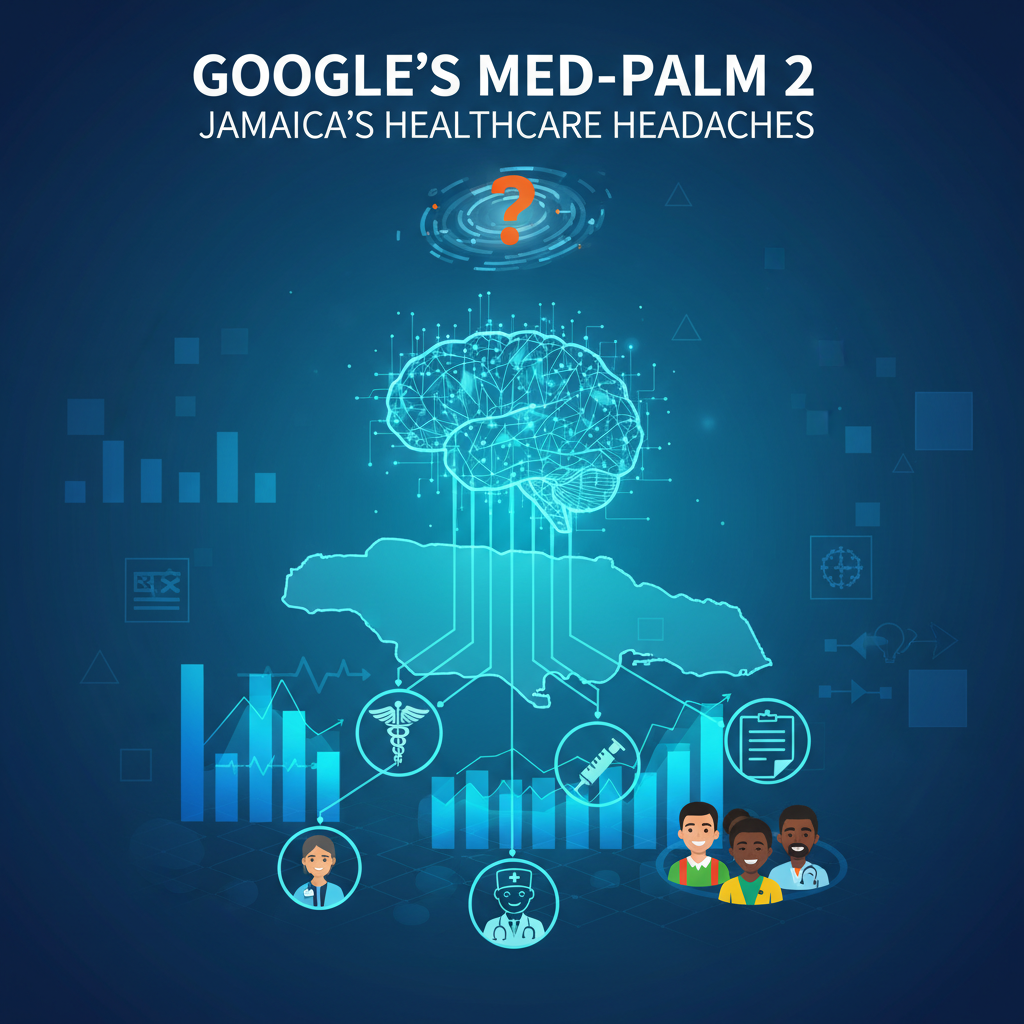
Fast forward to today, and the AI hype machine is in full swing. Companies like Google, with their Med-PaLM 2, are making bold claims. This large language model, specifically fine-tuned for medical knowledge, reportedly performs at an “expert” level on medical licensing exams. Google DeepMind is also pushing boundaries with projects like AlphaFold, which has revolutionized protein structure prediction, a critical step in drug and vaccine development. This isn't just theoretical; it's already accelerating research for diseases like malaria and neglected tropical diseases. Then you have companies like NVIDIA, whose powerful GPUs are the backbone of much of this computational heavy lifting, enabling faster processing of massive datasets for everything from medical imaging analysis to genomic sequencing.
But let's peel back the layers a bit. The global market for AI in healthcare is projected to reach hundreds of billions of dollars in the next few years. Reports from various consulting firms, like one I saw recently, estimate the market could hit over $200 billion by 2030. That’s a lot of zeros, and a lot of potential. We're seeing AI being deployed in everything from predictive analytics for hospital readmissions to personalized treatment plans for oncology patients. Diagnostics are a huge area, with AI models showing impressive accuracy in detecting early signs of diseases from medical scans, sometimes even outperforming human experts in specific tasks. For example, AI algorithms have demonstrated up to 90% accuracy in detecting certain types of diabetic retinopathy, a leading cause of blindness.
Now, about those expert opinions. Dr. Eric Topol, a renowned cardiologist and author of “Deep Medicine: How Artificial Intelligence Can Make Healthcare Human Again,” has been a vocal proponent of AI's transformative potential. He often speaks about how AI can free up clinicians from administrative burdens and repetitive tasks, allowing them to focus more on patient care and empathy. He once stated, “AI is not going to replace doctors, but doctors who use AI will replace doctors who don’t.” That's a powerful sentiment, suggesting that adaptation is key, not just for the tech companies, but for the medical community itself. You can find more of his insights on the future of medicine on platforms like Wired.
On the other hand, there’s a healthy dose of skepticism, and rightly so. Dr. Ziad Obermeyer, an emergency physician and researcher at the University of California, Berkeley, has highlighted the potential for AI algorithms to perpetuate and even amplify existing biases in healthcare. He points out that if the data used to train these models is biased, the AI will simply learn and reproduce those biases, potentially leading to unequal care for minority populations. This is a critical concern for a country like Jamaica, where socioeconomic disparities are already a major factor in health outcomes. We absolutely cannot afford to import new forms of discrimination through technology.
So, where does Jamaica fit into this grand narrative? We have our own unique challenges and opportunities. Our Ministry of Health and Wellness has been exploring digital health initiatives, and there’s a growing recognition that technology can bridge gaps. Imagine AI-powered diagnostic tools assisting doctors in rural clinics, where specialists are scarce. Or telemedicine platforms connecting patients in remote communities with experts at Kingston Public Hospital or the University Hospital of the West Indies. Jamaica's tech scene is like reggae, it'll surprise you, and there are local innovators eager to tackle these problems.
However, the path isn't smooth. Data privacy and security are paramount. Who owns the health data of Jamaicans, and how is it protected from cyber threats? The infrastructure for widespread telemedicine, particularly in terms of reliable internet and affordable devices, needs significant investment. And then there's the human element: training our healthcare professionals to effectively use these new tools, and ensuring that patients trust the technology. It’s not just about throwing a fancy AI at a problem; it’s about thoughtful integration into a complex, human-centric system.
My verdict? This global healthcare revolution, driven by AI, is definitely not a fad. The advancements in diagnostics, drug discovery, and remote care are too significant to ignore. Companies like OpenAI, with their general-purpose AI models, are also making strides that could indirectly benefit healthcare by improving information access and administrative efficiency. But for it to be the 'new normal' for everyone, especially in places like Jamaica, we need to be proactive, not just reactive. We need to demand solutions that are culturally relevant, ethically sound, and accessible to all, not just the privileged few. We need to ensure that the benefits of this revolution don't bypass us, leaving us with the same old problems, just with a new layer of digital dust. Small island, big ideas, but we need big, equitable implementation too. Otherwise, it’s just another story for the tech blogs, not a real change for our people.