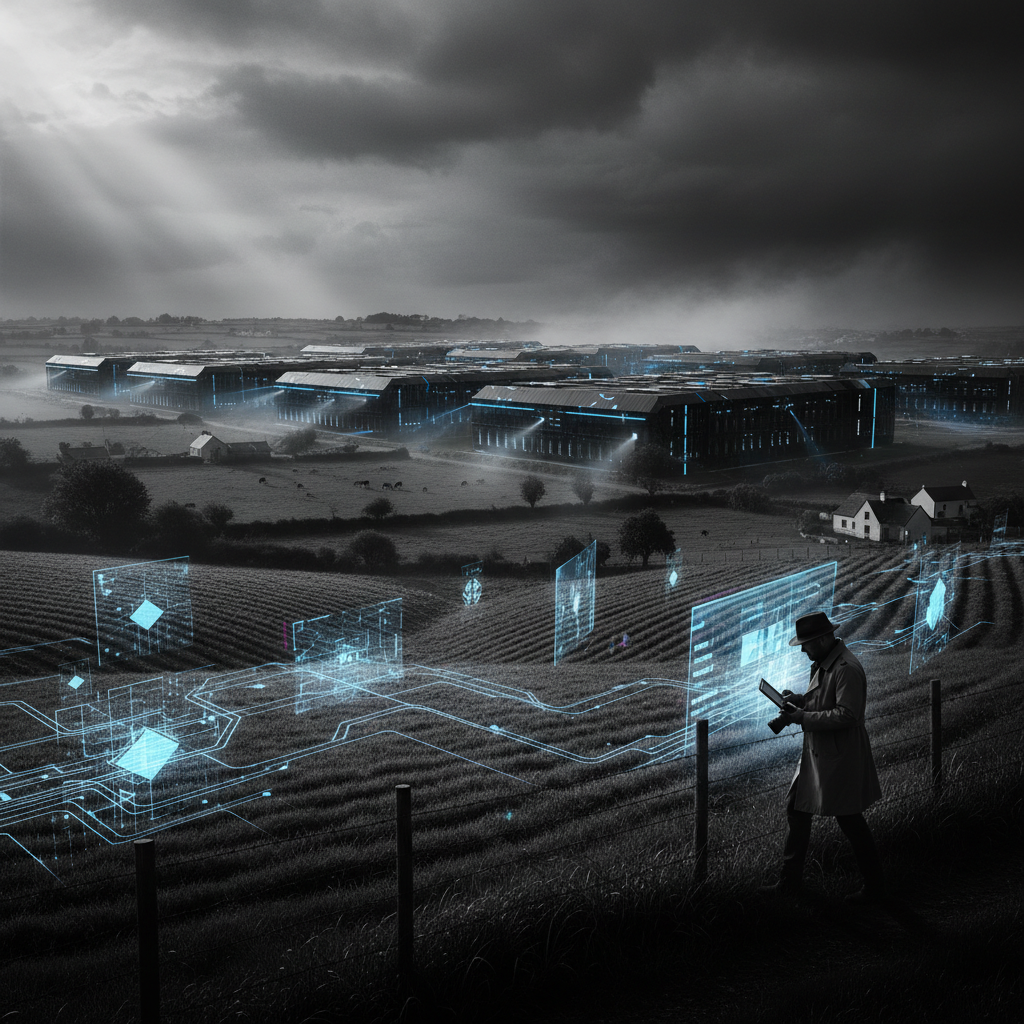

The verdant fields of Ireland, long synonymous with tradition and pastoral simplicity, are rapidly becoming a laboratory for the next frontier of artificial intelligence. While the public narrative speaks of enhanced efficiency, reduced waste, and sustainable practices, my investigation reveals a far more complex and troubling reality. Behind the press release lies a very different story, one of unprecedented data harvesting, opaque corporate agreements, and a quiet erosion of farmer autonomy that could reshape our food landscape irrevocably.
For months, my inquiries into the burgeoning AI agriculture sector in Ireland were met with a familiar blend of corporate boilerplate and bureaucratic obfuscation. Companies lauded their 'innovative solutions' and 'precision farming technologies,' yet detailed information regarding data ownership, algorithmic transparency, and long-term economic impacts remained elusive. It was only through persistent digging, conversations with disaffected insiders, and careful analysis of obscure corporate filings that the true picture began to emerge.
At the heart of this transformation are sophisticated AI platforms, often developed by multinational tech giants with significant footprints in Dublin, and deployed by agricultural technology firms across the country. These systems promise to optimize everything from crop yield and livestock health to supply chain logistics, utilizing an array of sensors, drones, and satellite imagery. The catch, however, is the sheer volume of proprietary data these systems collect. Every soil sample, every cow's movement, every microclimate reading, every pesticide application, and every market transaction is fed into algorithms designed to identify patterns and predict outcomes. This data, I discovered, is not always remaining with the farmers who generate it.
One anonymous source, a former data analyst for a prominent agri-tech firm operating out of Cork, spoke to me under strict conditions of anonymity. "The farmers think they're buying a tool, a service," he explained, his voice hushed over an encrypted line. "But what they're really doing is signing away the intellectual property of their land and their labour. The contracts are dense, deliberately so. The data ownership clauses are buried deep, often granting the tech companies perpetual, irrevocable licenses to use, modify, and even sell the aggregated data." This account was corroborated by two other sources, both with intimate knowledge of these contracts, who expressed deep unease about the implications.
My investigation uncovered several instances where Irish farming cooperatives, enticed by government grants and promises of increased profitability, entered into agreements that effectively ceded control over vast datasets. For example, a pilot project in County Tipperary, involving a consortium of dairy farmers and a US-based AI firm, saw detailed biometric data from over 10,000 cows collected daily. While the immediate benefit was a marginal increase in milk production efficiency, the long-term implications are stark. "That data, anonymised or not, becomes a goldmine," stated Dr. Niamh Gallagher, an agricultural economist at University College Dublin. "It allows these firms to build predictive models that can dictate everything from optimal feed formulations to market pricing strategies. Farmers become price takers, not price makers. Their competitive edge, their unique knowledge of their land, is effectively commodified and sold back to them, or worse, to their competitors."
This trend is not unique to Ireland, but our small, open economy and our historical reliance on agriculture make us particularly vulnerable. The Irish tech sector has a secret it doesn't want you to know: the ease with which data can be extracted and monetised under the guise of 'innovation,' often skirting the spirit, if not the letter, of GDPR when it comes to non-personal agricultural data. While GDPR offers robust protections for personal data, the regulatory landscape for agricultural data, especially when aggregated and anonymised, remains a grey area, ripe for exploitation.
Documents obtained through a freedom of information request to the Department of Agriculture, Food and the Marine, though heavily redacted, hinted at ongoing discussions about data governance frameworks for agricultural AI. However, there was no clear indication of a proactive strategy to protect farmer data ownership or to ensure fair compensation for its use. Instead, the focus appeared to be on facilitating adoption and attracting foreign direct investment in agri-tech.
The implications extend beyond individual farm economics. The consolidation of agricultural data into the hands of a few powerful tech entities creates a single point of failure and a potential for market manipulation. Imagine a scenario where a dominant AI platform, privy to the collective yields and production costs of an entire region, could leverage that information to influence commodity prices or dictate input purchases. "This isn't just about efficiency, it's about power," cautioned Mr. Seán Óg MacManus, a long-time advocate for small farmers and former director of an agricultural cooperative in County Kerry. "If we allow these algorithms to become the gatekeepers of our food supply, we risk losing our food sovereignty. Who decides what gets grown, where, and for whom? It won't be the farmers, it will be the algorithms and the corporations that own them."
The silence from regulatory bodies on this issue is deafening. The European Union's AI Act, while a landmark piece of legislation, primarily focuses on high-risk AI applications impacting fundamental rights. Agricultural AI, often framed as a tool for sustainability and productivity, has largely flown under the radar, despite its profound potential to disrupt livelihoods and control essential resources. The Irish government, keen to position the country as a hub for AI innovation, seems reluctant to impose stringent regulations that might deter investment.
My investigation reveals a pattern of corporate interests quietly shaping policy, with promises of economic growth overshadowing concerns about data ethics and farmer welfare. The evidence suggests a deliberate strategy to embed these AI systems deeply into the fabric of Irish agriculture before any meaningful regulatory framework can be established. This creates a fait accompli, making it far more challenging to unwind or regulate these systems once they are entrenched.
What does this mean for the public, for the consumers of Irish produce? It means a food system increasingly dictated by algorithms rather than by the nuanced knowledge of generations of farmers. It means a potential for reduced diversity in crops and livestock, as algorithms favour efficiency over biodiversity. It means a future where the cost of your milk or your potatoes could be influenced not by the farmer's hard work, but by a predictive model owned by a distant corporation. The romantic image of the Irish farmer, tending their land with care and wisdom, is being quietly replaced by a data-driven operative, whose every action is monitored, analysed, and potentially dictated by an unseen intelligence. This is not progress if it comes at the cost of our independence and the integrity of our food supply. The time for robust, proactive regulation is now, before the harvest of data becomes a monopoly on our future.```