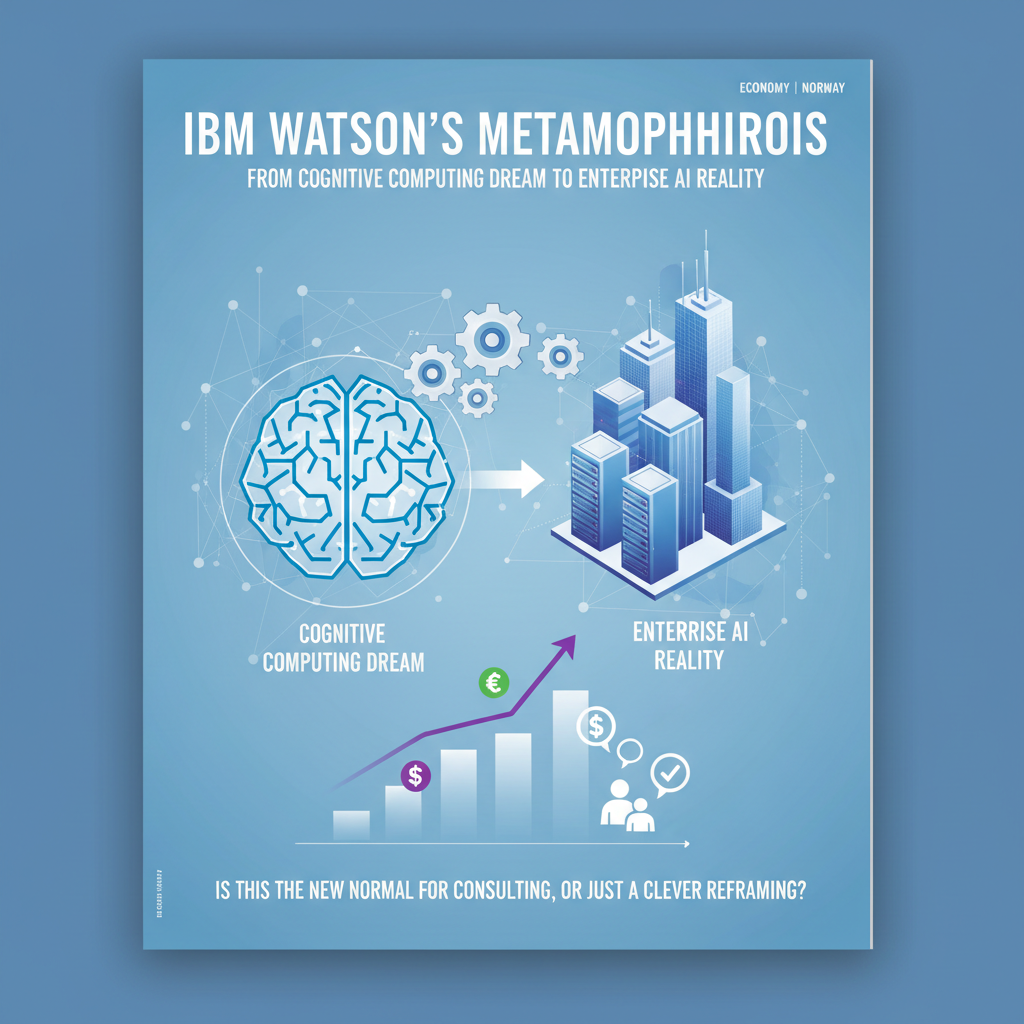

The fjords of Norway teach us a fundamental truth: even the most imposing structures can be reshaped by persistent forces, be they glacial erosion or market dynamics. In the realm of artificial intelligence, few entities have experienced such a dramatic geological shift as IBM Watson. Once heralded as the harbinger of cognitive computing, a system capable of winning Jeopardy and diagnosing complex diseases, Watson has quietly shed its more ambitious, almost mythical, aspirations. What remains is a leaner, more focused enterprise AI platform, strategically positioned within a burgeoning consulting market. The critical question for DataGlobal Hub readers, and indeed for global industry, is this: Is Watson's reinvention a fleeting trend, a clever rebranding exercise, or does it signify a fundamental recalibration of enterprise AI strategy, a new normal for how businesses adopt and integrate intelligent systems?
To understand the present, we must first revisit the past. IBM Watson's journey began with a flourish. Its victory on Jeopardy in 2011 captivated the world, promising an era where machines could understand and reason with human language at an unprecedented scale. The subsequent years saw significant investment and ambitious ventures into healthcare, finance, and various industries. However, the promise often outpaced the practical delivery. Many early adopters found the technology complex to implement, expensive to maintain, and sometimes falling short of its grand claims. The term 'AI washing' even emerged in some circles, hinting at a gap between marketing and demonstrable value. This period, roughly from 2014 to 2019, was characterized by high expectations and, for some, eventual disillusionment.
The turning point began around 2020. IBM, under new leadership, initiated a strategic divestiture of non-core assets, including the spun-off Kyndryl, and sharpened its focus on hybrid cloud and AI. Watson, once a sprawling collection of services, began to consolidate and specialize. The emphasis shifted from attempting to be an all-encompassing 'cognitive' brain to providing targeted, modular AI services designed to solve specific enterprise problems. This meant leveraging Watson's strengths in natural language processing, automation, and data analysis, but within clearly defined business contexts. It was less about recreating human intelligence and more about augmenting human capabilities in areas like customer service, IT operations, and supply chain optimization.
Today, the landscape is markedly different. IBM Watson is now predominantly seen as a suite of enterprise-grade AI tools, often delivered through a consulting-led approach. This pivot acknowledges a crucial reality: implementing AI in complex organizations is not merely a software deployment; it is a profound organizational change requiring deep industry expertise, data governance, and strategic integration. According to a recent report by Reuters, the global AI consulting market is projected to reach over $50 billion by 2027, growing at a compound annual growth rate exceeding 25%. This robust growth underscores the demand for guidance in navigating the AI frontier.
IBM's strategy now heavily leans on its Global Business Services division, which acts as the primary conduit for Watson's deployment. This team, comprising thousands of consultants worldwide, works with clients to identify use cases, prepare data, customize models, and integrate Watson solutions into existing IT infrastructures. This approach, while less flashy than the earlier 'cognitive' narrative, is proving more pragmatic and effective for large enterprises grappling with legacy systems and complex data estates.
Consider the Norwegian context. Our nation, with its deep commitment to data privacy, ethical technology, and robust public services, presents both unique challenges and opportunities for enterprise AI. Norway's approach to AI is rooted in trust, a principle that resonates deeply with IBM's renewed emphasis on explainability and responsible AI. For instance, in our energy sector, a critical pillar of our economy, companies like Equinor are exploring AI for optimizing drilling operations, predictive maintenance on offshore platforms, and enhancing safety protocols. These are not tasks for a general intelligence, but for highly specialized, data-driven systems that can process vast amounts of sensor data and historical records. The consulting aspect becomes paramount here, ensuring that AI solutions align with strict regulatory frameworks and operational reliability standards.