Let's be real, folks. The tech world is always chasing the next big thing, and right now, that thing is AI-generated content. We're not just talking about deepfake videos anymore, we're talking about entire feature films, TV series, commercials, all conjured from the digital ether. Hollywood, that glittering dream factory, is salivating at the prospect. The promise is tantalizing: endless content, reduced costs, faster production cycles. But if you're not asking who pays the price for this supposed progress, then you're missing the whole damn picture.
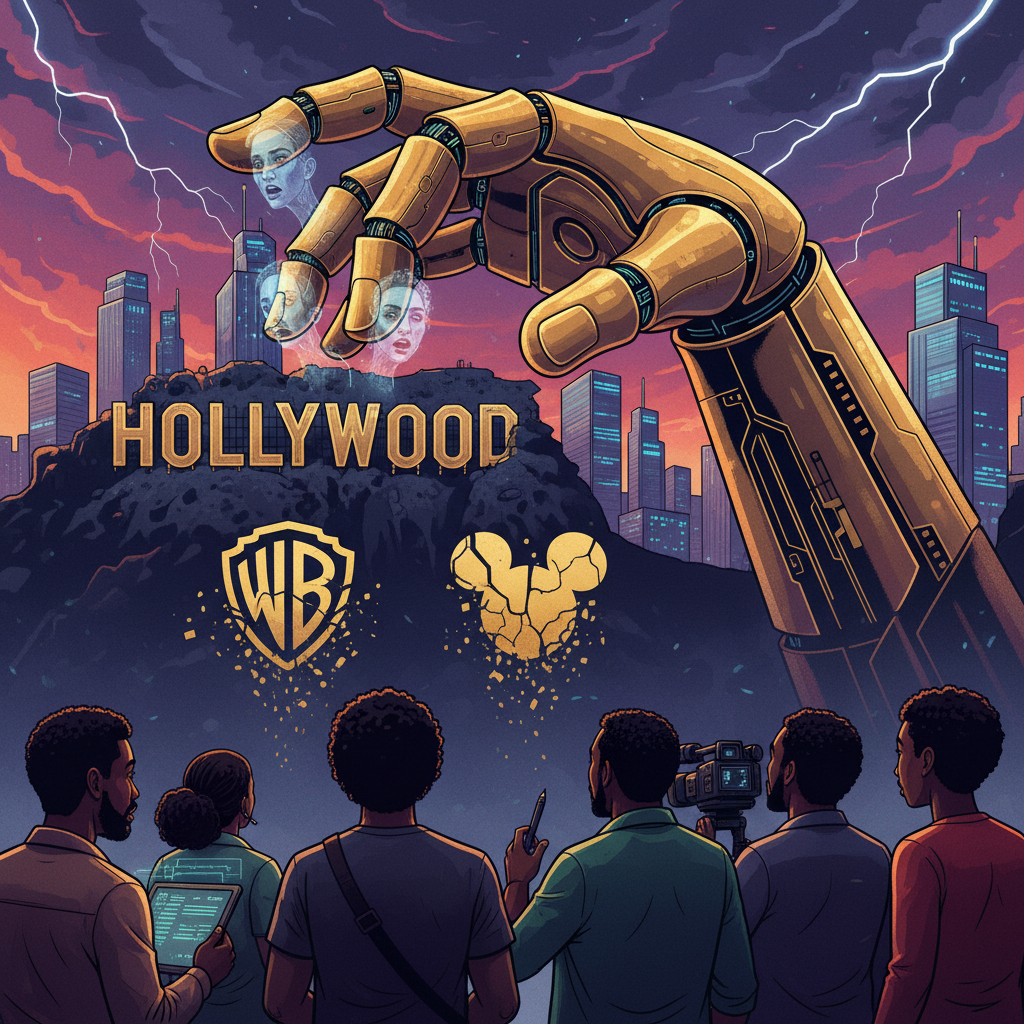
The risk scenario here isn't some far-off sci-fi dystopia, it's already knocking on Tinseltown's door. Imagine a world where a major studio, say Warner Bros. or Disney, decides to greenlight a blockbuster not based on a brilliant script from a human writer, but on a prompt fed to an advanced generative AI. The AI spits out a full screenplay, character designs, storyboards, even initial voice acting. The cost savings could be astronomical, sure, but what about the human element? What about the thousands of writers, actors, directors, cinematographers, costume designers, and grips who make up the backbone of this industry? What about the unique perspectives that AI, no matter how sophisticated, simply cannot replicate, especially when it comes to diverse storytelling?
Technically speaking, we're closer than many realize. Companies like RunwayML and Pika Labs are already pushing the boundaries of text-to-video generation, creating short, stylized clips that are increasingly coherent. Then you've got the advancements in large language models from OpenAI and Google DeepMind, capable of generating complex narratives and dialogue. Combine these with sophisticated 3D rendering engines and AI-driven character animation, and suddenly, the idea of an AI-generated feature film isn't just a fantasy. NVIDIA's powerful GPUs are the engine behind much of this, crunching the data needed to train these massive models. The technical hurdle isn't whether it can be done, but how well it can be done, and how quickly it can scale to Hollywood's demanding standards. The quality is improving at an alarming rate, moving from uncanny valley to genuinely impressive in what feels like mere months. According to The Verge, the pace of these generative AI tools is outstripping even expert predictions.
Now, let's dive into the expert debate, because it's a hot one. On one side, you have the tech evangelists, often venture capitalists and AI company executives, who see this as an inevitable evolution. They argue that AI will democratize filmmaking, allowing anyone with an idea to create high-quality content without needing a multi-million dollar budget or studio connections. Sam Altman, CEO of OpenAI, has often spoken about AI's potential to unlock new creative avenues, though he's also acknowledged the ethical challenges. "The tools we're building are powerful," Altman stated in a recent interview, "and with that power comes a responsibility to ensure they augment human creativity, not replace it entirely." A nice sentiment, but the devil is always in the implementation, isn't it?
On the other side, you have the artists, the unions, and the cultural critics who are ringing alarm bells louder than a New York City fire truck. The Writers Guild of America, for example, has already been vocal about protecting human writers from being replaced by AI. Fran Drescher, president of Sag-aftra, has repeatedly emphasized the need for guardrails. "Our members' livelihoods are not fodder for algorithms," Drescher declared during a press conference last year. "We must ensure that AI serves humanity, not the other way around." This isn't just about job security, it's about the very soul of storytelling. Can an algorithm truly understand the nuances of human emotion, cultural context, or the lived experience that gives a story its depth and resonance? I'm not convinced.
Here's what the tech bros don't want to talk about: the real-world implications, especially for marginalized communities. Silicon Valley has a blind spot the size of Texas when it comes to diversity, equity, and inclusion. If AI models are trained predominantly on existing, often biased, datasets of films and TV shows, what kind of content will they generate? Will we see an endless stream of stories reinforcing old stereotypes, or worse, erasing entire groups from the narrative? Black creators, for example, have fought tooth and nail for representation and authentic storytelling in Hollywood. If AI becomes the primary content generator, will those hard-won gains evaporate? Will the unique voices and perspectives that challenge the status quo be drowned out by algorithms optimized for mass appeal and lowest common denominator content?
Think about it. A major studio can use AI to generate a script that looks diverse on paper, ticking all the boxes for representation, but lacks any genuine cultural insight or heart. It's diversity theater, and it's dangerous. We've already seen how algorithmic bias can manifest in everything from facial recognition software to lending decisions. Why would AI-generated narratives be any different? The risk isn't just unemployment, it's the homogenization and whitewashing of culture, presented as progress.
What should be done? First, we need robust regulation, not just vague ethical guidelines. The European Union's AI Act is a start, but the USA needs its own comprehensive framework, one that specifically addresses the creative industries. This means mandating transparency in AI usage, ensuring fair compensation for human artists whose work is used to train these models, and establishing clear lines of accountability when AI-generated content perpetuates harm or bias. We can't let Hollywood become a Wild West for AI, where the biggest studios with the deepest pockets dictate the future of storytelling. The MIT Technology Review has been publishing excellent pieces on the urgency of these regulatory discussions.
Second, unions like Sag-aftra and the WGA need to continue their fight, demanding strong protections in collective bargaining agreements. This isn't just about wages, it's about intellectual property rights and ensuring that human creativity remains at the core of the industry. They need to push for clauses that limit AI's role, define ownership of AI-assisted creations, and create new revenue streams for artists whose work informs these systems. This isn't about stopping progress, it's about ensuring equitable progress.
Third, we need to invest in diverse AI development. If the teams building these generative AI tools lack diversity, then the biases will inevitably be baked into the algorithms. We need more Black engineers, more women in AI research, more people from underrepresented backgrounds shaping these technologies. This isn't just a feel-good initiative, it's a critical safety measure. If we want AI to reflect the richness and complexity of human experience, then the people creating it must reflect that diversity.
Uncomfortable truth time: the allure of efficiency and cost-cutting is powerful, especially in an industry as financially driven as Hollywood. But if we sacrifice the human touch, the unique perspectives, and the very soul of storytelling on the altar of AI, what are we left with? A sterile, algorithmically optimized wasteland of content that might entertain, but will never truly move us, challenge us, or reflect the messy, beautiful reality of our world. The revolution might be here, but we need to make damn sure it doesn't destroy the very essence of what makes movies and TV shows matter.