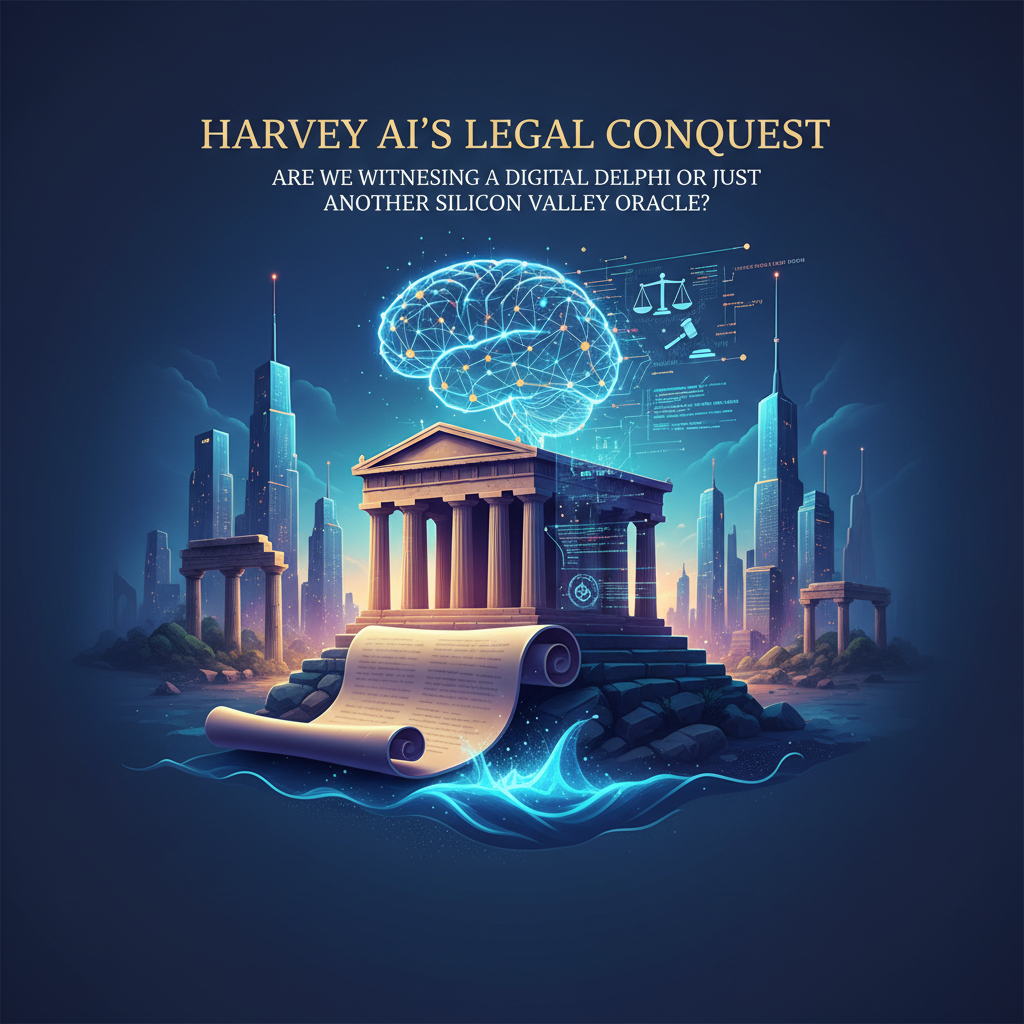

The legal world, bless its staid, parchment-scented heart, has always moved at a glacial pace. Change, for lawyers, is often something to be litigated against, not embraced. So, when a new player bursts onto the scene and starts rewriting the rules, it is not just news, it is an earthquake. And this time, the seismic activity comes courtesy of Harvey AI, a company founded by two former lawyers, Winston Weinberg and Gabriel Pereyra, who apparently grew tired of the endless paper chase and decided to code their way out of it.
Suddenly, every major law firm, from the hallowed halls of Allen & Overy to the bustling offices of Greece's own legal eagles, is talking about AI. Not just talking, mind you, but deploying it. Harvey AI, leveraging OpenAI's powerful language models, has become the de facto standard for legal AI assistance, promising to automate everything from contract review to due diligence. The gods of Olympus would have loved this AI drama, a modern-day battle between ancient traditions and algorithmic efficiency. But is this a true revolution, a digital Delphi offering infallible legal wisdom, or just another Silicon Valley oracle whispering sweet nothings into the ears of eager partners?
Let us peel back the layers of this digital onion. Harvey AI is not just a fancy search engine. It is designed to understand complex legal queries, summarize lengthy documents, draft initial legal memoranda, and even assist in predicting litigation outcomes. Its adoption has been swift and, frankly, a little terrifying for those who still believe in the sanctity of human-crafted legal arguments. Major law firms like Allen & Overy, which famously announced a global rollout of Harvey AI to over 3,500 lawyers, are not doing it for a lark. They are doing it because the promise of efficiency and cost reduction is too compelling to ignore. This is not some boutique firm playing with new toys, this is the establishment embracing the future, or at least, a very shiny version of it.
According to reports, Harvey AI has secured significant funding, including a Series B round that pushed its valuation well into the hundreds of millions. This kind of investment signals serious intent, not just a passing fad. The company claims its AI can reduce the time spent on certain legal tasks by up to 50 percent, a figure that sends shivers down the spines of junior associates everywhere. Imagine, an AI that does not need coffee breaks, does not complain about billable hours, and never asks for a raise. It is the perfect employee, if you are a managing partner with a heart of silicon.
But here is where my Greek skepticism kicks in. We invented logic, remember? We understand that even the most eloquent rhetoric can hide a multitude of sins, or in this case, algorithmic biases. While Harvey AI is undoubtedly powerful, the legal profession is not just about processing information. It is about nuance, interpretation, human empathy, and the often messy, unpredictable nature of human behavior. Can an AI truly grasp the subtle implications of a witness's tone, the unwritten rules of a courtroom, or the ethical dilemmas that define so many legal battles?
Professor Stavros Katsanevas, a renowned legal scholar at the University of Athens, expressed his reservations recently. "While these tools offer undeniable efficiencies for repetitive tasks, the core of legal practice remains human judgment and ethical reasoning," he told a local newspaper. "We must be careful not to outsource our moral compass to an algorithm, no matter how sophisticated." His words echo a growing concern that while AI can be a formidable assistant, it cannot, and should not, replace the human element entirely. The legal system, after all, is built on trust, precedent, and the often agonizing process of seeking justice for individuals, not just optimizing data points.
Even Brad Smith, Vice Chair and President of Microsoft, a company deeply invested in AI, has spoken about the need for responsible AI development, particularly in sensitive fields. He emphasized that "AI must be designed to augment human capabilities, not to replace human accountability." This is a critical distinction. Harvey AI can draft a contract, but who bears the responsibility if that contract leads to unforeseen legal consequences? The lawyer who signed off on it, of course. The AI is a tool, not a scapegoat, and certainly not a sentient legal entity.
In Greece, the adoption of such advanced AI tools is still in its nascent stages, but the conversations are happening. Law firms here, often smaller and more traditional than their Anglo-American counterparts, are watching with a mix of fascination and trepidation. The Hellenic Bar Association has begun discussions on ethical guidelines for AI use in legal practice, recognizing that this is not a trend that can be ignored. "The challenge for us is to integrate these powerful tools in a way that upholds our legal traditions and protects client interests," noted Eleni Petrova, a prominent lawyer in Thessaloniki, during a recent tech conference. "It is about finding the right balance, not blindly following the latest Silicon Valley trend." It is a sentiment I can certainly appreciate. We are not known for blindly following anything, especially if it involves disrupting our afternoon coffee.
So, is Harvey AI a fad or the new normal? The truth, as always, lies somewhere in the middle, probably sipping a frappe by the Aegean. It is certainly not a fad. The efficiencies it offers are too significant, and the investment too substantial, for it to simply disappear. Law firms, driven by competitive pressures and client demands for lower costs, will continue to adopt and integrate these tools. The legal industry, for better or worse, is being reshaped by algorithms.
However, it is also not the complete replacement of human lawyers that some fear or others perhaps secretly wish for. Harvey AI, and tools like it, will become indispensable assistants, handling the grunt work, sifting through mountains of data, and providing initial drafts. This frees up human lawyers to focus on the truly complex, strategic, and human aspects of their profession: client relations, courtroom advocacy, ethical considerations, and the art of persuasion. It means the role of the lawyer will evolve, demanding more critical thinking, more strategic oversight, and a deeper understanding of both law and technology.
For us in Greece, this means an opportunity to adapt, to integrate these tools thoughtfully, and to ensure that our unique legal heritage is preserved even as we embrace the future. It is a chance to prove that while technology can streamline processes, the wisdom of centuries of legal thought, combined with human ingenuity, remains irreplaceable. Pass the ouzo, this tech news requires it, and perhaps a good long debate about the true meaning of justice in the age of AI. For more on the evolving role of AI in professional services, you can always check out TechCrunch. The future of law is not just about code, it is about how we choose to wield it, with wisdom and a healthy dose of skepticism. The algorithm in the courtroom is certainly a topic that has sparked debate globally, as seen in discussions around the algorithm in the courtroom: how chile's legal minds grapple with ai's cognitive grip [blocked], highlighting the universal challenges AI presents to legal systems worldwide. And for a broader perspective on how AI is impacting various industries, Reuters Technology offers continuous updates.