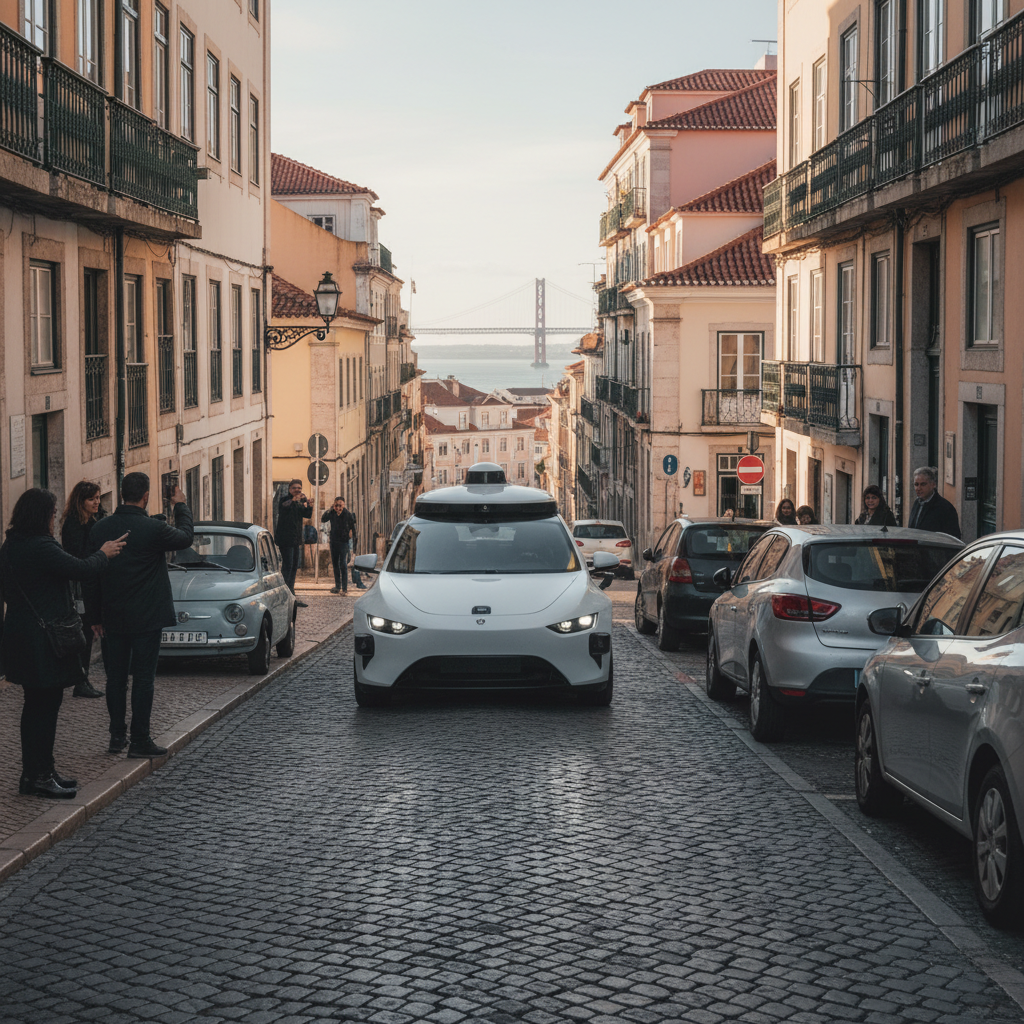

Ah, Europe. The old continent, where history is etched into every cobblestone and bureaucracy often moves at the pace of a leisurely Sunday stroll. And then there's Google, specifically its Waymo division, with its shiny, futuristic autonomous vehicles, reportedly eyeing new horizons. You see, while we in Portugal are still debating the merits of a new metro line and whether our pastel de nata should be eaten warm or cold, Waymo is out there, conquering Phoenix and San Francisco, and now, whispers suggest, looking our way.
It's a scene straight out of a science fiction novel, isn't it? Imagine a Waymo vehicle, sleek and silent, navigating the narrow, winding streets of Alfama, perhaps stopping politely for a tram, or waiting patiently as a flock of pigeons decides to cross the road with all the urgency of a sleepy cat. It's a charming thought, if a little absurd. But the reality of Waymo's potential expansion into European cities, particularly those with the unique character of Lisbon, is far more complex than a mere romantic daydream.
Waymo, a subsidiary of Alphabet, has been steadily expanding its operations in the United States. Their fully autonomous ride-hailing service, Waymo One, has been ferrying passengers in Phoenix for years, and more recently, launched in San Francisco, where it now covers a significant portion of the city. According to their latest public reports, Waymo vehicles have driven millions of miles without a human safety driver, a statistic that makes even the most skeptical among us raise an eyebrow. This isn't just a tech demo anymore, it's a functioning, albeit geographically limited, transportation system.
But Europe is not America. Our cities are older, denser, and our regulatory frameworks, well, let's just say they are as intricate as the azulejo tiles on an old church. The European Union, with its penchant for consumer protection and data privacy, has been meticulously crafting its approach to artificial intelligence and autonomous systems. The AI Act, a landmark piece of legislation, is set to impose stringent requirements on high-risk AI applications, and fully autonomous vehicles certainly fall into that category. This means Waymo, or any other autonomous vehicle company, would face a gauntlet of certifications, risk assessments, and ethical considerations before even being allowed to test their vehicles on public roads.
I spoke with Dr. Lena Schmidt, a leading expert in AI regulation at the Technical University of Munich, about the challenges. She put it quite plainly, 'The regulatory landscape in Europe is designed to be cautious, prioritizing safety and ethical implications above rapid deployment. Any company looking to operate autonomous vehicles here will need to demonstrate an unprecedented level of transparency and adherence to our high standards. It's not just about the technology working, it's about trust and accountability.' Her words echo a sentiment I've heard often, a healthy skepticism mixed with a desire for progress, but on our terms.
Then there's the infrastructure. While Lisbon's tech scene is like a good port wine, complex and improving with age, our roads, bless their ancient hearts, are a different story. They were built for horse-drawn carriages, not LiDAR sensors and AI algorithms. Narrow streets, sudden inclines, unexpected tram lines, and the glorious chaos of Portuguese drivers who sometimes treat traffic laws as mere suggestions, all present a unique set of challenges. A Waymo vehicle might find itself in a perpetual state of 'I'm sorry, I didn't understand that instruction' if it relies solely on its American-trained algorithms.
Yet, the potential benefits are hard to ignore. Reduced traffic congestion, fewer accidents caused by human error, and increased accessibility for those who cannot drive could be transformative. Portugal, a country that often punches above its weight in innovation, particularly in the digital nomad economy and green tech, could certainly benefit from smarter, more sustainable urban mobility solutions. Imagine a future where tourists effortlessly glide through Lisbon's historic center in a silent, electric robotaxi, or where our elderly can maintain their independence with ease.
Manuel Costa, CEO of a Lisbon-based urban planning consultancy, shared his perspective, 'The idea of autonomous vehicles in Lisbon is exciting, but it requires a fundamental rethink of our urban fabric. It's not just about the cars, it's about smart infrastructure, data integration, and public acceptance. We need to prepare our cities, not just wait for the technology to arrive.' He emphasized the need for pilot programs, starting small, perhaps in designated zones, to gradually integrate the technology. This phased approach, he believes, would be crucial for building public trust and understanding.
Waymo's CEO, Tekedra Mawakana, has spoken publicly about the company's long-term vision, which certainly includes international expansion. While she hasn't specifically named European cities, the company's continuous investment in its technology, including its fifth-generation Waymo Driver, suggests a readiness to tackle diverse environments. The company recently announced a significant increase in its operational design domain in San Francisco, demonstrating its ability to adapt and scale. This kind of progress, reported by outlets like TechCrunch, shows a company not afraid of a challenge.
However, the economic model for autonomous taxis in Europe also needs careful consideration. The cost of operation, the pricing structure, and how it competes with existing public transport and ride-hailing services will be critical. Europeans are generally more inclined towards public transport and cycling, and the idea of a private, albeit driverless, taxi service might need to offer a compelling value proposition beyond mere novelty.
Furthermore, the data privacy implications are enormous. Waymo vehicles collect vast amounts of data about their surroundings, their passengers, and the routes they take. Under the EU's General Data Protection Regulation, or GDPR, this data collection and processing would be subject to strict rules. Companies would need to be transparent about what data they collect, how it's used, and how it's protected. This isn't just a minor hurdle, it's a fundamental requirement that could shape the entire operational model.
As we look ahead to April 2026, the prospect of Waymo vehicles navigating European streets remains a tantalizing blend of innovation and apprehension. It's not a question of if autonomous vehicles will arrive, but how and when. The sardine can of European tech is actually a treasure chest, full of brilliant minds and innovative startups, many of whom are also working on smart mobility solutions. Perhaps a collaboration, a partnership between global giants and local expertise, could be the key to unlocking this complex puzzle.
For now, I'll continue to enjoy my walks through Lisbon, dodging the occasional scooter and marveling at the intricate dance of our city's traffic. It's a dance that, for all its quirks, has a certain human charm. Whether a robotaxi can learn those steps, or if we'll need to teach it a new rhythm, remains to be seen. But one thing is certain: the conversation has begun, and it's a fascinating one.