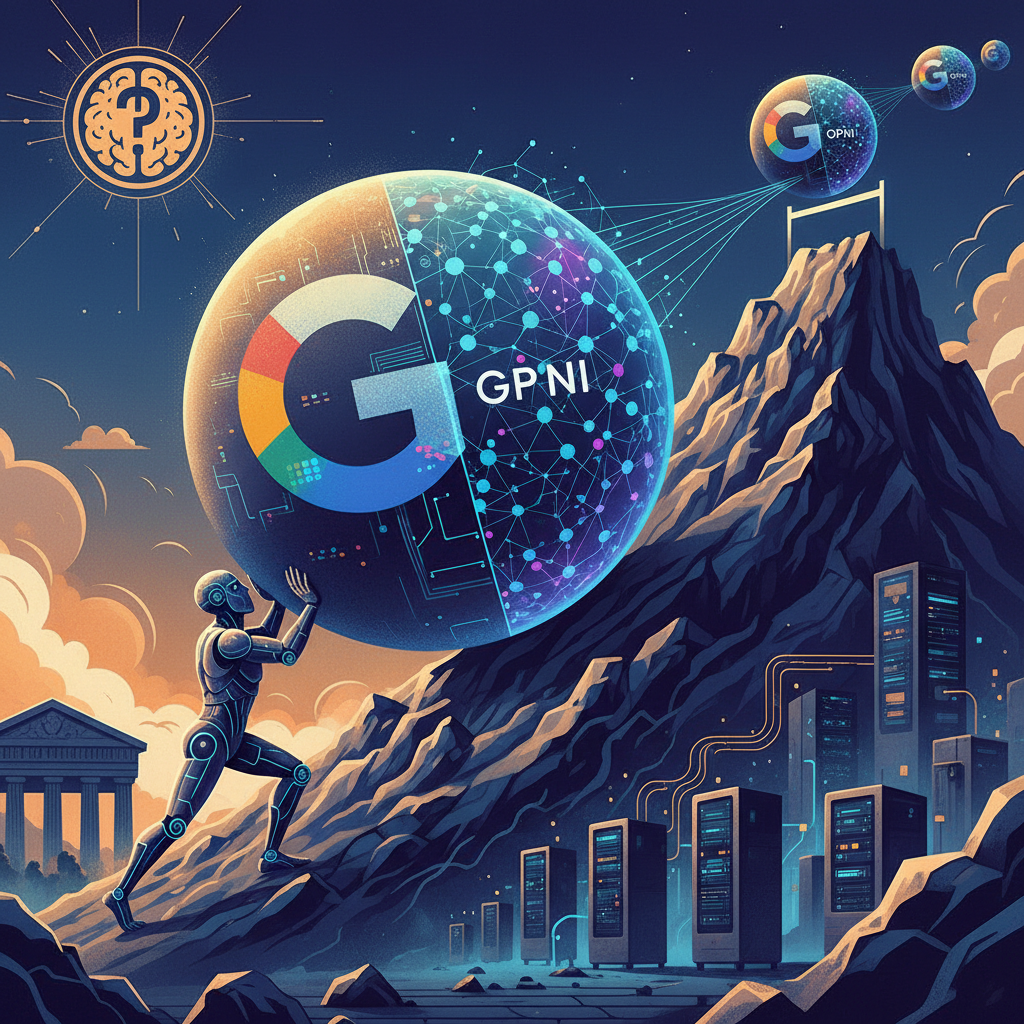

The digital gladiators, Google with its Gemini and OpenAI with its GPT, are locked in a spectacle of multimodal prowess. Every other week, it seems, we are treated to another dazzling demo, another incremental leap in their ability to see, hear, and, dare I say, understand the world. But as I watch from my small balcony in Athens, sipping my morning coffee, I cannot help but wonder: is this a genuine ascent to AI supremacy, or merely a modern retelling of the myth of Sisyphus, an endless, exhausting push up a hill, only for the stone to roll back down?
My take, and it is a strong one, is that this furious, almost frantic, competition for multimodal dominance is missing a crucial ingredient: a genuine philosophical grounding. We are so enamored with the how that we forget to ask the why. Google's recent demonstrations of Gemini interpreting complex visual data or OpenAI's GPT-4o conversing with nuanced emotional understanding are undeniably impressive. They parse images, analyze video, and respond to spoken queries with a fluidity that would have been science fiction a mere five years ago. We are told this is the path to artificial general intelligence, to systems that can reason and interact with the world like humans. But do they truly reason or merely simulate reasoning with ever-increasing fidelity?
Consider the latest buzz around Gemini's ability to process live video feeds and offer real-time commentary. "Imagine a future where an AI assistant can guide you through a complex repair, identifying parts and suggesting steps as you work," enthused Dr. Eleni Stavropoulou, a lead researcher at the National Technical University of Athens, during a recent online seminar. "This multimodal integration is transformative for practical applications, from manufacturing to personalized education." She speaks with an academic's optimism, focusing on the utility. And yes, the utility is there, I grant you. But I see a different side. I see a system that can identify a wrench, but does it understand the frustration of a stripped bolt? Does it grasp the satisfaction of a job well done, the kind of satisfaction that comes from messy, tangible effort?
This is where my Greek sensibilities kick in. Greece to Silicon Valley: we invented logic, remember? We understood that true intelligence isn't just about processing information; it's about wisdom, about understanding context, nuance, and the human condition. These AIs are becoming phenomenal pattern matchers, but pattern matching is not wisdom. It is a tool, a very powerful one, but still a tool. The sheer volume of data they consume, the billions of parameters they tune, allows them to mimic understanding with astonishing accuracy. Yet, the core of true understanding, the kind that arises from lived experience, from joy and sorrow, from the smell of fresh bread and the sting of betrayal, remains elusive.
Some might argue, and they often do, that these systems are just in their infancy. They will learn, they will evolve, they will eventually bridge that gap. "The rapid pace of development suggests that what seems like a philosophical hurdle today will be a solved engineering problem tomorrow," stated Mr. Andreas Kouris, a venture capitalist based in London with significant investments in AI startups, in a recent interview with Reuters. He believes that with enough data and computational power, the emergent properties of these large models will eventually yield something akin to human consciousness. He points to the unexpected capabilities that arise from scaling, the way these models surprise even their creators. And he is right, to a point, that they surprise us. But a surprise is not necessarily a revelation of true intelligence; it can also be a revelation of how sophisticated mimicry can become.
My rebuttal is simple: scaling up a calculator does not make it a poet. It makes it a faster, more complex calculator. The qualitative leap from processing information to truly understanding it, from identifying an object to comprehending its cultural significance, is not merely a matter of more data or more layers in a neural network. It is a difference in kind, not just degree. When Gemini can look at a Greek vase and not just identify it as 'Attic red-figure pottery, circa 5th century BCE' but also feel the echoes of ancient hands, the stories it tells, the societal values it represents, then perhaps we can talk about genuine understanding. Until then, it is a magnificent, highly efficient librarian, not a philosopher.
The gods of Olympus would have loved this AI drama, I think. They understood the hubris of mortals reaching for god-like powers, often with unforeseen consequences. This race between Google and OpenAI, between Sundar Pichai's vision and Sam Altman's ambition, feels like a modern epic. Each company pours billions into R&D, into acquiring the best talent, into building ever-larger data centers. The stakes are immense, not just for market share, but for shaping the very fabric of our future. According to TechCrunch, investments in multimodal AI alone surged by 45% in the last year, reaching an estimated $18 billion globally. This is not a casual pursuit; it is a full-blown technological arms race.
But what are they truly racing towards? Is it a future where AI enriches human experience, or one where it merely replaces it, albeit with greater efficiency? The danger, as I see it, is that in this relentless pursuit of 'human-like' AI, we risk losing sight of what makes us uniquely human. The messiness, the irrationality, the intuition, the very things that defy algorithmic logic are often the wellsprings of our creativity and our deepest insights. If AI can do everything we can, but better, faster, and without error, what then becomes of our purpose? Will we become mere spectators in a world run by flawless algorithms?
We need to pause, to breathe, to reflect. Perhaps the goal should not be to create an AI that can perfectly mimic human intelligence, but one that can complement it, that can augment our uniquely human capacities without diminishing them. We should be asking how these powerful tools can help us solve pressing global challenges, like climate change or poverty, rather than just perfecting their ability to generate photorealistic images or write compelling marketing copy. We have an article discussing Google DeepMind's efforts to unlock the sun's power [blocked], a truly impactful application. More of that, please.
Pass the ouzo, this tech news requires it. The competition between Google Gemini and OpenAI's GPT is fascinating, a technological marvel unfolding before our eyes. But let us not be so dazzled by the light that we forget to look for the shadows. Let us demand that these technological titans build not just smarter machines, but wiser ones, machines that understand their place in the grand tapestry of human existence, not as replacements, but as partners. Otherwise, we risk building a future that is technically brilliant but philosophically hollow, a future where the rock of progress is forever pushed uphill, only to tumble down again, leaving us no closer to true enlightenment.