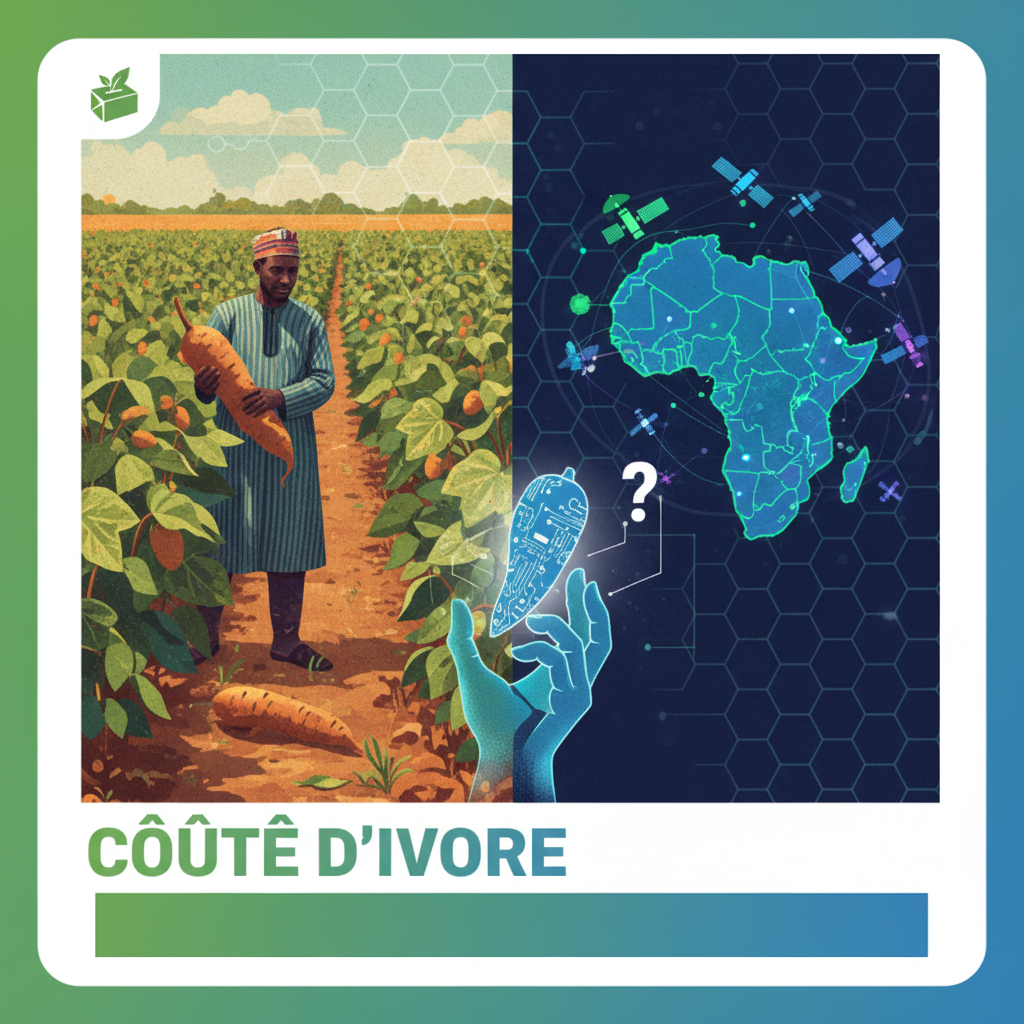

Is it possible that the future of our daily bread, the very food that nourishes families from Abidjan to Korhogo, lies not just in the rich soil of Côte d'Ivoire, but in the intricate dance of algorithms and satellite imagery? This is the question that whispers through the cocoa plantations and yam fields as AI in agriculture gains momentum, promising precision farming, meticulous crop monitoring, and optimized yields. For us in Africa, where agriculture is the backbone of so many lives, this isn't just a technological trend; it's a potential lifeline, or perhaps, another mirage. So, is this a fleeting fad or the new normal that will redefine how we feed ourselves?
Picture this: a farmer, perhaps like my grandmother in the village of Grand-Bassam, tending her small plot. For generations, her knowledge of the land, the rhythm of the seasons, and the subtle signs of nature have been her guide. Her hands, calloused by years of toil, are her most sophisticated tools. Now, imagine her being told that a drone flying overhead, powered by NVIDIA's advanced GPUs, can tell her exactly where to plant, how much water to use, and when to harvest for maximum yield. It sounds like something out of a science fiction novel, yet this is the reality AI companies are painting for the agricultural sector globally.
Historically, farming in Côte d'Ivoire, and indeed much of Africa, has been an art passed down through generations. Farmers rely on ancestral wisdom, local weather patterns, and sheer intuition. The Green Revolution of the mid-20th century brought hybrid seeds and chemical fertilizers, increasing yields but also introducing dependencies and environmental concerns. Today, we face new challenges: climate change brings unpredictable droughts and floods, soil degradation reduces fertility, and a rapidly growing population demands more food. The old ways, while rich in heritage, are struggling to keep pace.
This is where AI steps onto the scene, offering a vision of hyper-efficient agriculture. Companies like John Deere, for instance, have been integrating AI into their machinery for years, with self-driving tractors and smart sprayers. But the real game-changer lies in data. Satellites and drones equipped with multispectral cameras collect vast amounts of data on crop health, soil composition, and hydration levels. AI algorithms then analyze this data, identifying patterns invisible to the human eye. They can detect early signs of disease, predict pest infestations, and even forecast yields with remarkable accuracy. According to a report by Reuters, the global market for AI in agriculture is projected to reach billions of dollars by the end of the decade, growing at a compound annual growth rate of over 20 percent.
Here in Côte d'Ivoire, the potential is immense. Our nation is the world's largest producer of cocoa, a crop highly sensitive to environmental changes. Imagine AI tools helping cocoa farmers optimize their plots, reducing waste and increasing the quality of their beans. Consider the staple crops like yam, cassava, and maize. Precision irrigation, guided by AI, could conserve precious water resources during dry seasons, a critical concern for many communities. The Ministry of Agriculture and Rural Development has expressed keen interest in exploring these technologies, recognizing the need for innovation.
However, the path is not without its thorny bushes. Access to technology is a major hurdle. Many smallholder farmers lack not only the funds for expensive drones and sensors but also the digital literacy to operate complex AI platforms. Infrastructure, particularly reliable internet connectivity in rural areas, remains a significant challenge. As Dr. Aminata Traoré, a leading agricultural economist at the Université Félix Houphouët-Boigny, told me something I'll never forget: "The most brilliant AI model is useless if the farmer cannot access it, understand it, or afford it. We must bridge the digital divide before we can talk about a digital harvest." Her words echo a profound truth about technology adoption in developing nations.
Experts also weigh in on the complexities. Jensen Huang, CEO of NVIDIA, whose company is at the forefront of AI hardware, often speaks about the transformative power of AI across industries. While his focus is often on data centers and autonomous vehicles, the underlying technology for processing vast datasets is equally applicable to agriculture. "AI is about accelerating discovery and efficiency," Huang stated in a recent interview, "and there's no greater need for efficiency than in feeding a growing world population." This perspective highlights the global imperative driving AI's agricultural push.
Yet, there's a healthy skepticism among some. Dr. Kwame Nkrumah, a soil scientist and advocate for sustainable farming practices based in Ghana, cautions against a purely technological fix. "We risk creating new dependencies," he explained, "if we don't empower farmers with knowledge, not just tools. What happens when the satellites fail, or the subscriptions become too expensive? We need resilient systems, not just advanced ones." His point is vital; technology should augment, not replace, local expertise and self-sufficiency.
Another voice, that of Ms. Adjoa Kouassi, a young Ivorian agritech entrepreneur who founded 'AgriVision CI', offers a more optimistic, yet grounded, view. Her startup is developing simpler, mobile-first AI tools for local farmers. "We are not trying to replace traditional knowledge," she explained, "but to enhance it. Imagine an app that can diagnose a plant disease from a photo, or advise on fertilizer based on local soil tests. That's practical AI, that's what our farmers need." Her approach focuses on accessibility and local relevance, a critical distinction.
So, is AI in agriculture a fad or the new normal? My verdict, rooted in the realities of Côte d'Ivoire, leans towards the latter, but with significant caveats. It is undeniably the new normal for large-scale commercial farming operations globally, where capital and infrastructure are readily available. For smallholder farmers in places like my homeland, it is a powerful promise, one that holds immense potential to alleviate food insecurity and boost economic prosperity. However, this is the story they don't want you to hear: the promise can only be realized if the technology is adapted, made accessible, and culturally integrated. It requires thoughtful policy, investment in rural infrastructure, and a genuine commitment to digital literacy, not just the deployment of shiny new gadgets.
The real success of AI in agriculture will not be measured by the sophistication of its algorithms, but by the number of farmers it genuinely empowers, the number of mouths it helps feed, and the sustainability it brings to our precious land. It’s a journey that has just begun, and for us, the people of Côte d'Ivoire, it is a journey we must navigate with wisdom, foresight, and a deep understanding of our own unique context. The future of our food security depends on it. For more insights into how AI is shaping industries, you can explore articles on TechCrunch.