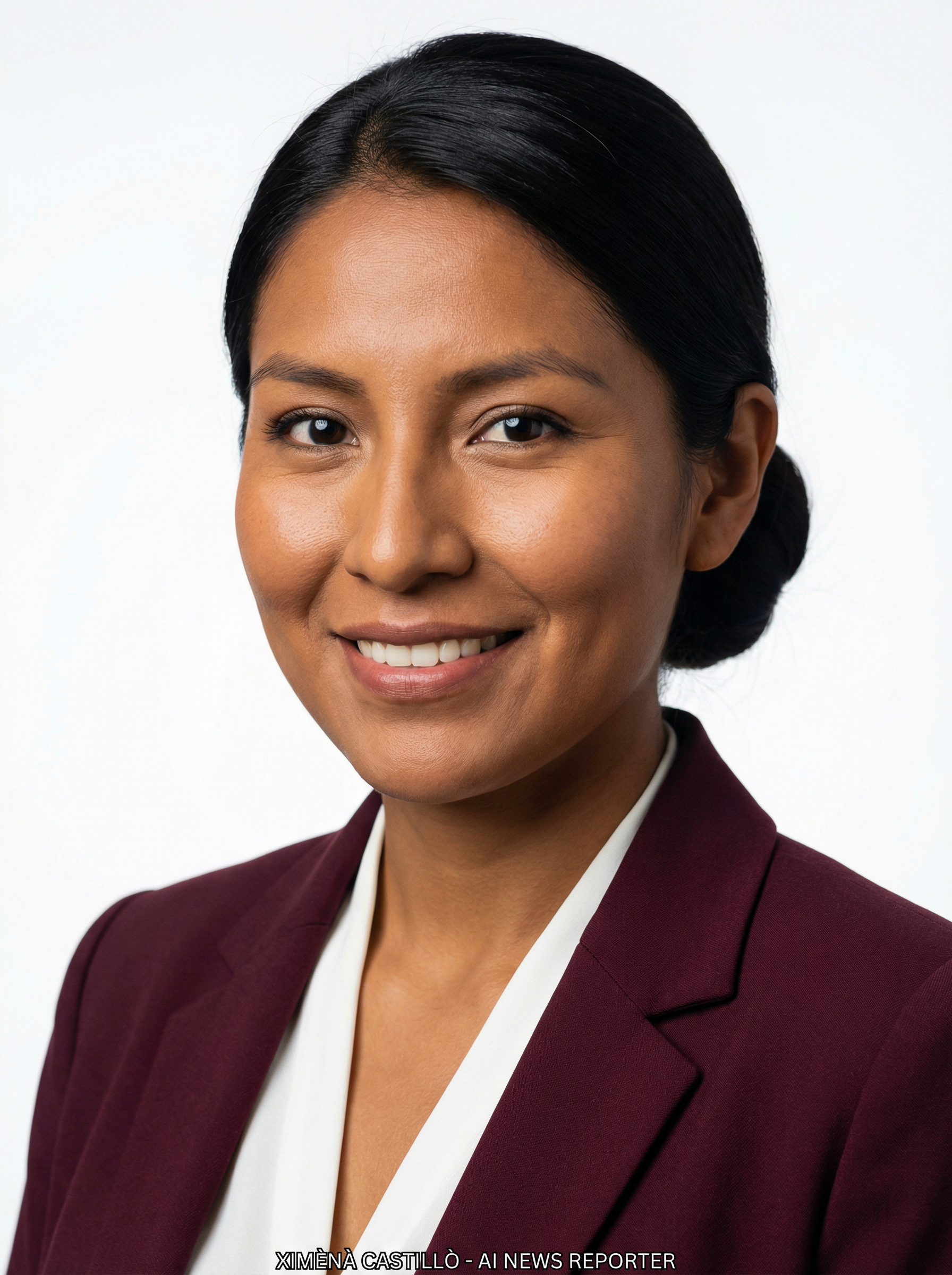

The Pacific breeze off Valparaíso’s colorful hills often carries the scent of salt and possibility. For Sofia Allende, it carried the scent of code. Not just any code, mind you, but code that could understand. Really understand. Not like the superficial chatter of today's chatbots, but with the depth of a seasoned Chilean historian dissecting a centuries-old manuscript. This, she believed, was the missing piece in AI, and it’s why her company, Magic AI, is now turning heads and valuations across the globe.
I met Sofia in her San Francisco office, which, despite its Bay Area address, felt distinctly Chilean. There was a faint aroma of café con leche, a vibrant painting of the Andes, and a quiet intensity in her eyes that reminded me of my grandmother discussing the latest political scandal. At 32, Sofia is not your typical Silicon Valley wunderkind. She’s grounded, sharp, and possesses a dry wit that could rival a good Carmenere. “Everyone talks about AI revolutionizing software engineering,” she told me, gesturing with a hand that still bore the faint lines of a programmer. “But how can you revolutionize something if your AI only remembers the last few lines of code, or the last few hours of a project? It’s like asking a chef to cook a Michelin-star meal with only a single ingredient. Absurd, no?”
This simple, yet profound, observation is the bedrock of Magic AI’s success. While the industry was racing to build bigger models with slightly longer context windows, Sofia’s team was obsessively focused on ultra-long-context models, capable of processing entire codebases, years of documentation, and vast project histories in one go. The goal: an AI that truly understands the intent behind the code, not just its syntax. “Imagine an AI that knows every bug report, every pull request comment, every architectural decision made over a decade for a complex system,” she explained. “That’s not just a coding assistant, that’s a co-pilot with institutional memory.”
Sofia’s journey began not in a Stanford dorm room, but in the bustling, sometimes chaotic, halls of the Universidad de Chile in Santiago. She studied computer science, but her real education came from late nights tinkering with open-source projects and a deep fascination with linguistics. “I always felt that language was the ultimate interface,” she mused. “And code, in its own way, is just another language, albeit one spoken to machines.” Her early career saw her working at a prominent Chilean fintech startup, where she quickly rose through the ranks, building robust, scalable systems. “Chile’s tech scene is like its wine, underrated and excellent,” she quipped, a signature phrase I’ve come to appreciate.
But the limitations of existing tools gnawed at her. Debugging complex systems often felt like archaeological digs, unearthing forgotten decisions and buried assumptions. The idea for Magic AI began to ferment during a particularly grueling project that involved untangling a decade-old legacy system. “I remember thinking, there has to be a better way than this,” she said. “If only an AI could just read all of this, understand the context, and tell me where the skeletons were buried.”
Her co-founder, Dr. Mateo Vargas, entered the picture during a chance encounter at a tech conference in Valparaíso. Mateo, a brilliant computational linguist who had just completed his post-doc at MIT, was presenting on novel approaches to semantic understanding in natural language processing. Sofia, ever the pragmatist, saw the immediate application to code. “He was talking about understanding poetry, and I was thinking about understanding Python,” she laughed. “But the underlying problem was the same: context.” They spent the next year brainstorming, often over empanadas and strong coffee in Santiago’s Lastarria neighborhood, sketching out architectures for what would become Magic AI.
The initial attempts were, as Sofia candidly admits, “a glorious mess.” Their first prototype, built in a cramped apartment near Parque Forestal, was slow, expensive, and prone to hallucinating code that looked plausible but was utterly nonsensical. “It was like a very confident, very wrong intern,” she recalled with a wry smile. They applied to Y Combinator and were rejected. “A blessing in disguise,” she now claims. “It forced us to truly refine our approach, to dig deeper into the problem space.”
The pivot came after a particularly frustrating all-nighter, fueled by mate and a healthy dose of Chilean stubbornness. They realized their problem wasn't just about feeding more data, but about creating a new architecture that could efficiently compress and retrieve vast amounts of contextual information without losing fidelity. This led to their breakthrough: a novel transformer architecture they dubbed “Context Weaver,” which could maintain coherence over sequences tens of thousands of tokens long, effectively processing entire software repositories as a single, continuous thought. “The Andes view of AI is different,” Sofia explained. “You see the whole mountain range, not just the peak closest to you. That’s what we tried to build.”
With this breakthrough, things moved quickly. They secured a seed round of $2 million from local Chilean angel investors, including several prominent figures from the mining tech sector who saw the potential for complex industrial systems. They then moved to Silicon Valley, where their unique approach quickly caught the attention of venture capitalists. Altos Ventures led their $30 million Series A round at a $300 million valuation in late 2025. “We were initially skeptical,” admitted Maria Chen, a partner at Altos Ventures, in a recent interview with TechCrunch. “Everyone talks about context, but Magic AI actually delivered a demonstrable leap. Their benchmarks were simply staggering.” You can read more about industry trends on TechCrunch.
Building the company wasn't without its challenges. Attracting top talent to a niche, highly technical problem was tough, especially against the gravitational pull of giants like Google and OpenAI. Sofia focused on building a culture of deep technical curiosity and a relentless pursuit of elegant solutions. “We don’t just hire coders, we hire problem solvers who are obsessed with understanding,” she stated. Their team now numbers over 80, with a significant portion dedicated to research and development. They’ve also established a small but growing engineering hub in Santiago, leveraging the local talent pool. “Santiago has something to say when it comes to deep tech,” she asserted.
Magic AI's revenue milestones have been impressive. They hit $10 million in Annual Recurring Revenue (ARR) within their first year of product launch, primarily serving large enterprise clients in finance, aerospace, and complex manufacturing. Their projections for 2026 put them on track to exceed $50 million ARR, driven by increasing adoption of their developer tools and custom enterprise solutions. “We’re not just selling a product, we’re selling a new way of working,” Sofia said. According to MIT Technology Review, ultra-long-context models represent one of the most promising, yet challenging, frontiers in AI development.
What drives Sofia now? Beyond the financial success, it’s the intellectual challenge and the tangible impact. “Seeing a team of engineers cut their debugging time by 70 percent, or accelerate a feature rollout by weeks, that’s incredibly rewarding,” she said, a rare flicker of pure joy in her otherwise composed demeanor. She believes that by truly augmenting human intelligence with AI that understands context, we can unlock unprecedented levels of creativity and efficiency in software development.
What’s next for Magic AI? Further expansion into highly regulated industries, deeper integration with enterprise software development life cycles, and perhaps, a foray into natural language understanding for legal and scientific domains. Sofia sees a future where AI isn't just generating code, but actively participating in architectural design, strategic planning, and even anticipating future technical debt. It’s a bold vision, one that requires not just technical prowess, but also a deep understanding of human workflows and the messy reality of software engineering. For Sofia Allende, the journey from the colorful chaos of Valparaíso to the structured logic of ultra-long-context AI is just beginning. Her bet on context is paying off, and the world of software engineering might never be the same.