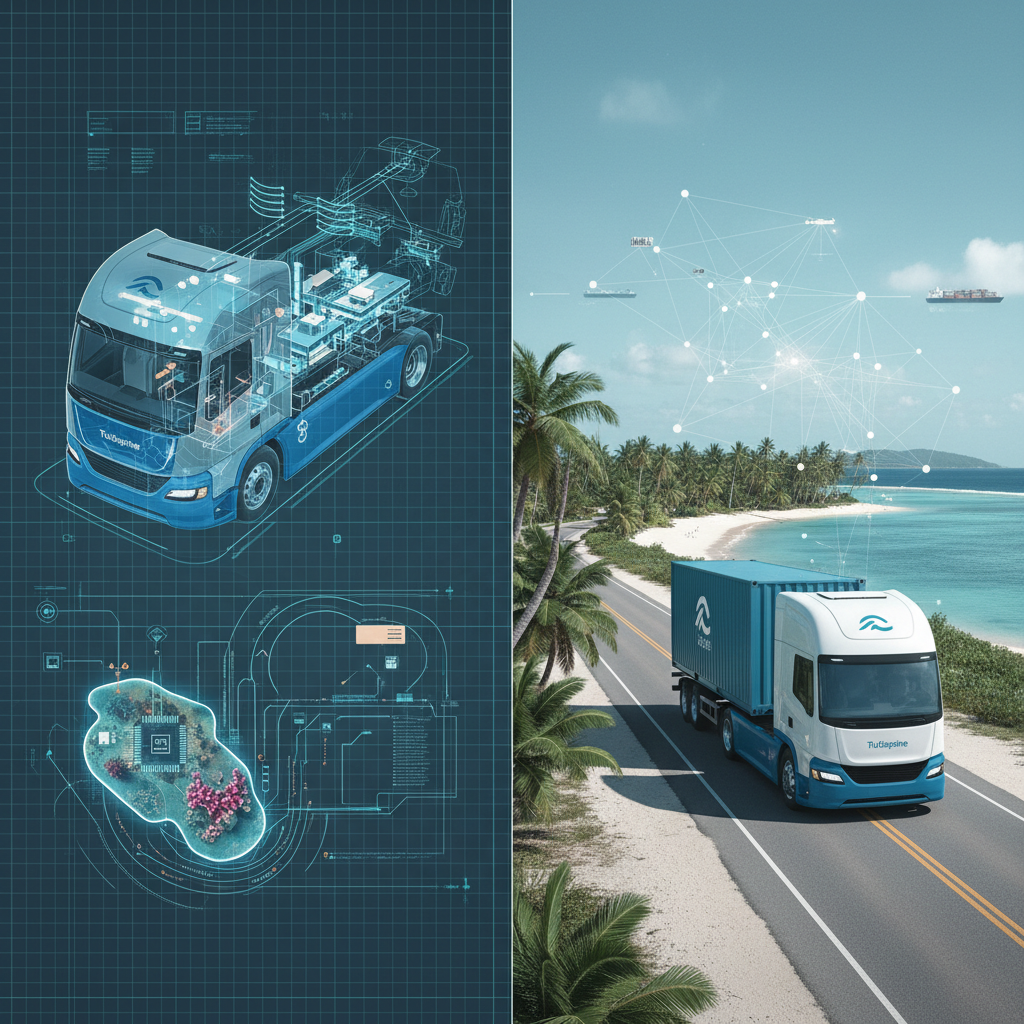

The sun rises here in Tahiti, painting the sky with hues that defy description, and as the waves gently kiss our shores, I often think about connection. Not just the connection between our islands, or between our people and the ocean, but the connection to the wider world. For us, logistics isn't just a business, it's the lifeline that brings everything from building materials to fresh produce, linking our remote communities to the global marketplace. That's why a recent development in autonomous trucking, particularly the work done by companies like TuSimple, has caught my eye, and I believe it holds profound implications for places like French Polynesia.
We often hear about self-driving cars, but the real revolution, the one quietly reshaping the $800 billion logistics industry, is happening with trucks. Imagine behemoths of the road, moving cargo across vast distances, not with a human hand on the wheel, but guided by an intricate dance of sensors, AI, and sophisticated algorithms. This isn't science fiction anymore, it's the present, and it's evolving at a breathtaking pace. The latest advancements, particularly in Level 4 autonomous driving for long-haul freight, are what truly excite me.
The Breakthrough: Precision on the Open Road
The breakthrough I'm talking about isn't a single 'aha!' moment, but rather the culmination of years of relentless research and development, particularly by pioneers like TuSimple. They've been at the forefront of developing what's known as a 'driver-out' solution for autonomous trucks. This means the truck can operate entirely without human intervention under specific conditions, primarily on highways. Their systems combine high-definition mapping, advanced perception algorithms, and predictive control to navigate complex road scenarios, even in varying weather conditions. It's about achieving a level of safety and efficiency that human drivers, no matter how skilled, simply cannot maintain over thousands of miles.
Why does this matter so much? For us in the Pacific, technology takes a different form. It’s not always about the flashy new gadget, but about solutions that bridge distances, overcome isolation, and build resilience. Our goods arrive by sea, then often need to be transported across islands, sometimes on challenging roads. The ability to automate parts of this journey, to make it more predictable and less reliant on a constantly available human workforce, could be transformative. Think about the sheer cost of shipping to our islands, and then the internal distribution. Any efficiency gained is a direct benefit to our communities, potentially lowering the cost of living and improving access to essential goods.
Why It Matters: Beyond the Mainland Highways
While TuSimple's primary focus has been on the vast stretches of American highways, the underlying technology, the principles of robust autonomous navigation and logistics optimization, are universally applicable. For French Polynesia, the direct application might not be long-haul across continents, but rather optimizing inter-island freight movement or even automating transport within larger islands like Tahiti. Imagine a future where goods arriving at the port of Papeete could be autonomously loaded onto trucks and dispatched to distribution centers across the island, operating through the night with unparalleled precision. This could dramatically reduce delivery times and operational costs, a significant factor when every imported item carries a premium.
As Jean-Marc Pambrun, a logistics expert with the Port Autonome de Papeete, once told me, “Our biggest challenge isn’t just getting goods here, it’s getting them efficiently to every family, every shop, every corner of our islands. Any innovation that can streamline that last mile, or even the last hundred miles, is a game-changer for our economy and our people.” He understands that the ocean connects us and so does AI, especially when it helps us manage the flow of goods.
The Technical Details: A Symphony of Sensors and AI
At the heart of TuSimple's system is a sophisticated blend of hardware and software. Their trucks are equipped with a suite of sensors: cameras for visual perception, LiDAR for precise distance measurement and 3D mapping, and radar for all-weather object detection. These sensors feed massive amounts of data into an AI-powered perception system, which then builds a real-time, 360-degree understanding of the truck's environment. This isn't just about seeing obstacles, it's about predicting the behavior of other vehicles, understanding traffic patterns, and reacting safely to dynamic situations.
The AI then uses this information to make driving decisions, planning trajectories, controlling acceleration and braking, and steering with sub-meter accuracy. Their proprietary algorithms are trained on petabytes of real-world driving data, allowing the system to learn from millions of miles of experience. This deep learning approach is crucial for handling the unpredictable nature of real-world driving. For a deeper dive into the technical underpinnings of such systems, MIT Technology Review often publishes excellent analyses of autonomous vehicle technology.
Who Did the Research: A Global Effort with a Clear Leader
While many companies are exploring autonomous driving, TuSimple has carved out a significant niche in the heavy-duty trucking sector. Founded in 2015 by Xiaodi Hou, a renowned computer scientist, the company has consistently pushed the boundaries of Level 4 autonomous technology. Their work involves collaborations with major truck manufacturers like Navistar and logistics giants such as UPS. Their research papers, often found on platforms like arXiv, detail advancements in areas like sensor fusion, predictive control, and robust localization, showcasing a commitment to scientific rigor alongside commercial ambition.
Other players like Waymo Via, Aurora, and Embark also contribute significantly to the field, each bringing their unique approaches to the complex problem of autonomous freight. However, TuSimple’s focus on the long-haul, hub-to-hub model, and their extensive testing on public roads, positions them as a key innovator in this space. They have demonstrated the ability to operate trucks autonomously for extended periods, covering hundreds of miles without human intervention, a critical milestone for commercial viability.
Implications and Next Steps: A Future Connected by Code
The implications for a region like French Polynesia are vast. Beyond the immediate cost savings, autonomous logistics could enhance supply chain resilience, a critical factor for islands vulnerable to disruptions. Imagine a fleet of autonomous vehicles ready to assist in disaster relief, delivering aid with precision when human drivers might be unavailable or roads too dangerous. It could also open up new economic opportunities, allowing our local businesses to connect more seamlessly with global markets.
Of course, there are challenges. The infrastructure needed to support fully autonomous fleets, from high-definition mapping to robust communication networks, would require significant investment. Regulatory frameworks would need to adapt, and public acceptance would be paramount. But these are not insurmountable obstacles. We have seen how satellite internet, like Starlink, is beginning to bridge our digital divide, and similar ingenuity can be applied to our physical logistics.
As we look to the horizon, the idea of self-driving trucks might seem distant from our turquoise lagoons and volcanic peaks. Yet, this is a story about paradise and pixels, about how cutting-edge AI research, developed thousands of miles away, can find a vital purpose in our island homes. It's about empowering our communities, ensuring that the goods we need arrive reliably, and perhaps, just perhaps, making our beautiful corner of the world a little more connected, a little more prosperous, and a little more resilient. The journey has just begun, and I, for one, am excited to see where these intelligent machines take us. We must always remember that technology, at its best, serves humanity, and here in the Pacific, we are always looking for ways to better serve our people and preserve our unique way of life. The future of logistics, even for our remote islands, is increasingly being written in code, and it promises to be a fascinating chapter indeed. For more on how AI is transforming global industries, I often check out Reuters Technology.
I believe that as these technologies mature, we will see them adapted and integrated into our unique island ecosystems. The rhythm of the Pacific is slow and deliberate, but it is also adaptable and innovative. Just as our ancestors navigated these vast waters with incredible precision, so too will we learn to navigate the new currents of AI, harnessing them to benefit our people and protect our precious environment. This is our way, to embrace the future while honoring our past, and autonomous logistics is simply another tool in our ever-evolving toolkit.