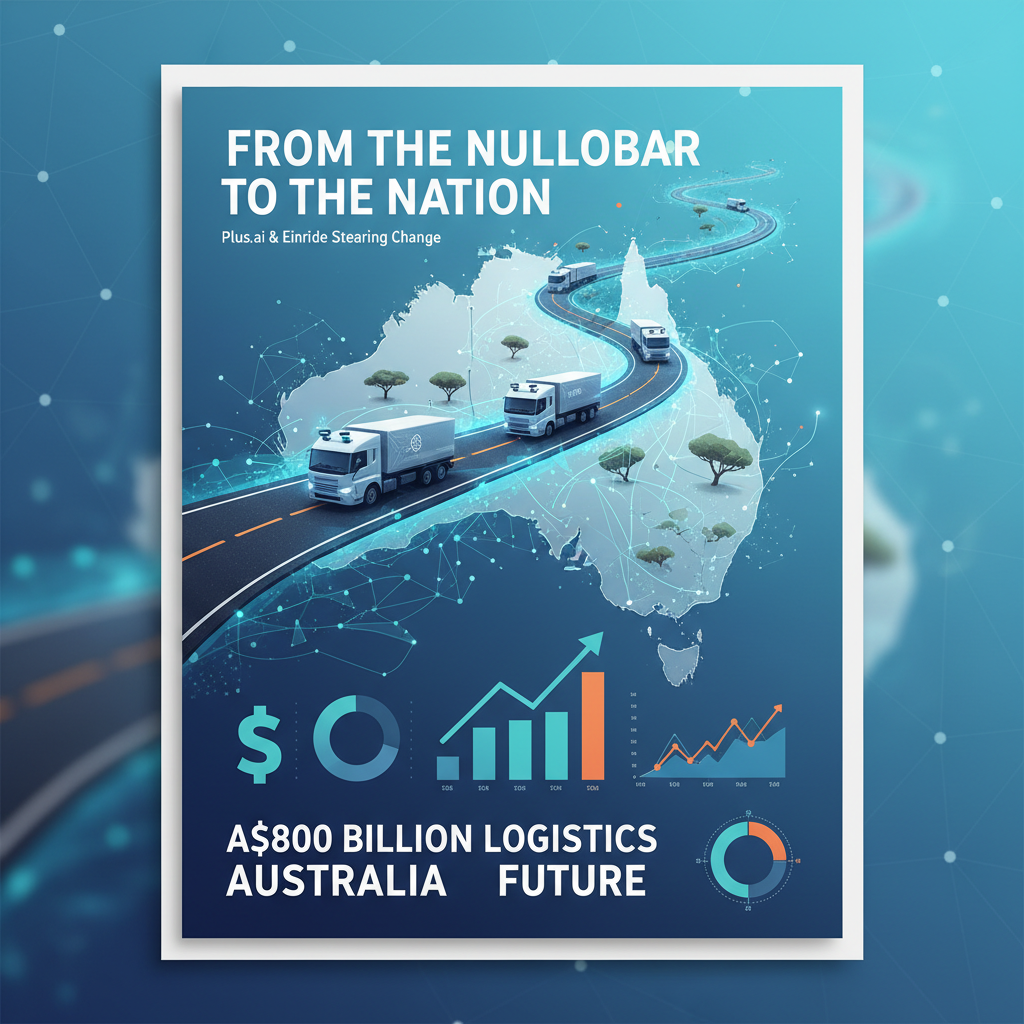

Is that the rumble of a diesel engine or the quiet hum of an electric, autonomous behemoth making its way across the vast, red expanse of the Australian outback? It’s a question that’s becoming less hypothetical and more a reality with each passing month, as self-driving trucks and autonomous delivery solutions begin to reshape the colossal $800 billion global logistics industry. Here in Australia, with our immense distances and unique challenges, this isn't just a tech trend, it's a potential game-changer for our economy and our way of life.
For decades, the image of the Aussie road train, a symbol of rugged determination, has been etched into our national psyche. But what if those road trains could drive themselves, tirelessly, safely, and more efficiently, 24/7? This isn't science fiction anymore, my friends, it's the very real, very exciting present. We're talking about a transformation that could redefine everything from how your morning coffee beans get to the local cafe to how critical mining equipment reaches the Pilbara.
Historically, the logistics sector has been a bedrock of the global economy, often overlooked but absolutely essential. It’s a complex dance of planning, transport, and delivery, fraught with challenges like driver shortages, fuel price volatility, and the sheer physical demands of long-haul routes. Enter AI, like a superhero in a high-vis vest, ready to tackle these issues head-on. Companies like Plus.ai, with their advanced autonomous driving systems, and Einride, pioneering electric and autonomous freight solutions, are not just tinkering in labs; they're deploying real-world solutions that are already making waves.
Think about the sheer scale of Australia. We've got some of the longest, most remote trucking routes on Earth. The journey from Perth to Sydney, for instance, is over 3,900 kilometres, a gruelling drive that takes multiple days and drivers. This is precisely where autonomous trucks shine. They don't need sleep, they don't get fatigued, and they can optimise routes with unparalleled precision, reducing fuel consumption and delivery times. According to a recent report by Kpmg, autonomous vehicles could cut freight costs by up to 40% in some long-haul scenarios, a figure that would send shivers of excitement through any logistics manager.
I recently spoke with Dr. Anya Sharma, Head of Autonomous Systems Research at the Csiro, our national science agency. She's absolutely buzzing with the possibilities. "Australia's unique geography makes us a perfect testbed for this technology," Dr. Sharma explained to me. "The long, predictable stretches of highway, often with low traffic density, provide an ideal environment for autonomous systems to learn and operate safely. We're seeing incredible advancements in sensor fusion, machine learning, and predictive analytics that are pushing the boundaries of what's possible, even in our harsh conditions." She believes that within five years, we'll see dedicated autonomous freight corridors becoming a common sight.
Now, some might raise an eyebrow and ask, "But Braideùn, what about the jobs?" It's a fair question, and one my Irish roots taught me to question, while my Australian home taught me to build. This isn't about replacing every single driver overnight. It's about evolving the industry. "We're not looking at a scenario where all drivers disappear," says Marcus 'Bluey' Peterson, CEO of Trans-Oz Logistics, a major freight operator based in Brisbane. "Instead, we anticipate a shift in roles. Drivers will become fleet managers, remote operators, and technicians, overseeing multiple autonomous units. The technology will solve our chronic driver shortage issues and make the industry safer and more appealing for a new generation of workers." This perspective, coming from someone on the ground, makes a lot of sense. The industry needs solutions, and AI is providing them.
Indeed, the economic impact is staggering. The global market for autonomous trucking is projected to reach over $100 billion by 2030, and Australia is poised to be a significant player. Companies like Plus.ai, which has been making significant inroads with partners in the US, are now eyeing the vast potential of our continent. Imagine the efficiency gains for our mining sector, moving raw materials from remote sites to ports with unprecedented speed and safety. Or for our agricultural sector, delivering fresh produce to urban centres without delay. This is where the rubber meets the road, quite literally.
And it's not just the big rigs. Autonomous last-mile delivery, though perhaps less dramatic than a self-driving road train, is also gaining traction. From robotic delivery vehicles navigating city streets to drones ferrying medical supplies to remote communities, the innovation is relentless. Amazon, for example, is continually experimenting with drone delivery in various markets, and while Australia's regulatory landscape is still evolving, the potential for urban and regional centres is enormous. Think about the convenience, the reduced traffic congestion, and the environmental benefits of electric autonomous vehicles.
However, it's not all smooth sailing. There are significant hurdles to overcome. Regulatory frameworks need to catch up with the technology, ensuring safety standards are robust and liability issues are clearly defined. Public perception also plays a crucial role; trust in autonomous systems needs to be built through transparent testing and proven reliability. "The biggest challenge isn't the technology itself, but the ecosystem around it," noted Professor Li Wei, an expert in transport policy from the University of Melbourne. "We need harmonised national regulations, robust digital infrastructure, and a workforce ready for these new roles. It's a whole-of-society transformation, not just a technological upgrade." This is a critical point, highlighting that the human element remains central, even in an autonomous future.
Despite these challenges, the momentum is undeniable. Major players like Tesla, with their Semi truck, and NVIDIA, providing the AI brains for many autonomous systems, are pouring billions into this space. The competition is fierce, but it's driving innovation at an incredible pace. I believe what we're witnessing is far more than a passing fad; it's the new normal taking shape before our very eyes. This is the startup story of the decade, unfolding across our sunburnt country and beyond.
The implications for Australia are particularly exciting. Our vast distances, our reliance on road freight, and our innovative spirit create a fertile ground for this technology to flourish. From reducing emissions with electric autonomous trucks to enhancing road safety and boosting economic productivity, the benefits are compelling. We're not just observing this global shift; we're actively participating in it, and in many ways, leading it in specific applications. The future of logistics, driven by AI, is not just coming; it's already here, and it's got a distinctly Australian accent. Keep an eye on this space, because the journey has only just begun. For more insights into the future of AI in logistics, you might want to check out reports on MIT Technology Review or Reuters Technology. The world is watching, and Australia is ready to deliver. Literally.