
Let me tell you something, mi gente. When we talk about AI and logistics, the conversation too often centers on Silicon Valley or Shenzhen, on the behemoths like Amazon and their seemingly unstoppable march. But what about our story? What about the innovative spirit thriving right here in Mexico, challenging these giants on our own terms? Mexico's AI story is not being told, until now, and it is a vibrant one, full of ingenuity and a deep understanding of our unique challenges.
Today, I want to shine a spotlight on a startup that embodies this spirit, a company born from the very heart of our industrial landscape: Logística Inteligente. They are not just building technology, they are building a bridge to a more prosperous future for our local businesses, proving that la tecnología es para todos.
The Founder's Origin Story: A Son of Sonora's Maquiladoras
Meet Ricardo Gómez, the visionary behind Logística Inteligente. Ricardo grew up in Hermosillo, Sonora, surrounded by the hum of maquiladoras, those bustling factories that are the backbone of Mexico's manufacturing sector. His father managed a mid-sized automotive parts plant, a place where efficiency was paramount but often hampered by outdated systems. "I remember my father spending countless hours tracking inventory by hand, dealing with bottlenecks on the assembly line," Ricardo shared with me over a strong café de olla in his Guadalajara office. "He knew there had to be a better way, but the solutions available were either too expensive, too complex, or simply not designed for the specific realities of Mexican supply chains, which are often fragmented and rely heavily on human interaction for last-mile delivery."
Ricardo left Sonora to study robotics engineering at Tecnológico de Monterrey, then spent five years working for a major e-commerce player in Seattle, ironically, Amazon. He witnessed firsthand the incredible power of their AI-driven logistics, the sophisticated dance of robots and algorithms optimizing every single movement within their massive fulfillment centers. But he also saw a disconnect. "Amazon's system is built for Amazon's scale and infrastructure," he explained. "It's a top-down, highly centralized model. What about the thousands of small and medium-sized businesses, the PyMEs, that make up the vast majority of our economy? They can't afford to build their own robotic warehouses, nor do they have the data scientists to optimize complex AI models." That was his aha! moment: the realization that Mexico needed its own, tailored solution, one that could democratize access to advanced logistics AI.
The Problem They're Solving: Bridging the Logistics Gap for Mexico's PyMEs
Mexico's logistics landscape is a paradox. We are a global manufacturing hub, deeply integrated into North American supply chains, yet our internal distribution networks often struggle with inefficiency, high costs, and a lack of real-time visibility. Amazon's entry into Mexico, while bringing convenience to consumers, has also highlighted the competitive disadvantage faced by local businesses. They simply cannot match the speed, precision, and cost-effectiveness of Amazon's AI-powered operations. This affects every family in Latin America, from the small artisan trying to sell their crafts online to the local grocery store struggling to keep shelves stocked efficiently.
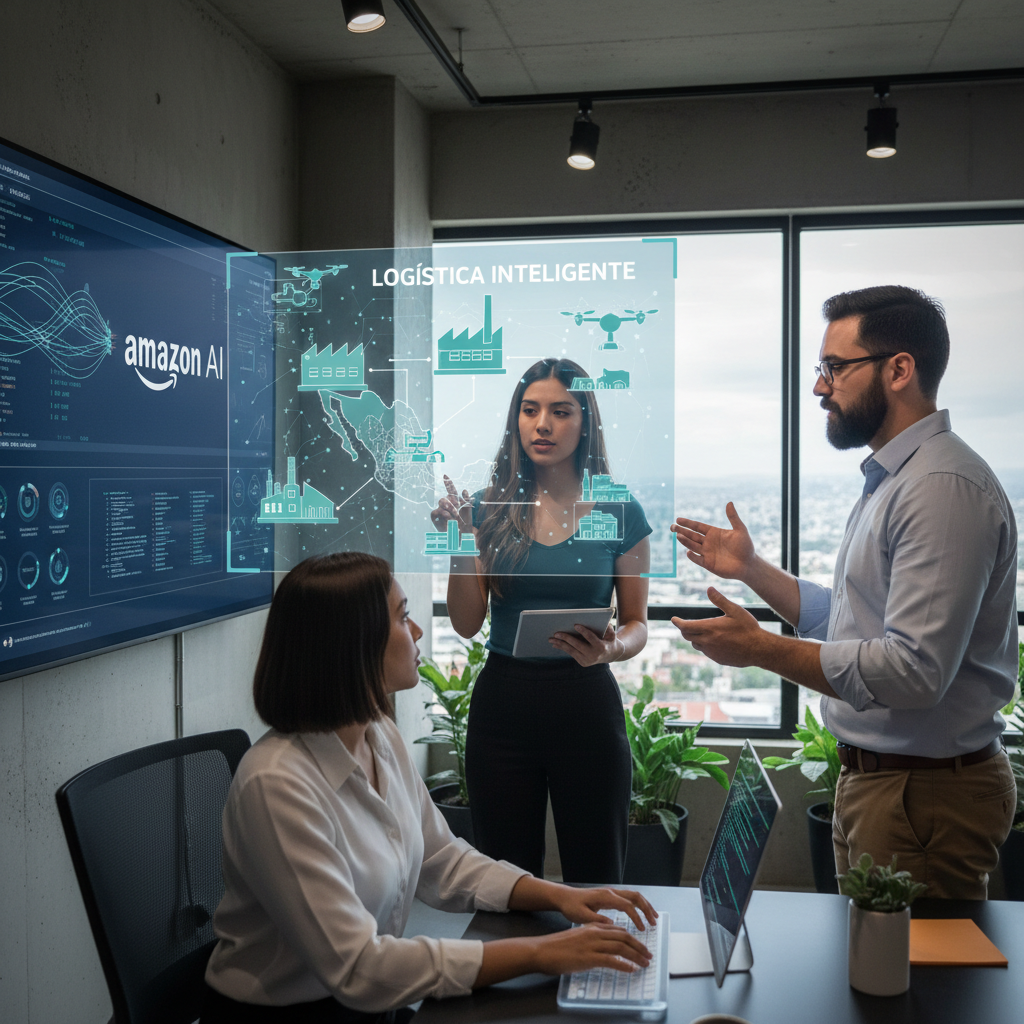
Logística Inteligente aims to level this playing field. They are developing a suite of AI-powered tools and robotic solutions specifically designed for the unique challenges of Mexican PyMEs: fragmented warehousing, complex customs processes, diverse transportation methods, and a labor force that needs to be upskilled, not replaced. Their goal is to offer an affordable, modular, and easy-to-implement system that allows businesses of all sizes to optimize their inventory, streamline their warehousing, and accelerate their last-mile delivery.
The Technology: Adaptive AI and Collaborative Robotics
At the core of Logística Inteligente's offering is their proprietary AI platform, 'Sincronía.' Unlike the monolithic systems of global giants, Sincronía is built on a modular, federated learning architecture. "We're not asking businesses to overhaul their entire operation," Ricardo clarified. "Sincronía integrates with existing ERP systems and provides intelligent recommendations for inventory placement, demand forecasting, and route optimization. It learns from each client's unique data, adapting to regional variations and seasonal demands, rather than imposing a one-size-fits-all solution." They are leveraging advanced machine learning models, including deep reinforcement learning, to predict supply chain disruptions and suggest proactive measures.
Accompanying Sincronía are their 'Cobots,' or collaborative robots. These are not the massive, fixed-arm robots found in Amazon's fulfillment centers. Instead, Logística Inteligente's Cobots are smaller, more agile autonomous mobile robots (AMRs) designed to work alongside human employees in existing warehouse layouts. They handle repetitive tasks like picking and packing, moving heavy loads, and conducting inventory scans, freeing up human workers for more complex, value-added roles. "Our Cobots are built to be affordable and easy to deploy," said Dr. Elena Vargas, Logística Inteligente's Head of Robotics Engineering. "They are designed to augment our workforce, not displace it, creating new opportunities for training and skill development." The company is also experimenting with drone technology for inventory management in larger, more complex facilities, a concept that has shown promising results in pilot programs.
Market Opportunity: A Trillion-Dollar Sector Ripe for Disruption
The logistics market in Mexico alone is estimated to be worth over 150 billion dollars annually, with significant growth potential driven by nearshoring trends and the booming e-commerce sector. The broader Latin American market dwarfs this figure. While Amazon, Mercado Libre, and other large players dominate the direct-to-consumer segment, the vast majority of business-to-business (B2B) logistics, especially for PyMEs, remains largely underserved by advanced AI and robotics. "We estimate that fewer than 10 percent of Mexican PyMEs currently utilize any form of advanced logistics automation," stated Ana María Reyes, an analyst at a leading Mexican venture capital firm, Inversiones Futuras. "Logística Inteligente is tapping into a massive, hungry market. Their focus on affordability and local integration gives them a significant edge over foreign competitors who often struggle to understand the nuances of our market."
The nearshoring phenomenon, where companies relocate production closer to their end markets, particularly from Asia to Mexico, is further fueling this demand. As more factories open and supply chains shorten, the need for efficient, agile, and AI-driven logistics solutions will only intensify. According to a recent report, Mexico is projected to attract over 40 billion dollars in new foreign direct investment related to nearshoring by 2028, much of which will require robust logistics infrastructure. This presents an unprecedented opportunity for companies like Logística Inteligente.
Competitive Landscape: David vs. Goliath, with a Mexican Twist
Logística Inteligente faces formidable competition, primarily from the in-house logistics arms of global giants like Amazon and Walmart, which have poured billions into AI and robotics. However, Ricardo argues that their approach is fundamentally different. "We are not trying to be Amazon," he asserted. "We are building a platform for everyone else. Our strength lies in our deep understanding of the local context, our flexible technology, and our commitment to empowering local businesses." Other competitors include traditional logistics providers, but many of these are slow to adopt cutting-edge AI, relying instead on legacy systems.
There are also a handful of smaller, regional tech startups entering the space, but Logística Inteligente believes its early mover advantage in collaborative robotics and its federated AI model provide a significant differentiator. They recently closed a 15 million dollar Series A funding round, led by Inversiones Futuras and a Silicon Valley-based fund, indicating strong investor confidence. "Their valuation of 80 million dollars after this round reflects the immense potential of their localized approach," noted Ana María Reyes. "They are not just selling software; they are selling a vision for a more competitive Mexico."
What's Next: Expanding the Vision, Empowering the Future
Logística Inteligente plans to use its recent funding to scale its operations across Mexico, with an initial focus on key industrial corridors like the Bajío region and the northern border states. They are also investing heavily in R&D, particularly in developing more sophisticated predictive analytics for cross-border logistics and integrating their Cobots with advanced vision systems for even greater accuracy. Ricardo envisions a future where small businesses in Oaxaca can access the same logistical efficiencies as multinational corporations, where the vibrant tapestry of Mexican commerce is supported by intelligent, equitable technology.
"Our ultimate goal is to create an ecosystem where every Mexican business, regardless of size, can thrive in the digital economy," Ricardo concluded, his eyes alight with conviction. "We want to ensure that as the world moves towards an AI-driven future, Mexico is not left behind. We are building the tools to make that future accessible, fair, and uniquely ours." This is more than just a startup; it is a movement, a testament to the power of local innovation to reshape global narratives. It is a story that truly makes me believe in the future of our patria in the age of AI. For more insights into how AI is transforming industries, you can always check out TechCrunch's AI section. We must keep asking ourselves, who benefits from these technological shifts, and how can we ensure the benefits are shared broadly, not just concentrated at the top? The answer, I believe, lies in supporting ventures like Logística Inteligente, companies that build for us.