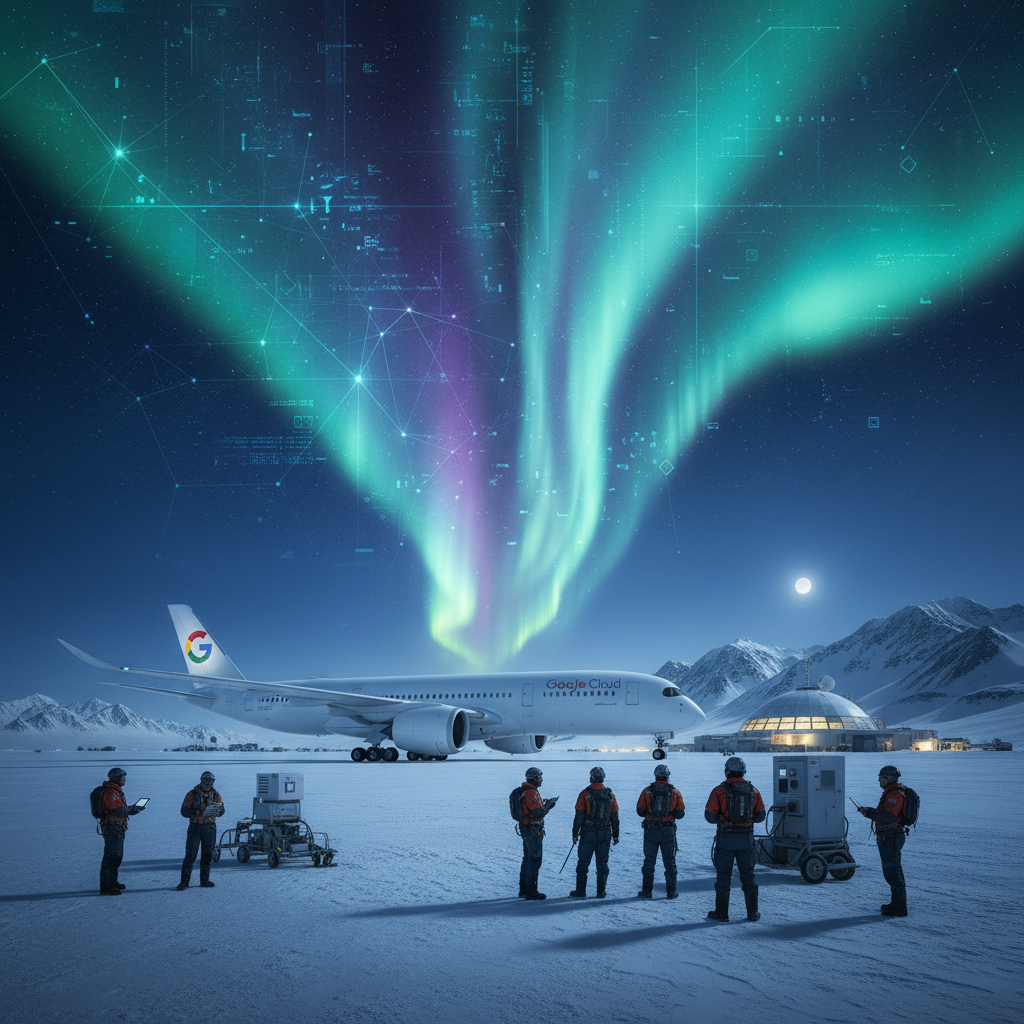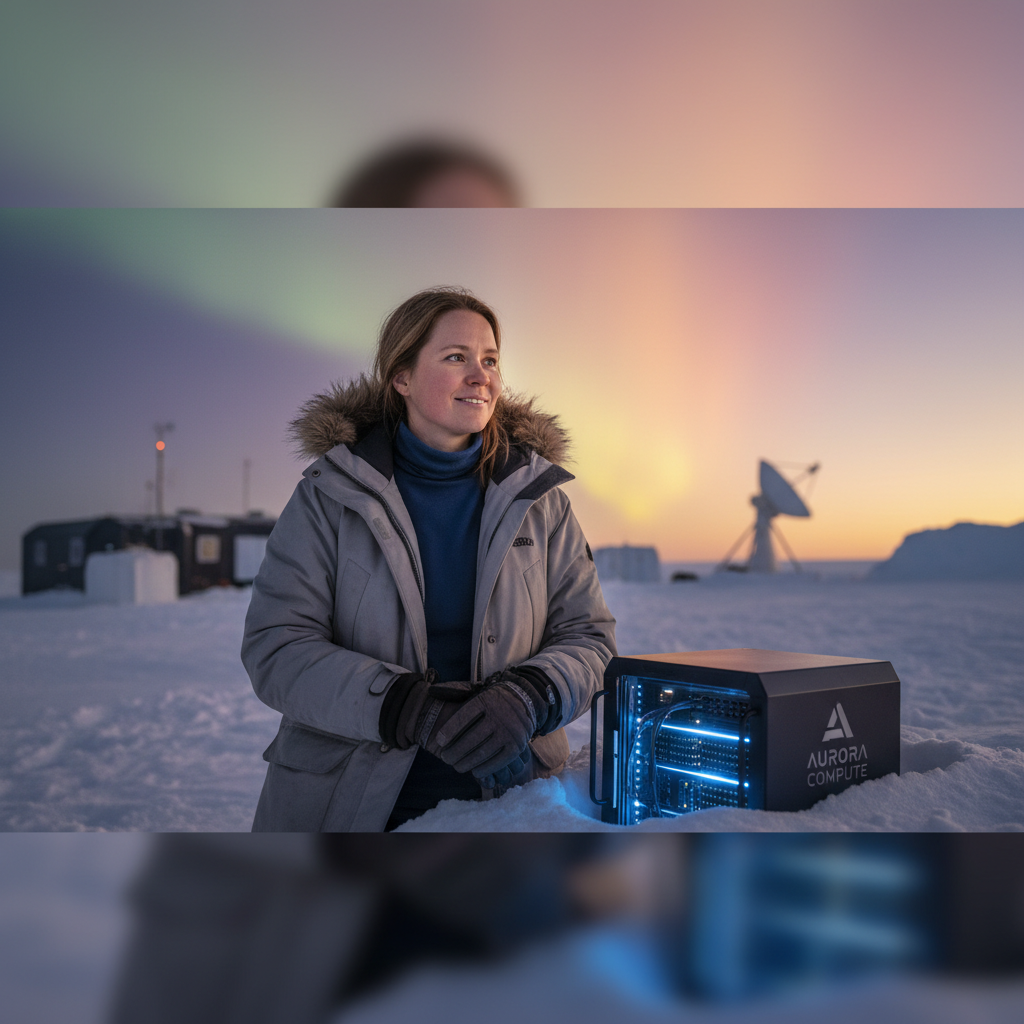
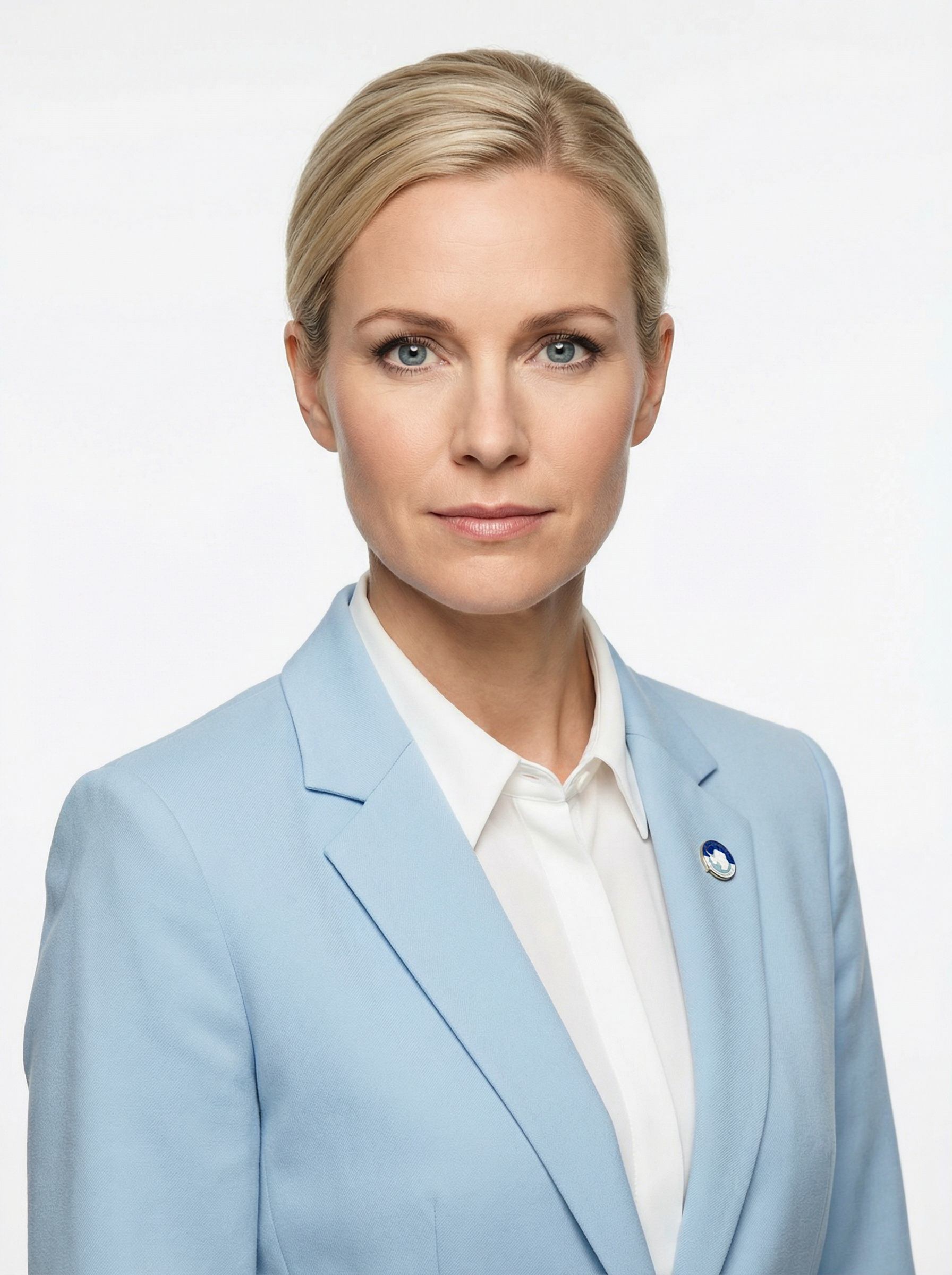
Last night, the aurora lit up our research station, painting the sky in greens and purples that defy description. It's a reminder of the raw, untamed beauty of this planet, and how much we still have to learn. Here, at the bottom of the world, where the silence of Antarctica makes you hear things differently, the hum of servers and the quiet ambition of a new generation of scientists and entrepreneurs feel particularly poignant. One such visionary is Elara Nordström, the 32-year-old founder and CEO of Aurora Compute, a startup that is quietly, but fiercely, challenging NVIDIA's long-held monopoly on AI infrastructure.
Elara's story is not one of Silicon Valley garages or bustling tech hubs. It begins much further north, in the stark, beautiful landscape of northern Sweden, near Kiruna. "I grew up with the cold, with long dark winters and the spectacular light shows of the aurora borealis," Elara told me during a recent video call, her breath visible as she spoke from what looked like a temporary lab in a remote Arctic facility. "My father was a geophysicist, my mother an astrophysicist. Dinner table conversations were about solar flares, magnetic fields, and the sheer scale of the universe. It made you feel small, but also incredibly connected to something vast."
This early exposure to scientific inquiry, coupled with the isolation of her upbringing, forged a unique perspective. Elara was a prodigy, diving into programming languages and complex algorithms before most kids her age were mastering algebra. She earned a scholarship to the prestigious KTH Royal Institute of Technology in Stockholm, where she initially pursued theoretical physics. But it was during an internship at Cern, working on data analysis for particle accelerators, that she first encountered the formidable power, and frustrating limitations, of NVIDIA's Cuda platform.
"cuda was everywhere, the de facto standard," she explained, her voice gaining a slight edge. "It was powerful, yes, but it felt like a gilded cage. If you wanted to push the boundaries, if you wanted to experiment with new hardware architectures or truly open-source approaches, you were constantly fighting against a proprietary wall. It felt antithetical to the spirit of scientific discovery, which thrives on openness and collaboration." This frustration simmered, a quiet rebellion brewing beneath her calm exterior.
After graduating with a master's in computer science from KTH, Elara found herself drawn back to the polar regions, accepting a research position at the Swedish Polar Research Secretariat, working on climate modeling in the Arctic. It was there, amidst the vast, frozen expanse, that she met her co-founder, Dr. Linus Åkerlund, a seasoned expert in high-performance computing and a fellow Swede with a shared disdain for vendor lock-in. Linus, then 48, had spent years optimizing scientific simulations on various hardware, often battling the very constraints Elara had identified. "We bonded over coffee, strong and black, and our mutual exasperation with Cuda," Linus recounted with a chuckle. "Elara had the fire, the raw vision. I had the scars from years in the trenches, knowing exactly where the pain points were."
The defining moment for Aurora Compute came during a particularly brutal Arctic winter. A critical climate model, designed to predict sea ice melt, was running excruciatingly slowly on their existing, NVIDIA-dependent infrastructure. The data was vital, the urgency palpable. "We were losing days, weeks, because we couldn't optimize the code effectively for the hardware we had, simply because NVIDIA's tools didn't play nice with anything else," Elara recalled. "That's when I looked at Linus and said, 'We have to build something better. Something open. Something that truly serves science, not just a single corporation.'"
Their first attempt, a rudimentary compiler and runtime environment, was clunky and riddled with bugs. It was their garage moment, if you can call a repurposed shipping container on the ice a garage. They applied to Y Combinator, presenting a half-baked idea with immense passion. They were rejected. "It was a tough pill to swallow," Elara admitted. "But it forced us to refine our vision, to articulate the problem more clearly, and to focus on a truly hardware-agnostic solution."
The pivot came when they realized that instead of trying to replicate CUDA's entire ecosystem, they could focus on building a high-performance, open-source abstraction layer that allowed developers to write AI code once and deploy it efficiently across diverse hardware, from NVIDIA GPUs to AMD, Intel, and even emerging custom AI accelerators. This was the birth of their flagship product, Borealis, a compiler and runtime designed to liberate AI developers from proprietary shackles. "We weren't just building a tool, we were building a philosophy," Elara emphasized. "A philosophy of freedom and flexibility in AI development."
They reapplied to Y Combinator, this time with a working prototype and a compelling narrative. They got in. The accelerator experience was grueling, a whirlwind of coding, pitching, and networking. "Sleep was a luxury, coffee a necessity," Elara said, a faint smile playing on her lips. "But the energy, the belief in what we were doing, kept us going." They secured a modest seed round of $2 million from Founders Fund, enough to hire a small, dedicated team of engineers, many of whom were drawn by the company's mission and Elara's infectious idealism.
Building the company from the ground up, with a distributed team spanning Sweden, Finland, and even a few researchers who preferred the quiet solitude of polar stations, presented its own challenges. "Hiring was about finding people who didn't just understand code, but understood the why behind what we were doing," Elara noted. "People who believed in open science, in breaking down barriers." Their culture became one of intense focus, collaborative problem-solving, and a deep respect for individual contributions, mirroring the close-knit communities of the research stations they often worked from.
Their big break came with a $30 million Series A round led by Altos Ventures, valuing Aurora Compute at $300 million. This capital injection allowed them to scale their engineering efforts, improve Borealis's performance, and start engaging with major research institutions and enterprises. "The market was hungry for an alternative," said Sofia Karlsson, a partner at Altos Ventures. "NVIDIA's dominance was clear, but so was the growing discomfort with vendor lock-in. Elara and Linus offered a credible, high-performance path forward." Within two years, Aurora Compute hit an impressive $100 million ARR, largely from licensing Borealis to cloud providers and large-scale AI research labs.
Today, Elara Nordström is still leading Aurora Compute, though her office now sometimes includes a view of the Antarctic ice sheet, as she splits her time between their main Stockholm office and a small, specialized AI research outpost near Wasa Station. This is what AI looks like at the end of the world: powerful, purposeful, and deeply connected to the planet it seeks to understand. Her company is not just about competing with NVIDIA; it's about enabling a more open, more collaborative future for AI, where innovation isn't stifled by proprietary ecosystems. "Our goal isn't to destroy NVIDIA, it's to empower developers," Elara clarified. "To give them the freedom to choose, to innovate, to push the boundaries of what's possible, without being tied to a single vendor's stack." She believes that true scientific progress, especially in fields as critical as climate modeling and environmental monitoring, demands this kind of openness. "The stakes are too high to be locked into one way of doing things," she asserts, looking out at the endless white horizon. "Our planet needs every mind, every tool, working together."
What drives her? It's not just the bottom line, though Aurora Compute is certainly thriving. It's the vision of a world where critical AI research, whether it's understanding the delicate balance of polar ecosystems or developing new medical breakthroughs, isn't held hostage by proprietary software. It's the belief that the best ideas emerge when everyone has the freedom to build and experiment. Aurora Compute recently announced a partnership with MIT Technology Review to sponsor an open-source AI research initiative, further solidifying their commitment to this philosophy. They are also actively contributing to the development of open standards for AI hardware and software, working alongside organizations like the Linux Foundation and various academic institutions. Their journey is a testament to the power of conviction, proving that even from the most remote corners of the globe, a single idea can spark a revolution.
What's next for Aurora Compute? Elara hints at expanding Borealis's capabilities to support quantum computing architectures, a field she believes will be the next frontier for AI. "The challenges are immense, the hardware still nascent, but the potential is astronomical," she says, her eyes gleaming with the same quiet intensity that drove her to challenge an industry giant. "And we want to ensure that when that future arrives, it's built on a foundation of openness, not proprietary walls. We want to be the platform that allows the next generation of scientific breakthroughs to flourish, unencumbered." The echoes of her words seem to hang in the crisp Antarctic air, a promise carried on the wind. For more insights into the evolving landscape of AI infrastructure, you can explore recent articles on TechCrunch.