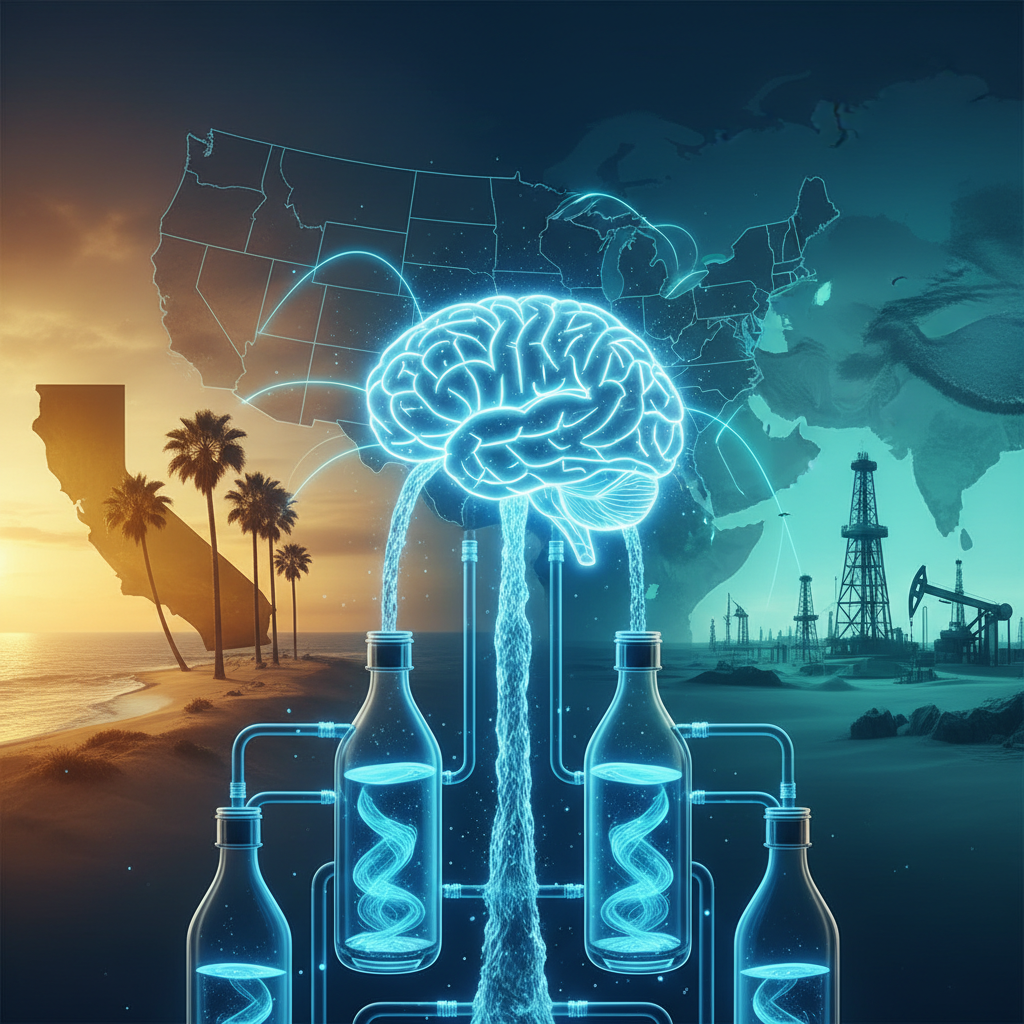

Alright, listen up folks, because I'm about to drop some knowledge that is going to make your jaw hit the floor. We're talking about water, the stuff of life, and how artificial intelligence is literally rewriting its future right before our eyes. Forget everything you thought you knew about the global water crisis. This isn't some distant problem; it's happening in our backyards, from the parched fields of California to the humid bayous of Louisiana. But here's the kicker: AI isn't just observing the problem, it's becoming our most powerful tool to solve it. This is going to change everything.
I've been crisscrossing the country, from the gleaming new desalination plants on the West Coast to the smart city initiatives in the Southwest, and let me tell you, the energy is palpable. It's like the early days of the internet, but instead of connecting people, we're connecting every drop of water to a smarter, more sustainable future. We're not just talking about fancy algorithms; we're talking about real, tangible solutions that are making a difference today.
The Big Picture: Quenching a Thirsty Planet, One AI-Powered Drop at a Time
So, what exactly are we trying to do here? Simple: ensure everyone has access to clean, fresh water. The global water crisis is a beast with many heads: climate change bringing droughts and floods, aging infrastructure leaking precious resources, and a booming population demanding more every single day. In the USA, we see it acutely. Think about the Colorado River basin, a lifeline for millions, shrinking year after year. Or the ancient pipes under our cities, wasting billions of gallons annually. It's a complex puzzle, but AI is providing the missing pieces.
At its core, AI is helping us in three major ways: making saltwater drinkable through advanced desalination, conserving every single drop we have, and building smarter, more resilient water infrastructure. It's about taking overwhelming data, from satellite imagery of snowpacks to real-time sensor readings in pipes, and turning it into actionable intelligence. It's like giving our water systems a super-brain.
The Building Blocks: What Makes This AI Magic Happen?
To understand how AI is doing this, let's break it down into its core components. It's not one giant, mysterious AI, but a collection of specialized tools working together:
- Sensors and IoT Devices: These are the eyes and ears of the system. Imagine tiny sensors embedded in water pipes, smart meters on homes, weather stations, and even drones flying over reservoirs. They collect massive amounts of data about water flow, pressure, quality, soil moisture, and weather patterns. Think of them as the nervous system of our water network.
- Machine Learning Algorithms: This is the brainpower. These algorithms, often deep learning models, analyze the sensor data. They can identify patterns, predict future events (like drought severity or pipe bursts), and optimize processes. For example, a neural network might learn to predict when a specific pump will fail based on its operational history and current conditions.
- Data Analytics Platforms: These are the central hubs where all that raw data is collected, processed, and visualized. They turn complex numbers into easy-to-understand dashboards and alerts for human operators. Companies like IBM and Google Cloud offer services that are becoming critical for managing these vast datasets.
- Control Systems and Actuators: Once the AI makes a decision, these components execute it. This could mean automatically adjusting pump speeds in a desalination plant, rerouting water flow to reduce pressure on a leaky pipe, or even sending an alert to a farmer's smartphone to adjust irrigation schedules.
"The sheer volume of data involved in water management was once our biggest hurdle," explains Dr. Elena Rodriguez, lead AI scientist at AquaSense Technologies in San Jose, California. "Now, with advanced machine learning, that data is our greatest asset. We're seeing efficiency gains that were unimaginable just five years ago." She's not wrong, I saw it with my own eyes.
Step by Step: How AI Transforms Water Management
Let's walk through a typical scenario, say, optimizing a modern desalination plant, one of those marvels turning ocean water into drinking water. These plants are energy hogs, so efficiency is everything.
- Input Data Collection: Sensors monitor everything: seawater salinity, temperature, energy consumption of pumps, membrane performance, water quality at various stages, and even electricity prices from the grid. Weather forecasts and tidal data are also fed in.
- Real-time Analysis: AI models continuously process this torrent of data. They look for anomalies in membrane performance, predict energy demand based on output targets and grid prices, and forecast future seawater conditions.
- Predictive Optimization: Based on its analysis, the AI predicts the most efficient operating parameters. For instance, it might determine that running the high-pressure pumps at 92% capacity for the next three hours, then dropping to 88% for two hours, will produce the required water volume at the lowest energy cost, considering current electricity tariffs and membrane degradation rates.
- Automated Adjustments: The AI sends commands to the plant's control systems. Pump speeds are adjusted, chemical dosages are fine-tuned, and membrane cleaning cycles are scheduled proactively, all without human intervention, or at least with minimal oversight. This isn't just about saving money; it's about extending the life of expensive equipment and ensuring consistent water quality.
- Continuous Learning: The AI constantly learns from the outcomes of its decisions. Did a particular adjustment lead to better efficiency? Was a prediction accurate? This feedback loop allows the models to improve over time, becoming even smarter and more precise.
It's like a finely tuned orchestra, with AI as the conductor, ensuring every instrument plays its part perfectly to create the most harmonious, and in this case, efficient, water production possible.
A Worked Example: Saving Every Drop in the Desert
Let's switch gears to conservation, a huge deal in places like Arizona and Nevada. Imagine a sprawling agricultural area in the Central Valley of California, where every drop of water is gold. Traditionally, farmers would irrigate based on a schedule or visual inspection.
Now, with AI, it's a whole new ballgame. Soil moisture sensors are buried in the fields, drones equipped with hyperspectral cameras fly overhead, and local weather stations provide hyper-localized forecasts. All this data streams into an AI platform.
The AI analyzes the soil moisture levels, the crop's growth stage (identified by the drone imagery), the evapotranspiration rates predicted by the weather model, and even the current price of water. It then calculates the exact amount of water each section of the field needs, down to the millimeter. It can even predict when a specific crop will be most receptive to water, minimizing runoff and evaporation.
"We've seen farmers reduce water usage by up to 30% in pilot programs, while actually improving crop yields," says Michael Chen, CEO of Agri-Water Solutions, a startup based out of Phoenix. "That's not just saving water; that's saving livelihoods and ensuring food security for the region." That's a game changer, folks. This isn't just theory, it's happening right now, making a real impact on our food supply and our environment.
Why It Sometimes Fails: The Bumps in the Road
Now, I'm an optimist, but I'm also a realist. AI isn't a magic bullet. There are challenges. Data quality is a big one. "Garbage in, garbage out" is a real threat. If sensors are faulty or data streams are incomplete, the AI's decisions will be flawed. Cybersecurity is another massive concern. Imagine a malicious actor gaining control of a city's water infrastructure. That's a terrifying thought, and it's why robust security protocols are non-negotiable.
Then there's the human element. Integrating AI into existing, often decades-old, infrastructure requires significant investment and a workforce trained in new skills. Not everyone is ready to trust a machine with something as vital as their water supply. Education and transparency are key to building that trust.
According to a recent report by MIT Technology Review, the initial investment for AI-powered water infrastructure can be substantial, often in the tens of millions for a medium-sized city, but the long-term savings in water, energy, and maintenance can be even greater, sometimes reaching 5-10% annually.
Where This is Heading: The Future is Flowing
So, what's next? The future is looking incredibly bright, and honestly, I'm buzzing with excitement. We're going to see even more sophisticated AI models, capable of integrating even wider arrays of data, from seismic activity to social media sentiment (yes, really, to gauge public perception during water crises). Digital twins, virtual replicas of entire water systems, will become common, allowing engineers to simulate scenarios and test AI strategies without risking real-world infrastructure.
We'll also see more decentralized AI, with edge computing devices making intelligent decisions right where the data is collected, reducing latency and increasing responsiveness. Imagine a smart pump in a remote area fixing itself before a major breakdown, all thanks to local AI. This is the kind of stuff that makes me jump out of bed in the morning!
This isn't just about technology; it's about building a sustainable future for our communities, for our kids, and for generations to come. From the bustling streets of New York City to the quiet farmlands of Kansas, AI is empowering us to manage our most precious resource with unprecedented intelligence and efficiency. You need to pay attention to this, because it's not just a technological revolution; it's a lifeline for our planet. And frankly, it's one of the most exciting stories unfolding in the USA today. We're not just hoping for a better water future; we're building it, one intelligent decision at a time.