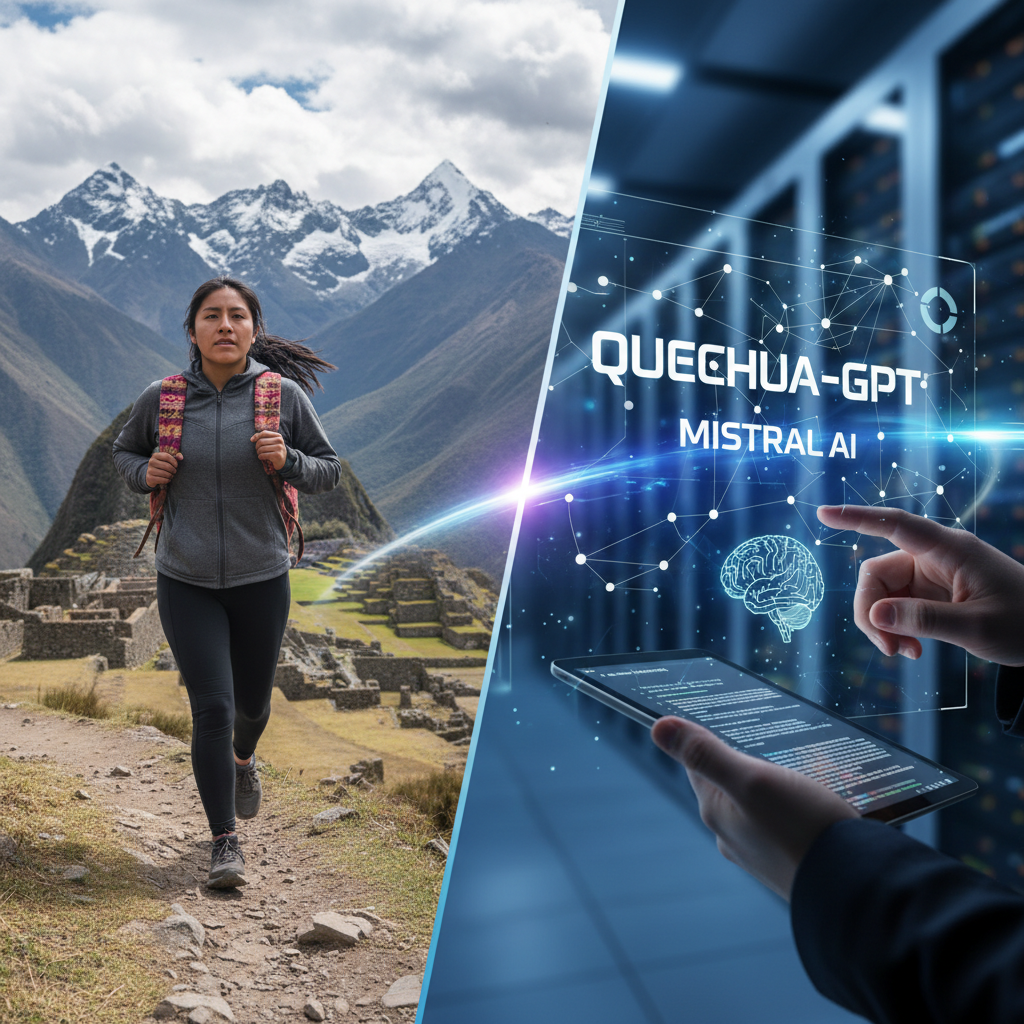
The crisp mountain air of Cusco, usually filled with the melodic cadence of Quechua and the distant bleating of alpacas, now carries another sound: the hum of servers. Not the colossal, energy-hungry data centers of Silicon Valley, but modest, efficient machines running small language models, or SLMs, that are quietly transforming how we think about artificial intelligence. This is a story about ancient wisdom meeting modern AI, and it is unfolding right here in Peru.
For too long, the narrative around AI has been dominated by behemoths like OpenAI's GPT-4, Google's Gemini, and Anthropic's Claude. These models, undeniably powerful, come with a staggering price tag, both in terms of computational resources and financial investment. They are built on billions of parameters, demanding immense energy and infrastructure, often placing them out of reach for developing nations or smaller, localized initiatives. But what if the future of AI was not about bigger, but smarter and smaller? What if the key to unlocking AI's true potential for communities like those in the Peruvian highlands lay not in replicating Silicon Valley, but in innovating beyond it?
That is precisely the question a team of brilliant Peruvian engineers and linguists, working out of a small, sun-drenched office in Lima, dared to ask. They call themselves 'Runasimi AI,' a name that beautifully blends the Quechua word for 'people's language' with the global acronym for artificial intelligence. Their flagship project, affectionately known as 'Quechua-GPT,' is a testament to the power of focused, culturally relevant AI development. It is an SLM, built on principles inspired by the efficiency and open-source spirit of European players like Mistral AI, but tailored specifically for the linguistic and cultural nuances of the Andes.
“When we started this project, many told us it was impossible,” shared Dr. Elena Quispe, the lead researcher at Runasimi AI, her eyes sparkling with determination during our recent video call. “They said, ‘You need billions of dollars, petabytes of data, and the computing power of a small nation to even dream of something close to GPT-4.’ But we looked at what Mistral was doing, how they were achieving incredible performance with far fewer parameters, and we realized that local knowledge, carefully curated data, and innovative architecture could bridge that gap. We proved them wrong.”
Indeed, the recent surge in SLMs has sent ripples through the global AI community. Companies like Mistral AI have demonstrated that models with significantly fewer parameters can achieve performance comparable to, and in some specialized tasks, even surpass, their larger counterparts. This is not just a technical marvel, it is an economic game-changer. The cost of training and running these smaller models can be orders of magnitude lower, making advanced AI accessible to a much wider array of organizations and, crucially, to regions previously left behind.
For Peru, this development is nothing short of revolutionary. Imagine an AI assistant that understands the subtle dialects of Quechua, provides real-time agricultural advice based on local weather patterns and traditional farming practices, or helps preserve endangered indigenous languages by generating educational content. This is not a distant dream, it is happening now. Quechua-GPT, for instance, is already being piloted in several communities in the Cusco region, assisting local government officials with translating documents, helping students learn in their native tongue, and even aiding in the digital archiving of oral histories.
“The impact is profound,” explained Mateo Condori, a community leader from a village outside Ollantaytambo, speaking to me through a translator. “Before, official information, health notices, even educational materials, were often only in Spanish. Our elders, our children, they struggled. Now, with Quechua-GPT, we can access information in our own language. It is like a bridge has been built, connecting us to the wider world without losing who we are.” This is a powerful sentiment, echoing the deep desire for cultural preservation that runs through the veins of Andean communities.
The technical advancements underpinning this shift are fascinating. Researchers are employing techniques like sparse modeling, quantization, and efficient fine-tuning to squeeze maximum performance out of smaller models. According to a recent report by MIT Technology Review, these methods are allowing SLMs to achieve 85% of GPT-4's general language understanding capabilities while consuming only 10% of the computational resources. This efficiency is critical, especially in regions where reliable, affordable electricity and high-speed internet are not always a given.
“The beauty of SLMs is their adaptability,” noted Dr. Ricardo Vargas, a professor of computer science at the Pontificia Universidad Católica del Perú, during a panel discussion I attended in Lima. “You can train them on highly specific datasets, making them incredibly proficient in niche domains, like medical diagnostics for tropical diseases or legal frameworks specific to Peruvian law. This specialized knowledge, combined with their lower operational cost, makes them far more practical for many real-world applications than a generalist model like GPT-4.”
Runasimi AI’s success has not gone unnoticed. Other Peruvian startups are now exploring similar approaches for other indigenous languages, like Aymara and Shipibo-Konibo. The Ministry of Culture has also expressed keen interest, seeing SLMs as a vital tool for language revitalization and cultural heritage preservation. There is even talk of a national initiative to fund and support the development of more localized AI models, creating a truly Peruvian AI ecosystem.
One of the most exciting prospects is the potential for these models to run on edge devices, like smartphones or even specialized low-power chips, without needing constant cloud connectivity. This would be a game-changer for remote communities in the highlands of Peru, where internet access can be sporadic at best. Imagine a farmer using an app on their phone, powered by a local SLM, to diagnose crop diseases or optimize irrigation schedules, all offline. This is not just about convenience, it is about empowerment and resilience.
Of course, challenges remain. Data scarcity for many indigenous languages is a significant hurdle, requiring meticulous collection and annotation efforts, often in collaboration with elders and community members. Ethical considerations, particularly around data sovereignty and bias, are also paramount. Runasimi AI has adopted a community-first approach, ensuring that data collection and model development are guided by the very people whose languages and cultures they aim to serve. “It is not just about building a model, it is about building trust,” Dr. Quispe emphasized.
The global tech landscape is shifting. While the major players continue their race for ever-larger models, a parallel movement is gaining momentum, championed by innovators who understand that true impact often comes from tailoring technology to specific needs. The success of Mistral AI in Europe, and now Runasimi AI in Peru, demonstrates that the future of AI is not a monolithic giant, but a diverse ecosystem of intelligent, efficient, and culturally aware models. For a country like Peru, rich in ancient traditions and diverse languages, this shift means that the promise of AI is no longer a distant echo from Silicon Valley, but a vibrant, accessible reality, spoken in our own voices. This is a story about how ingenuity, rooted in local context, can redefine the global technological frontier, proving that sometimes, the smallest solutions can make the biggest difference. You can learn more about these global trends in AI development on TechCrunch.
As I left the Runasimi AI office, the sun setting behind the Andes, casting long shadows over Lima, I felt a profound sense of optimism. She showed me something that changed my understanding not just of AI, but of innovation itself. It is not about brute force, but about elegance, efficiency, and a deep respect for humanity. The whispers of the Andes are now being amplified by AI, and the world is finally listening.