
The sun rises over the lush valleys of Raiatea, painting the sky in hues of orange and pink, a sight that never ceases to fill my heart with gratitude. Here, amidst the fragrant vanilla plantations and the rich soil where taro and breadfruit thrive, a quiet revolution is taking root. It is not a revolution of political upheaval or social unrest, but one of technology, a gentle yet powerful shift brought by artificial intelligence into the very heart of our agricultural traditions.
For generations, farming in French Polynesia has been a dance with nature, guided by ancestral knowledge and the rhythm of the seasons. Our farmers, with their hands in the earth and eyes on the skies, have nurtured our land, providing sustenance and cultural heritage. But the world is changing, and our islands, while beautiful, are not immune to its challenges. Climate change brings unpredictable weather patterns, pests are becoming more resilient, and the need for sustainable practices grows more urgent each day. This is where AI steps in, not to replace our traditions, but to empower them, to give our farmers new tools to face an uncertain future.
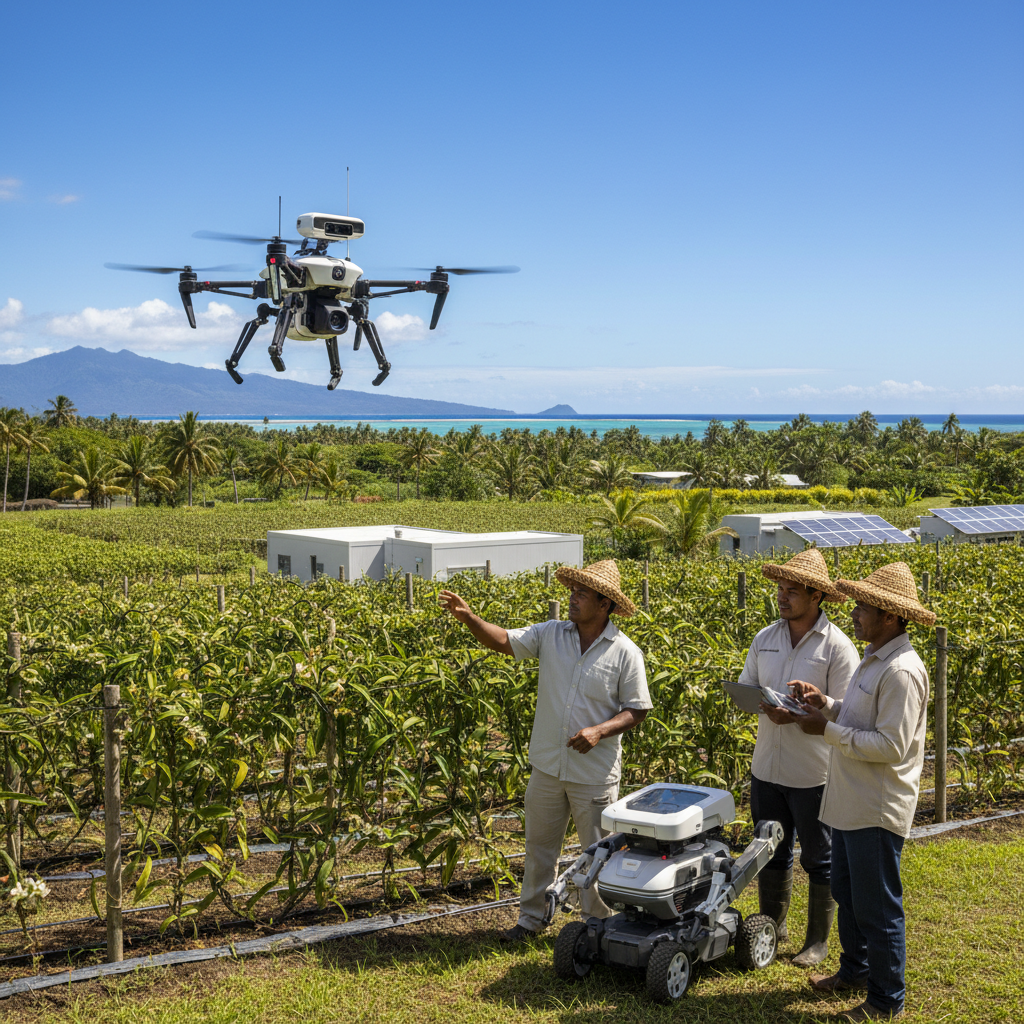
I recently visited a vanilla farm on Raiatea, where the air was thick with the sweet, intoxicating scent of orchids. Here, a pilot program, supported by Google's agricultural technology division, is deploying AI-powered drones and ground sensors. These aren't just fancy gadgets; they are becoming essential eyes and ears for the farmers. The drones, equipped with multispectral cameras, fly over the vanilla vines, collecting data that reveals the health of each plant. Are there signs of disease before they become visible to the human eye? Is a particular section of the field experiencing nutrient deficiency? The AI analyzes this imagery, providing precise, actionable insights.
“It’s like having a hundred extra pairs of eyes, all seeing things I might miss,” explained Teiki Mana, a third-generation vanilla farmer, his face weathered by years under the tropical sun. “Before, if a disease started, it could spread quickly. Now, the drone tells me exactly where to look, sometimes days before I would have noticed it myself. It saves my crop, it saves my time, and it saves my family’s livelihood.”
This kind of precision farming is a game-changer for high-value crops like Tahitian vanilla, which commands premium prices globally. The AI models, trained on local soil data and climate patterns, can even predict optimal harvest times, ensuring the beans are picked at their peak ripeness, maximizing their quality and market value. This is a story about paradise and pixels, where cutting-edge technology enhances, rather than diminishes, our natural treasures.
Beyond vanilla, similar initiatives are being explored for other staple crops. On Tahiti, researchers at the University of French Polynesia are collaborating with local agricultural cooperatives to use AI for taro cultivation. Taro, or talo as we call it, is a cornerstone of our diet and culture. Ensuring its robust growth is vital. Here, AI-driven sensors monitor soil moisture, pH levels, and nutrient content in real-time. This data is then fed into predictive models that advise farmers on precise irrigation schedules and fertilizer application, reducing waste and optimizing yields. It is a stark contrast to the traditional methods, which, while rich in wisdom, sometimes lacked the granular data needed for modern challenges.
“The ocean connects us and so does AI, bridging the gap between ancient practices and future needs,” remarked Dr. Hina Tevane, an agricultural scientist leading one of these projects. She emphasized the importance of tailoring these technologies to our unique island ecosystems. “We cannot simply import solutions from large continental farms. Our soil, our climate, our crops, they are all distinct. The AI models must learn from our land, from our people.” Her team is working on developing localized AI algorithms that understand the nuances of Polynesian agriculture, ensuring the technology serves our specific needs and preserves our biodiversity.
Globally, the trend of AI in agriculture is accelerating. Companies like John Deere are integrating AI into their machinery for autonomous planting and harvesting, while startups such as Aerobotics, based in South Africa, are using drone imagery and machine learning to help fruit farmers detect pests and diseases. According to a report by Reuters, the global AI in agriculture market is projected to reach over $4 billion by 2028, driven by the increasing demand for food security and sustainable farming practices. This growth is not just about big commercial farms; it is increasingly about empowering smallholder farmers, like those in our islands, to compete and thrive.
However, the adoption of such advanced technology in remote island communities is not without its hurdles. Connectivity remains a significant challenge. While satellite internet initiatives are improving, stable, high-speed internet is still a luxury in many of our outer islands. Training farmers, many of whom have limited exposure to digital tools, is another crucial step. The success of these programs hinges on making the technology accessible, intuitive, and truly beneficial to those who work the land.
“It’s about trust, you know,” Teiki Mana shared, gesturing towards his vanilla vines. “Trusting this new way, trusting the data. But when you see the results, when your crop is healthier, when you waste less water, it makes you believe.” He spoke of community workshops where Google representatives and local tech experts demonstrated the drone operations and sensor data, breaking down complex information into understandable terms, often in Tahitian. This human-centered approach is vital for successful integration.
In the Pacific, technology takes a different form. It is not just about efficiency or profit; it is about resilience, about preserving our way of life, and about ensuring food security for future generations. The AI tools are not replacing the wisdom of our elders, but rather augmenting it, providing a new layer of insight that respects and builds upon centuries of knowledge. Our islands are small, but our ambitions are vast, and with the intelligent hand of AI, our agricultural future looks brighter, more sustainable, and deeply rooted in both tradition and innovation.
For more insights into how technology is reshaping agriculture, you might find this article on MIT Technology Review interesting, exploring broader trends in agritech. The journey of AI in our fields is just beginning, and I, for one, am excited to see what new harvests it brings to our beautiful Fenua.
To learn more about the broader impact of AI on global food systems, you can explore articles on TechCrunch that cover agricultural startups and innovations. This blend of ancient wisdom and modern algorithms is truly a testament to our islands' spirit of adaptation and ingenuity.