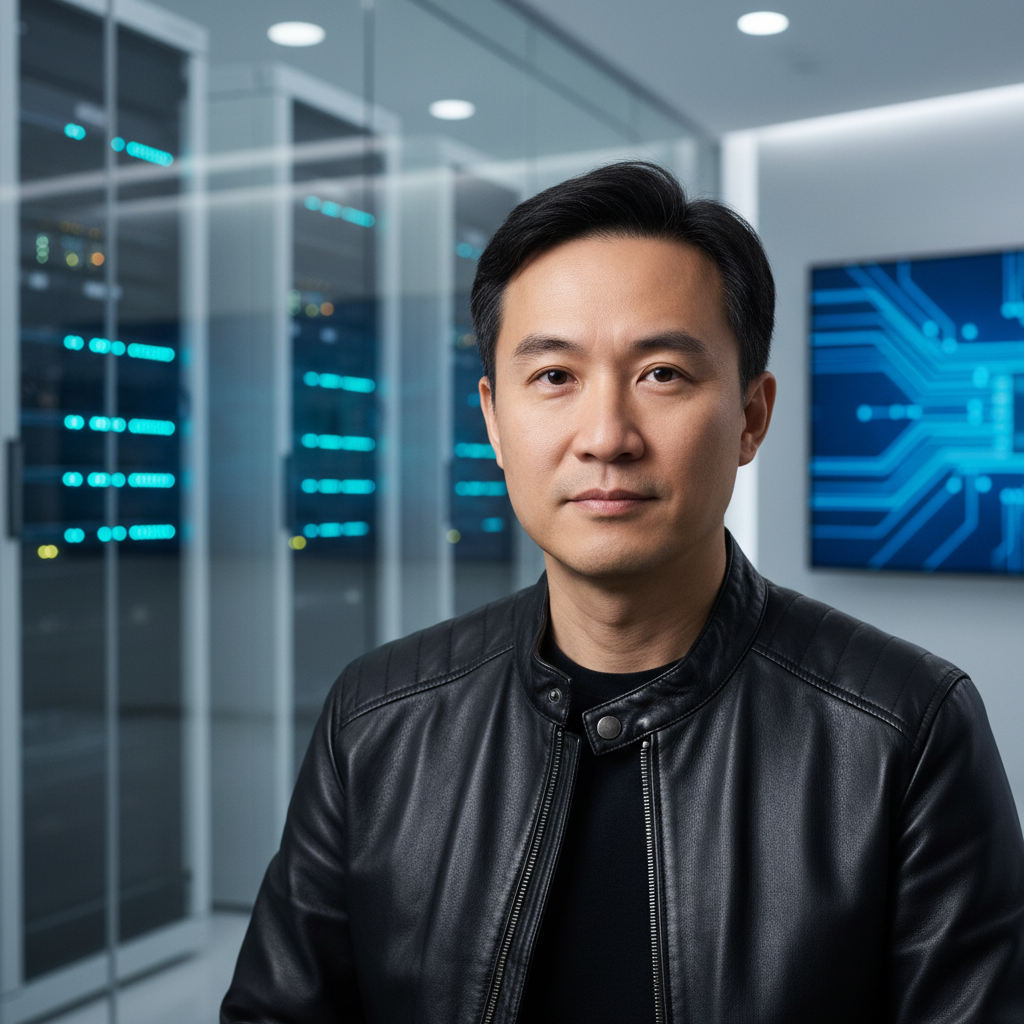

Man, let me tell you, the energy in Silicon Valley right now is absolutely electric. It's April 2026, and you can practically taste the innovation in the air, like a fresh batch of sourdough from a San Francisco bakery. Everyone's talking about AI, of course, but beneath the surface, there's this buzzing conversation about where all this incredible tech actually comes from. We're not just talking about lines of code anymore, folks, we're talking about the physical stuff, the chips, the hardware, the very foundations of our digital future.
I recently had the incredible opportunity to sit down with Dr. Evelyn Reed, the dynamic CEO of 'Forge AI Solutions,' a rising star in the American semiconductor landscape. Her company, based right here in the heart of California, is doing some truly groundbreaking work, pushing the boundaries of what's possible for domestic chip manufacturing. We met at her sleek, minimalist office in Santa Clara, the kind of place where the whiteboard walls are covered in complex equations and the coffee machine brews artisanal single-origin beans. Dr. Reed, with her sharp, analytical gaze and an infectious enthusiasm that rivaled my own, greeted me with a firm handshake. She was wearing a perfectly tailored blazer, but her eyes held the spark of a true innovator, someone who lives and breathes the future.
“Dontè, it’s a pleasure,” she said, her voice clear and confident, as she gestured towards a comfortable seating area overlooking a bustling research lab. “We’re at a pivotal moment, aren’t we? The global tech landscape is shifting faster than a Tesla on Ludicrous Mode, and the implications for consumer AI are immense.”
I nodded, already buzzing. “Absolutely, Dr. Reed. Everyone’s talking about the geopolitical chess game, the trade tensions, the push for ‘decoupling.’ But what does that really mean for the everyday person, for the AI apps we’re all falling in love with?”
She leaned forward, a slight smile playing on her lips. “It means resilience, Dontè. It means opportunity. For years, the tech supply chain was optimized for efficiency and cost, often leading to heavy reliance on a few key regions. The pandemic, and then the escalating trade discussions, highlighted the vulnerabilities in that model. Suddenly, everyone from NVIDIA to Apple realized that having all your eggs in one basket, especially when that basket is thousands of miles away, isn’t just a risk, it’s a strategic liability.”
Her company, Forge AI Solutions, is at the forefront of what she calls the 'reshoring revolution' for semiconductors. “We’re not just talking about assembling components here,” she explained, her hand sweeping towards the lab. “We’re talking about designing, fabricating, and packaging advanced AI chips right here in the USA. We’ve secured significant funding, including a recent $500 million investment from a consortium led by Intel Capital, to scale our next-gen 3nm process. This isn’t just about making chips, it’s about rebuilding an entire ecosystem.”
This is where it gets really exciting for us, the consumers. Dr. Reed explained that a more localized and diversified supply chain means greater innovation and security for the AI products we use daily. “Imagine your next smartphone, powered by a chip designed and manufactured entirely within a secure, transparent supply chain,” she elaborated. “Or your smart home devices, your autonomous vehicles, your personal AI assistants like Google’s Gemini or OpenAI’s GPT models, all running on hardware with guaranteed provenance and built to the highest security standards. That’s the future we’re building.”
I asked her about the challenges, because let’s be real, nothing this big comes easy. “The talent gap is real, Dontè,” she admitted, her expression turning more serious. “We need more skilled engineers, more technicians, more researchers. That’s why we’re partnering with universities like Stanford and MIT, investing heavily in Stem education from high school upwards. We’re also seeing a huge influx of talent from other sectors, people who are excited to be part of something truly transformative.” She paused, then added, “It’s a national imperative, not just a business venture.”
One of the most surprising moments came when she started talking about the environmental impact. “People often think of manufacturing as dirty, but modern fabs are incredibly advanced,” she said. “We’re implementing cutting-edge water recycling systems, renewable energy sources, and sustainable material sourcing. Our goal isn’t just to build chips, it’s to build them responsibly. We project a 40% reduction in carbon footprint compared to older overseas facilities, thanks to our new processes and local energy grids.” That’s a game-changer, right? Tech that’s good for your gadgets and the planet.
“So, what does this mean for the big players, for the NVIDIAs and Apples of the world?” I pressed, thinking about Jensen Huang's recent emphasis on diversified manufacturing. “Are they really on board with this shift?”
“Absolutely,” she affirmed. “Companies like NVIDIA, who are at the very heart of the AI revolution with their GPUs, understand the strategic importance of supply chain resilience better than anyone. Jensen Huang himself has been a vocal advocate for strengthening domestic manufacturing capabilities. They’re not just buying chips, they’re investing in the future of where those chips are made. They want to ensure a stable, secure, and innovative source for the foundational technology that powers their AI models and platforms. It’s a collective effort. We’re seeing more partnerships, more cross-industry collaboration than ever before.”
She painted a vivid picture of a future where AI innovation isn't just about software, but about a robust, geographically diverse hardware foundation. “Imagine a scenario where a new breakthrough in AI, say a quantum computing chip from Google or a revolutionary new sensor from Meta, can go from concept to mass production right here, without the delays and risks associated with distant supply lines. That acceleration of innovation, that speed to market, that’s what we’re unlocking.”
This is going to change everything, not just for the tech giants, but for every startup, every developer, and every consumer who relies on AI. The ability to iterate faster, to secure supply, and to integrate cutting-edge hardware directly into new AI products means we’re going to see an explosion of creativity and capability. Think about how much faster your smart devices could learn, how much more seamlessly your AI assistants could operate, how much more powerful your gaming experiences could become. The Verge has been covering the consumer AI boom, and this domestic chip push is the engine under the hood.
As our conversation wound down, Dr. Reed’s vision became even clearer. “My ultimate goal, Dontè, is for ‘Made in USA’ to not just be a label, but a hallmark of unparalleled quality, security, and innovation in the AI hardware space. We want to be the preferred partner for every company pushing the boundaries of AI, from autonomous vehicles to personalized medicine. We want to ensure that the American spirit of ingenuity continues to drive the global technological frontier.”
I left her office feeling absolutely invigorated. We often focus on the algorithms, the models, the software. But Dr. Evelyn Reed reminded me that the physical world, the chips and circuits, are just as crucial. The global economic shifts and trade dynamics, while complex, are pushing us towards a more resilient, more innovative future right here at home. This isn't just about politics or economics; it's about laying the groundwork for the next generation of AI experiences that will blow our minds. I just saw the future, and it's incredible, built on silicon, right here in the good ol' USA. For more insights into the broader tech industry shifts, check out Reuters' technology section. And if you're curious about the academic side of this, MIT Technology Review often has deep dives into semiconductor research and policy.```