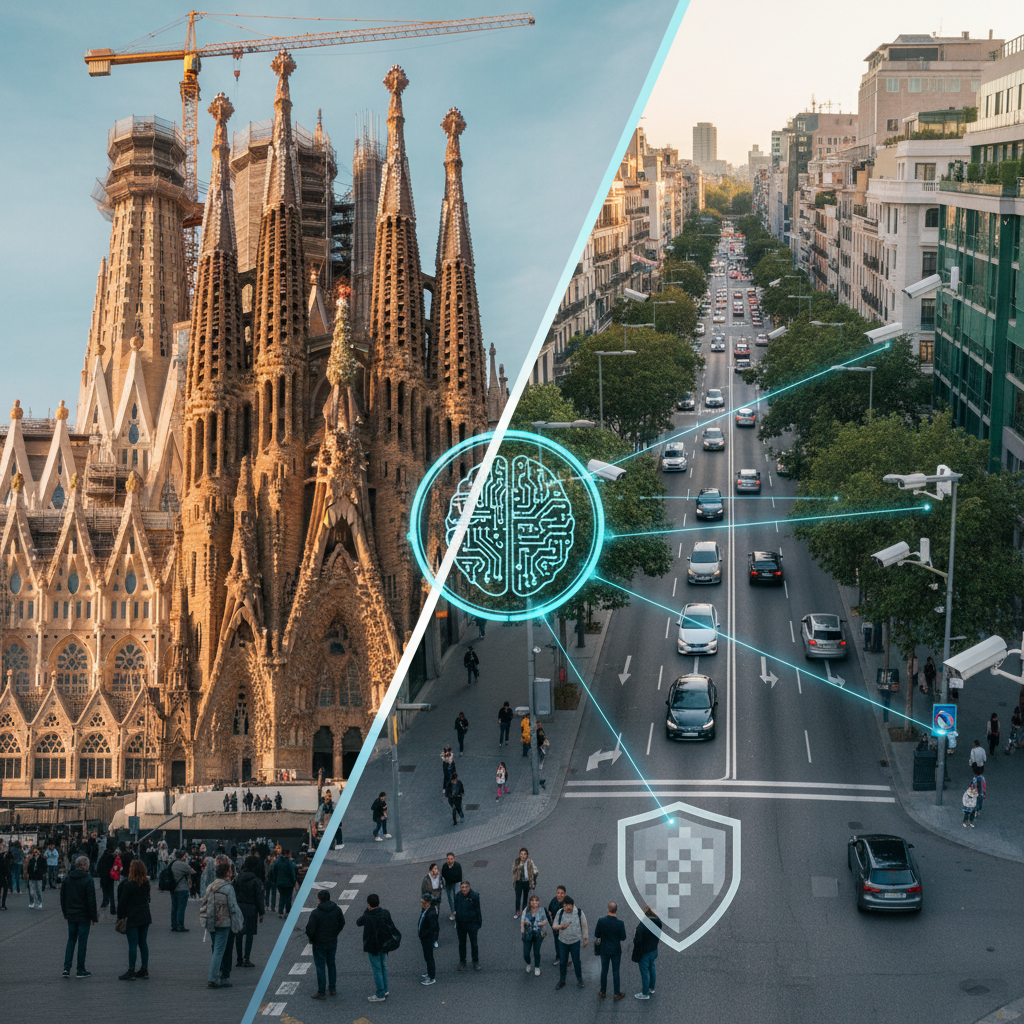

¡Hola, amigos! Marisolò Garcíà here, and let me tell you, the air in Spain, from the bustling plazas of Madrid to the sun-drenched alleys of Seville, is absolutely electric with talk of the future. We are not just dreaming of smart cities anymore; we are building them, brick by digital brick, and it is truly a sight to behold. But as we embrace these incredible advancements, particularly in AI-powered surveillance, a very Spanish question arises: can we have our jamón and eat it too, meaning safety and privacy, all at once?
It is April 2026, and the conversation around AI in urban spaces has reached a fever pitch. We are seeing cities across Europe, and indeed the world, deploying sophisticated camera systems, facial recognition software, and predictive analytics to enhance public safety, manage traffic, and even optimize waste collection. The promises are grand: reduced crime rates, faster emergency response, and a more efficient urban experience. Who would not want that, right? But here in Spain, where personal liberty and the joy of spontaneous public life are woven into our very DNA, the implications of constant digital watchfulness hit a little differently.
Take Barcelona, for instance. Barcelona is buzzing with innovation, a true Mediterranean tech hub. The city has been a pioneer in smart city initiatives for years, from intelligent street lighting to sensor-laden public transport. Now, with the latest generation of AI, we are talking about systems that can identify unusual behavior in crowds, detect abandoned packages, or even track individuals of interest in real-time across vast networks of cameras. "The potential for preventing crime and responding to emergencies is simply transformative," explains Dr. Elena Ramos, head of urban intelligence at the Barcelona Institute of Technology. "We are moving from reactive policing to proactive prevention, and AI is the engine driving this change. Imagine a world where a lost child is found in minutes, or a potential threat is neutralized before it escalates. This is the promise we are working towards."
However, this promise comes with a hefty asterisk, a question mark as big as the Sagrada Familia itself. For every person who feels safer with more cameras, there is another who feels less free. "Our public spaces are for everyone, for expression, for gathering, for simply being," says Javier Torres, a prominent civil liberties advocate based in Madrid. "When every step, every face, every interaction is potentially being recorded and analyzed by an algorithm, it fundamentally changes the nature of public life. It is not just about catching criminals; it is about the chilling effect on dissent, on anonymity, on the very spirit of our democratic society." Torres and his organization, Libertad Digital, have been vocal critics, pushing for stronger regulatory frameworks and greater transparency.
Indeed, Spain's AI moment has arrived, but it is arriving with a healthy dose of Mediterranean skepticism and a robust debate. The European Union, with its strong emphasis on data protection and human rights, is at the forefront of regulating AI. The EU AI Act, which is now in full swing, categorizes AI systems by risk level, placing strict requirements on high-risk applications like biometric identification in public spaces. This means that any city in Spain deploying such systems must adhere to rigorous standards for data protection, human oversight, and transparency. This is not Silicon Valley's wild west; this is Europe, where privacy is a fundamental right, not a negotiable feature.
I recently spoke with María José Pérez, a data privacy expert and professor at the University of Valencia. "The EU AI Act is a crucial step, but it is a framework, not a magic bullet," she told me. "The devil is in the implementation. We need clear, enforceable guidelines for how these systems are deployed, who has access to the data, how long it is stored, and what safeguards are in place against misuse. Without robust auditing and public accountability, even the best intentions can lead to unintended consequences." She cited a recent report by MIT Technology Review detailing how some cities globally are struggling with the ethical implications of AI surveillance, even with regulations in place.
Consider the practicalities. Companies like Google and Microsoft are developing incredibly powerful AI models, such as Google's Gemini or Microsoft's Copilot, which are not directly used for public surveillance but provide the foundational AI advancements that underpin many of these smart city solutions. NVIDIA's GPUs are the workhorses processing the vast amounts of video data. The technology is advancing at a breathtaking pace, far outstripping our legal and ethical frameworks. A mere five years ago, the idea of real-time, city-wide behavioral analysis was largely science fiction; today, it is becoming a reality.
One of the most fascinating developments I have seen is the emergence of privacy-preserving AI techniques. Imagine systems that can detect anomalies or count people without identifying individuals, or AI that processes data locally on edge devices before sending only aggregated, anonymized insights to a central server. "We are investing heavily in federated learning and differential privacy to ensure that safety does not come at the cost of individual rights," says Dr. Ricardo Soto, lead AI architect at Urbanos Inteligentes, a Spanish startup specializing in smart city solutions. "Our goal is to build trust. If people do not trust the technology, they will reject it, and then everyone loses out on the benefits. It is a delicate dance, but one we are committed to perfecting." ¡Increíble! This startup just secured a major contract with the city of Málaga to pilot their new privacy-first traffic management system.
Of course, the debate is not just academic. It touches on our daily lives. Will we feel comfortable having a quiet conversation in a park if we know an AI is listening for keywords? Will protests be as vibrant if every participant can be identified and tracked? These are not hypothetical questions for a dystopian novel; they are the very real challenges facing our cities right now.
Ultimately, the path forward for Spain, and for Europe, will require a delicate balance. We must harness the incredible power of AI to create safer, more efficient cities, but we must do so with our eyes wide open to the privacy implications. We need robust public dialogue, clear ethical guidelines, and continuous oversight. We need to demand transparency from both the technology providers and the municipalities deploying these systems. And perhaps most importantly, we need to ensure that human values, our deep-seated love for freedom and individuality, remain at the heart of every technological decision. As we build the smart cities of tomorrow, let us make sure they are not just intelligent, but also humane. Our Spanish spirit demands nothing less. For more on the global conversation, check out articles on TechCrunch. The future is bright, but we must shape it with care and courage. For additional perspectives on AI ethics, you might find this AI ethics documentary insightful.