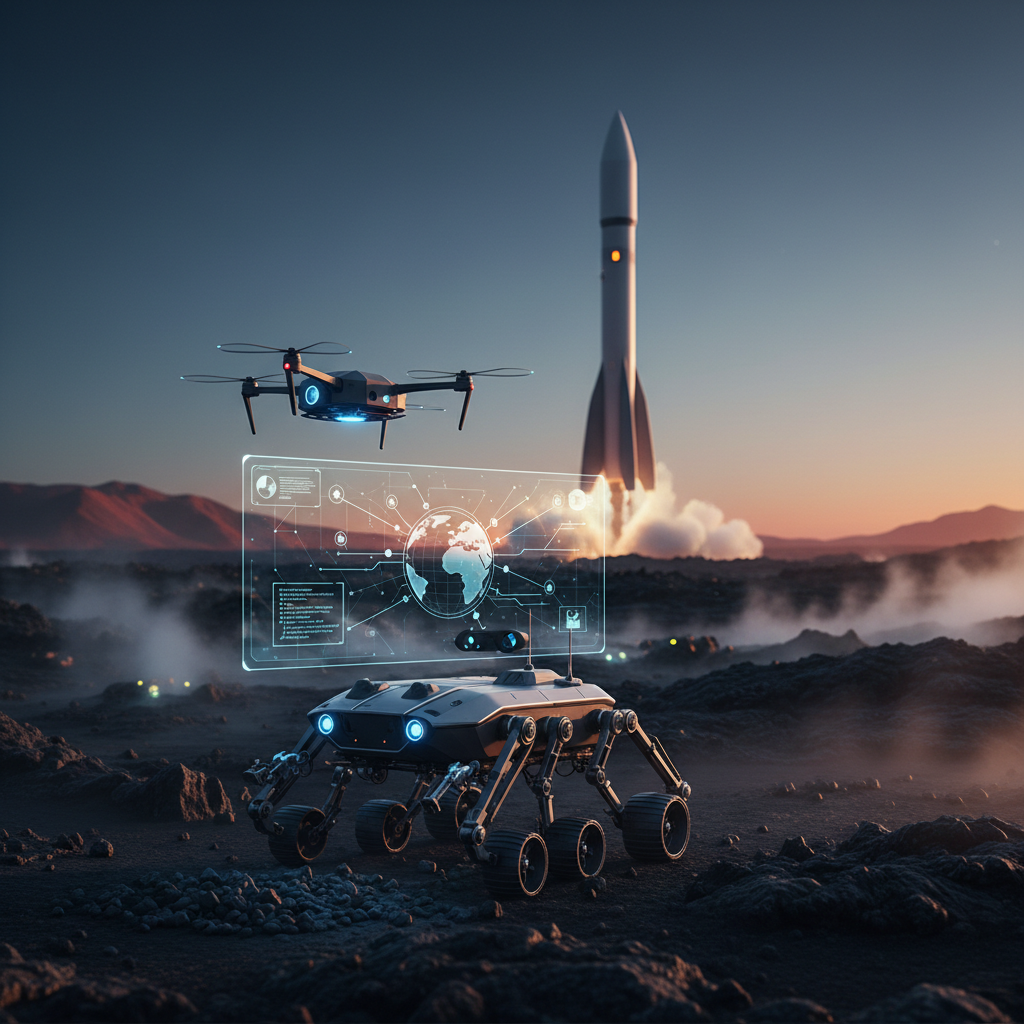

Most people, when they hear about space, think of rockets, astronauts, and perhaps Elon Musk’s latest pronouncements about Mars. They imagine grand endeavors, far removed from their daily lives. That is understandable. The cosmos feels distant, both physically and conceptually. But what if I told you that the artificial intelligence powering those distant probes and listening for whispers from other galaxies is already affecting your life, your job, and even the future of our small island nation? It is not just about sending rovers to Mars anymore, it is about how we process data here on Earth, how we manage resources, and how we might even find new ways to sustain ourselves.
Why Most People Are Ignoring It
The attention gap is wide. We are bombarded daily with news about large language models, AI art, and the latest Silicon Valley drama. The immediate, tangible impacts of AI on our screens and in our workplaces capture headlines. Space exploration, by contrast, feels like a long-term, high-budget science project, a luxury for rich nations. People see NASA or ESA and think of government spending, not personal relevance. They might hear about a new Mars rover using AI for navigation, but they rarely connect that to the algorithms optimizing their delivery routes or managing their local power grid. The connection is often too abstract, too far removed from the everyday grind of paying bills or navigating the Reykjavík traffic. This disconnect is a mistake, a big one.
How It Affects YOU
Let us bring this down to Earth, literally. The AI developed for space is not staying in space. Consider the autonomous navigation systems on Mars rovers. These systems, like those on NASA’s Perseverance, use sophisticated computer vision and machine learning to identify hazards, plan routes, and even select scientific targets without constant human oversight. This technology is directly transferable to autonomous vehicles on Earth, improving safety and efficiency for everything from self-driving cars to automated farming equipment. For a nation like Iceland, with its challenging terrain and often sparse infrastructure, such advancements could revolutionize logistics and transportation, making our remote communities more accessible and our industries more efficient. Imagine AI-driven drones inspecting power lines in the highlands or autonomous vehicles delivering supplies to isolated farms, all benefiting from algorithms refined millions of miles away.
Then there is satellite AI. Thousands of satellites orbit our planet, collecting vast amounts of data on weather patterns, climate change, land use, and even fishing activity. AI is essential for making sense of this deluge of information. It can detect subtle changes in sea ice, predict volcanic eruptions, or monitor agricultural yields with unprecedented accuracy. For Iceland, a country deeply reliant on its environment and natural resources, this is invaluable. Our fisheries, our geothermal energy industry, and our tourism sector all benefit from better environmental monitoring and predictive analytics. The data processed by AI in orbit helps us make smarter decisions about resource management, protecting our delicate ecosystems and ensuring sustainable growth. According to MIT Technology Review, the sheer volume of data from Earth observation satellites makes AI not just useful, but absolutely essential for analysis.
The Bigger Picture
The societal, economic, and political implications are profound. Economically, the space industry is booming, projected to reach over a trillion dollars in value in the coming years. AI is a core component of this growth, driving innovation in everything from launch services to in-orbit manufacturing. Small nations have big advantages in AI if they focus on niche applications and leverage their unique strengths. Iceland, with its abundant renewable energy, is already a hub for data centers. The massive computational demands of training complex AI models for space applications could find a natural home here, utilizing our clean geothermal and hydroelectric power. This creates high-skilled jobs and positions us as a critical player in the global AI infrastructure. As Dr. Guðrún Jónsdóttir, head of the Icelandic Space Agency, recently stated, “Our clean energy and stable environment make us an ideal location for the data processing backbone of future space endeavors. We are not just spectators, we are participants.”
Politically, AI in space exploration also touches on national security and international cooperation. Satellite intelligence, enhanced by AI, provides critical data for disaster response, maritime surveillance, and even climate diplomacy. The search for extraterrestrial intelligence, or Seti, might seem like pure science fiction, but the AI algorithms sifting through radio signals for anomalies are pushing the boundaries of pattern recognition. If we ever do detect a signal, the implications for humanity, our place in the universe, and our philosophical understanding of existence would be monumental. It is a long shot, yes, but the technological spin-offs from that pursuit are already benefiting other fields of scientific discovery.
What Experts Are Saying
Experts across the globe are keenly aware of AI's transformative role in space. Dr. Thomas Zurbuchen, former Associate Administrator for the Science Mission Directorate at NASA, has often emphasized the necessity of AI for future missions. He once noted, “We cannot explore the universe without artificial intelligence. It is the only way to handle the data, to make decisions autonomously, and to push the boundaries of what is possible.” His perspective highlights the operational imperative of AI in space, not just its theoretical potential.
On the commercial side, Jensen Huang, CEO of NVIDIA, has consistently pointed to the convergence of AI and accelerated computing as fundamental for scientific discovery, including space. NVIDIA’s GPUs are at the heart of many AI systems used by space agencies and private companies alike. He remarked, “AI is the engine of scientific discovery. From drug discovery to climate modeling, and certainly to space exploration, our ability to process vast datasets and run complex simulations is entirely dependent on advanced AI.” This underscores the hardware and software synergy driving current advancements.
Furthermore, Dr. Sara Seager, a planetary scientist at MIT, has stressed the role of AI in analyzing exoplanet data and hunting for biosignatures. Her work relies heavily on sophisticated algorithms to sift through telescopic observations. She recently commented, “Finding life beyond Earth requires sifting through an astronomical amount of data. AI is our best tool for identifying the subtle patterns that could indicate the presence of another living world.” Her insights reveal the scientific frontier AI is enabling.
Even closer to home, Professor Þorsteinn Gunnarsson, a data science specialist at the University of Iceland, points to the potential for local innovation. “In Iceland, we think differently about this. Our small size means we can be agile. We can develop specialized AI solutions for space data processing, leveraging our unique energy profile and skilled workforce. The geothermal approach to computing is not just for Bitcoin anymore, it is for the stars.” This local perspective is crucial, showing that the benefits are not confined to the usual tech giants.
What You Can Do About It
First, educate yourself. Understand that AI is not just a Silicon Valley product, it is a global tool with global implications. Follow developments from space agencies and private companies like SpaceX, Blue Origin, and Rocket Lab. Look beyond the launch videos to the data processing and decision-making systems. Second, advocate for investment in Stem education and research in your own community. The skills needed for AI development, whether for Earth or space, are increasingly valuable. Third, consider the ethical implications. As AI becomes more autonomous, especially in critical missions, questions of control, bias, and accountability become paramount. These are discussions we all need to be part of. You can find more details on AI's broader impact on industries on TechCrunch.
The Bottom Line
In five years, the line between AI for space and AI for Earth will blur even further. The algorithms that guide probes through asteroid fields will inform the navigation of autonomous ships in our fjords. The AI that sifts through cosmic background radiation will be the same kind of AI that helps us predict extreme weather events. The demand for clean, reliable computing power for these advanced AI systems will only grow, making locations like Iceland, with our abundant renewable energy, increasingly strategic. This isn't just about rockets and distant planets; it is about building a more resilient, data-driven future right here, for everyone. Ignore AI in space exploration at your own risk; it is changing everything, from the cosmos to our quiet island home. For a deeper dive into AI research, consider exploring resources like arXiv.