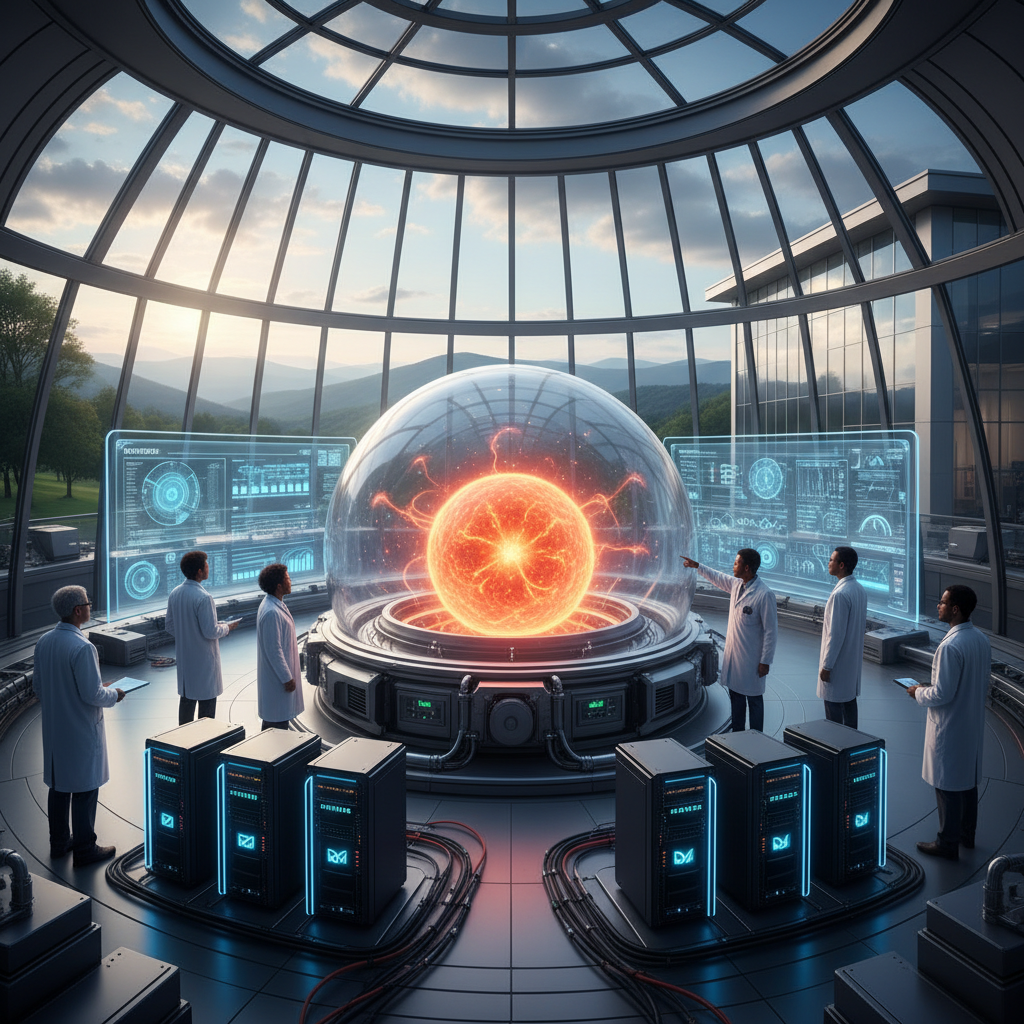

For decades, nuclear fusion has been the energy equivalent of a unicorn: everyone wants to see it, but no one has quite managed to catch it. The promise of clean, virtually limitless power, mimicking the sun's processes right here on Earth, has tantalized scientists and policymakers alike. Yet, the monumental challenge of containing superheated plasma, hotter than the sun's core, has remained a stubborn barrier. But here's what's actually happening inside labs from Princeton to San Diego: artificial intelligence is rewriting the rules, transforming fusion research from a slow, iterative process into a data-driven sprint.
We're not talking about some far-off sci-fi fantasy anymore. This is about real-world algorithms, machine learning models, and a whole lot of compute power, much of it flowing from companies like NVIDIA, accelerating our path to a sustainable energy future. The architecture tells the real story here. Fusion reactors, particularly tokamaks, are incredibly complex machines. Imagine a giant donut-shaped magnetic bottle designed to hold a gas so hot it would vaporize anything it touches. The plasma inside is turbulent, dynamic, and incredibly sensitive to electromagnetic fields. Controlling it is like trying to juggle a dozen raw eggs while riding a unicycle on a tightrope, blindfolded. Traditional control systems, based on physics models and empirical rules, simply can't keep up with the real-time chaos.
The Technical Challenge: Taming the Plasma Beast
The core problem in magnetic confinement fusion is plasma stability and sustainment. Plasma disruptions, sudden losses of confinement, can damage reactor components and halt experiments. Predicting and preventing these disruptions, optimizing heating and current drive, and maintaining a stable, high-performance plasma state are paramount. This is where AI steps in. Instead of relying on simplified physics equations that often fall short in describing the non-linear, chaotic nature of plasma, AI models learn directly from experimental data, identifying subtle patterns and correlations that human researchers might miss.
Architecture Overview: A Fusion of Sensors and Silicon
At the heart of an AI-driven fusion control system is a robust data acquisition and processing pipeline. Modern tokamaks are bristling with diagnostics: magnetic probes, Thomson scattering systems, bolometers, interferometers, and more, generating terabytes of data per second. This raw data is fed into a distributed computing architecture, often leveraging cloud platforms like Microsoft Azure or Google Cloud, or on-premise clusters packed with NVIDIA A100 or H100 GPUs.
The system typically comprises several interconnected modules:
- Data Ingestion and Preprocessing: High-frequency sensor data is streamed, cleaned, and normalized. This often involves real-time signal processing, noise reduction, and feature extraction. Libraries like Apache Kafka for streaming and Apache Spark for distributed processing are common.
- State Estimation: Machine learning models, often recurrent neural networks (RNNs) or transformer architectures, estimate the current state of the plasma (temperature, density, current profile, impurity levels) based on noisy sensor inputs. This is crucial for real-time decision-making.
- Disruption Prediction: A critical component. Classification models, such as Support Vector Machines (SVMs), Random Forests, or increasingly, deep neural networks, are trained on historical disruption events. Their goal is to predict an impending disruption milliseconds to seconds before it occurs, allowing for mitigation actions.
- Control Policy Generation: This is the most advanced part, often employing Reinforcement Learning (RL). An RL agent learns optimal control policies by interacting with a simulated tokamak environment or, in some cases, directly with a real reactor during low-power experiments. The agent's actions might include adjusting magnetic coil currents, gas puffing rates, or auxiliary heating power.
- Actuator Control: The generated control signals are translated into commands for the reactor's actuators (e.g., power supplies for magnetic coils, gas valves).
Key Algorithms and Approaches: Learning From Chaos
Let me decode this for you. Imagine you're trying to keep a balloon perfectly centered in a room using only fans. If you just react when it hits a wall, you're too late. AI predicts where it's going and adjusts the fans proactively. In fusion, this translates to:
- Deep Learning for Disruption Prediction: Researchers at the Princeton Plasma Physics Laboratory (pppl) have used deep neural networks to predict disruptions with over 90% accuracy, often several hundred milliseconds in advance. This is a huge leap from traditional methods. The models are trained on massive datasets from operational tokamaks like Diii-d in San Diego. A typical architecture might involve a Convolutional Neural Network (CNN) for feature extraction from time-series diagnostic signals, followed by an Lstm (Long Short-Term Memory) layer to capture temporal dependencies.
 # Conceptual pseudocode for a disruption prediction model
 def build_disruption_predictor(input_shape, num_features, time_steps):
 model = Sequential([
 Input(shape=(time_steps, num_features)),
 Conv1D(filters=64, kernel_size=3, activation='relu'),
 MaxPooling1D(pool_size=2),
 Lstm(100, return_sequences=True),
 Dropout(0.2),
 Lstm(100),
 Dropout(0.2),
 Dense(50, activation='relu'),
 Dense(1, activation='sigmoid') # Binary classification: disruption or no disruption
 ])
 model.compile(optimizer='adam', loss='binary_crossentropy', metrics=['accuracy'])
 return model
 # Conceptual pseudocode for a disruption prediction model
 def build_disruption_predictor(input_shape, num_features, time_steps):
 model = Sequential([
 Input(shape=(time_steps, num_features)),
 Conv1D(filters=64, kernel_size=3, activation='relu'),
 MaxPooling1D(pool_size=2),
 Lstm(100, return_sequences=True),
 Dropout(0.2),
 Lstm(100),
 Dropout(0.2),
 Dense(50, activation='relu'),
 Dense(1, activation='sigmoid') # Binary classification: disruption or no disruption
 ])
 model.compile(optimizer='adam', loss='binary_crossentropy', metrics=['accuracy'])
 return model
- Reinforcement Learning for Plasma Control: This is where the magic truly happens. RL agents, often using algorithms like Proximal Policy Optimization (PPO) or Soft Actor-Critic (SAC), learn control policies. The 'state' is the current plasma condition, 'actions' are changes to control parameters, and 'rewards' are given for stable, high-performance plasma and penalties for disruptions. The agent explores different control strategies in a simulated environment, refining its policy over millions of iterations. Google DeepMind has famously applied RL to control plasma in the Swiss TCV tokamak, demonstrating unprecedented control capabilities.
The breakthrough here is that RL can discover non-intuitive control strategies that outperform human-designed ones, pushing the boundaries of what's possible for plasma confinement. This is like teaching a robot to play a complex video game by letting it try millions of times, rather than programming every move.
Implementation Considerations: The Real-World Grind
Deploying these AI systems in a fusion environment isn't trivial. Latency is a killer. Decisions need to be made in milliseconds. This demands highly optimized code, specialized hardware, and efficient communication protocols. Edge computing solutions, where inference is performed close to the sensors, are becoming increasingly vital. Data quality is another huge factor; noisy or incomplete sensor data can derail even the most sophisticated models. Robust data validation and imputation techniques are essential.
Furthermore, the 'sim-to-real' gap is a persistent challenge for RL. A policy learned in simulation may not perform optimally in the real, more complex, and unpredictable physical world. Techniques like domain randomization and transfer learning are actively being researched to bridge this gap.
Benchmarks and Comparisons: Outperforming Traditional Methods
Traditional control systems rely on pre-programmed feedback loops based on simplified linear models. They are robust but often conservative and cannot adapt to unforeseen plasma behaviors. AI, particularly deep learning for prediction and RL for control, consistently demonstrates superior performance:
- Disruption Prediction: AI models achieve lead times of hundreds of milliseconds, compared to tens of milliseconds for traditional methods, providing critical time for mitigation.
- Plasma Performance: RL agents have shown the ability to maintain stable plasma for longer durations and achieve higher performance metrics (e.g., higher fusion gain) than human operators or classical controllers.
- Adaptability: AI systems can adapt to changes in reactor conditions or even different reactor geometries, something traditional systems struggle with.
Code-Level Insights: Tools of the Trade
For developers and data scientists diving into this field, the toolkit is familiar yet specialized. Python is the lingua franca, with libraries like TensorFlow and PyTorch for deep learning. For high-performance computing, Cuda and cuDNN are indispensable for leveraging NVIDIA GPUs. Data processing often involves NumPy, SciPy, and Pandas. For RL, frameworks like Ray RLlib or Stable Baselines provide robust implementations of various algorithms. Simulation environments are often custom-built, leveraging physics codes like Transp or M3D-C1, sometimes coupled with OpenAI Gym-like interfaces for RL agents.
Real-World Use Cases: From Lab to Reactor
- diii-d National Fusion Facility, San Diego, USA: General Atomics, in collaboration with Google DeepMind and others, has been a pioneer in using AI for disruption prediction and real-time control. Their work on Diii-d has demonstrated the feasibility of deep learning models for predicting plasma instabilities and optimizing plasma shape and current profiles. They've shown a 50% reduction in specific types of disruptions using AI-driven mitigation strategies.
- Princeton Plasma Physics Laboratory (pppl), USA: Researchers here are leveraging AI to understand and control edge localized modes (ELMs), a type of instability that can damage reactor walls. They're using sophisticated neural networks trained on data from their Nstx-u tokamak and other facilities to predict and suppress these events.
- iter (International Thermonuclear Experimental Reactor), France: While still under construction, Iter is designing its control systems with AI integration in mind. The sheer scale and complexity of Iter make AI an absolute necessity for its operation, particularly for real-time diagnostics and predictive maintenance. US contributions to ITER's AI efforts are significant, focusing on data infrastructure and control algorithms.
- Commonwealth Fusion Systems (CFS), Massachusetts, USA: This MIT spin-off, backed by Bill Gates and other major investors, is developing compact, high-field tokamaks. They are integrating AI from the ground up into their Sparc and ARC reactor designs, using machine learning for everything from materials science optimization to advanced plasma control. Their approach relies heavily on predictive modeling to accelerate design iterations and operational efficiency.
Gotchas and Pitfalls: The Road Ahead
Despite the incredible progress, challenges remain. Interpretability is a big one. When an AI model makes a critical decision about plasma control, understanding why it made that decision is crucial for trust and safety, especially in a high-stakes environment like a fusion reactor. Explainable AI (XAI) techniques are vital here. Another issue is data scarcity for certain rare but critical events, like major disruptions. Synthetic data generation and transfer learning are being explored to address this.
Finally, the sheer cost of compute is a factor. Training complex RL agents or deep neural networks requires vast amounts of GPU time, making partnerships with tech giants like NVIDIA and cloud providers essential. As Dr. Evelyn Reed, lead AI scientist at a major US fusion research consortium, told me last month,