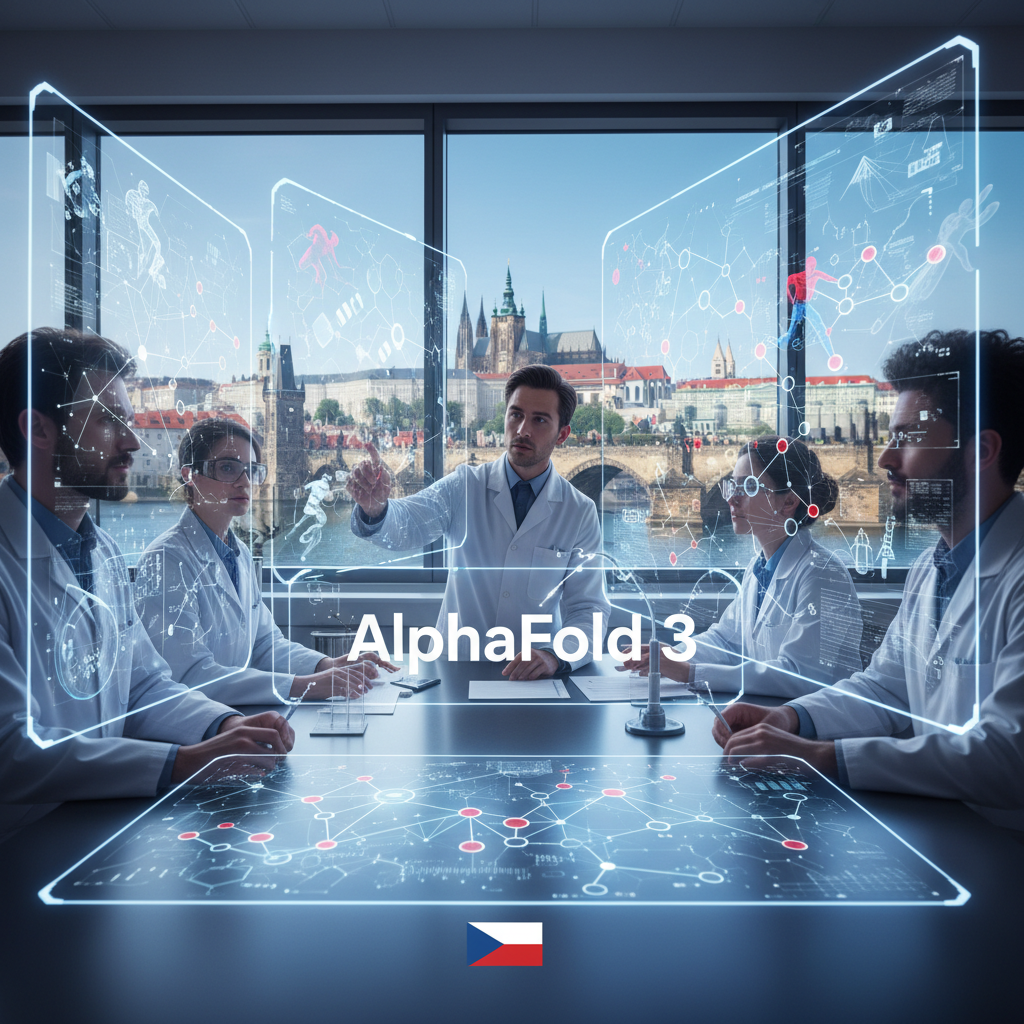

The intricate dance of life, at its most fundamental level, is orchestrated by proteins. These molecular machines, folded into precise three-dimensional structures, dictate everything from cellular function to disease progression. For decades, deciphering these structures was a painstaking, often impossible, endeavor, a veritable Gordian knot for biochemists. Then came artificial intelligence, and with it, a revolution that promises to rewrite the future of medicine and materials science.
Just weeks ago, Google DeepMind unveiled AlphaFold 3, a successor to its groundbreaking AlphaFold 2, which had already transformed structural biology. AlphaFold 3, however, represents a leap, not just a step. It can predict the structures of proteins with unprecedented accuracy, but crucially, it extends its predictive power to interactions with other molecules: DNA, RNA, ligands, and even small drug-like molecules. This is not merely an incremental improvement, it is a paradigm shift. Imagine trying to understand a complex machine by only seeing its individual parts. AlphaFold 3 now allows us to see how these parts interact, how they bind, and how they influence each other's function. It is akin to moving from static blueprints to a dynamic, animated simulation of molecular machinery.
For the pharmaceutical industry, this is nothing short of a seismic event. The traditional drug discovery pipeline is notoriously long, expensive, and fraught with failure. Identifying a promising drug candidate, synthesizing it, and then testing its efficacy and safety can take over a decade and cost billions of dollars. A significant portion of this time and expense is dedicated to understanding how a potential drug molecule interacts with its target protein. AlphaFold 3 dramatically shortens this initial phase. "The ability to accurately predict protein-ligand interactions at scale fundamentally changes our approach to lead optimization," states Dr. Jana Novotná, Head of Computational Chemistry at a leading European biotech firm based in Brno. "We can now computationally screen millions of compounds with a fidelity that was previously unimaginable, drastically reducing the need for costly and time-consuming experimental assays." This sentiment is echoed across the industry, with companies like AstraZeneca and Novartis reportedly integrating AlphaFold's capabilities into their early-stage research pipelines, aiming to accelerate the identification of novel therapeutic targets and drug candidates.
The implications extend far beyond pharmaceuticals. Materials science, a field often seen as distinct, is equally poised for transformation. The properties of advanced materials, from high-strength alloys to biodegradable plastics, are intrinsically linked to their molecular and atomic structures. Designing new materials with specific functionalities, such as enhanced conductivity, improved thermal stability, or novel catalytic activity, often involves understanding how proteins or other complex molecules can serve as templates or components. Consider the development of new enzymes for industrial processes, or bio-inspired materials that mimic the strength and resilience of natural structures like spider silk. AlphaFold 3's ability to predict protein-protein and protein-ligand interactions opens new avenues for de novo protein design, allowing engineers to create bespoke molecular structures for specific material applications. "The Czech approach is methodical and effective, and we are applying this rigor to the design of novel biomaterials," explains Professor Karel Svoboda, who leads a research group at the Czech Technical University in Prague focusing on computational materials design. "We are exploring how AI can help us engineer proteins that self-assemble into nanostructures with tailored properties, a process that was largely trial and error before these AI breakthroughs." This fusion of computational power and biological insight promises a new era of designer materials.
However, the deployment of such powerful AI tools is not without its challenges. The computational resources required to train and run models like AlphaFold 3 are substantial. NVIDIA's latest Blackwell architecture GPUs, for instance, are becoming indispensable for these large-scale simulations. Jensen Huang, CEO of NVIDIA, has repeatedly emphasized the critical role of accelerated computing in scientific discovery, a point underscored by the demand for their hardware in leading research institutions and pharmaceutical companies globally. The sheer volume of data generated, and the expertise required to interpret the predictions, also present significant hurdles. This is where Prague's engineering tradition meets modern AI, with a focus on developing robust, interpretable, and scalable AI systems. Czech researchers are actively contributing to the open-source ecosystem around protein folding, developing tools and methodologies to make these powerful AI models more accessible and manageable for smaller labs and startups.
One area of particular interest in Europe is the ethical deployment of these technologies. The potential for AI to accelerate drug discovery is immense, but so too is the responsibility to ensure equitable access and prevent misuse. Regulatory bodies across the European Union are actively engaging with these questions, seeking to balance innovation with public safety and ethical considerations. The EU AI Act, for example, sets a precedent for regulating high-risk AI systems, a category into which certain applications of protein folding AI might fall, particularly those directly impacting human health. This proactive stance reflects a broader European commitment to responsible innovation.
While the headlines often focus on the grand pronouncements from Silicon Valley, the quiet, persistent work happening in institutions across Europe, including those in the Czech Republic, is equally vital. Researchers at Charles University in Prague, for example, are leveraging these new AI capabilities to investigate neglected tropical diseases, where traditional drug discovery efforts have often lagged due to commercial viability concerns. By drastically reducing the cost and time of identifying potential drug candidates, AI protein folding offers a glimmer of hope for millions suffering from these conditions. This is a testament to the democratizing potential of AI, provided the tools are made accessible and the expertise is cultivated globally.
Looking ahead, the next frontier involves not just predicting static structures, but understanding protein dynamics and how they change over time and in response to environmental cues. This will require even more sophisticated AI models, capable of simulating molecular motion and conformational changes. The integration of quantum computing, though still in its nascent stages, also holds immense promise for simulating molecular interactions with even greater precision, potentially unlocking entirely new classes of drugs and materials. According to MIT Technology Review, the convergence of AI, quantum computing, and synthetic biology is creating an unprecedented era of scientific discovery.
In essence, AI protein folding is not just a tool, it is a new lens through which we view the molecular world. It allows us to peer into the fundamental mechanisms of life and disease with unparalleled clarity, offering the potential to design solutions with precision and speed previously confined to the realm of science fiction. The methodical, data-driven approach, a hallmark of Czech engineering, is perfectly suited to harness this power, transforming raw data into actionable insights that will define the next generation of therapeutics and materials. As we continue to unravel the complexities of the biological universe, these AI breakthroughs will serve as our compass, guiding us towards a future of enhanced health and innovative materials. For more on how AI is transforming healthcare, you might be interested in our article on AI's impact on drug discovery in the Balkans [blocked]. The journey has only just begun, and the vistas it reveals are truly breathtaking. Further insights into the broader AI landscape can be found on TechCrunch's AI section. The future of molecular design is here, and it is being shaped by algorithms.