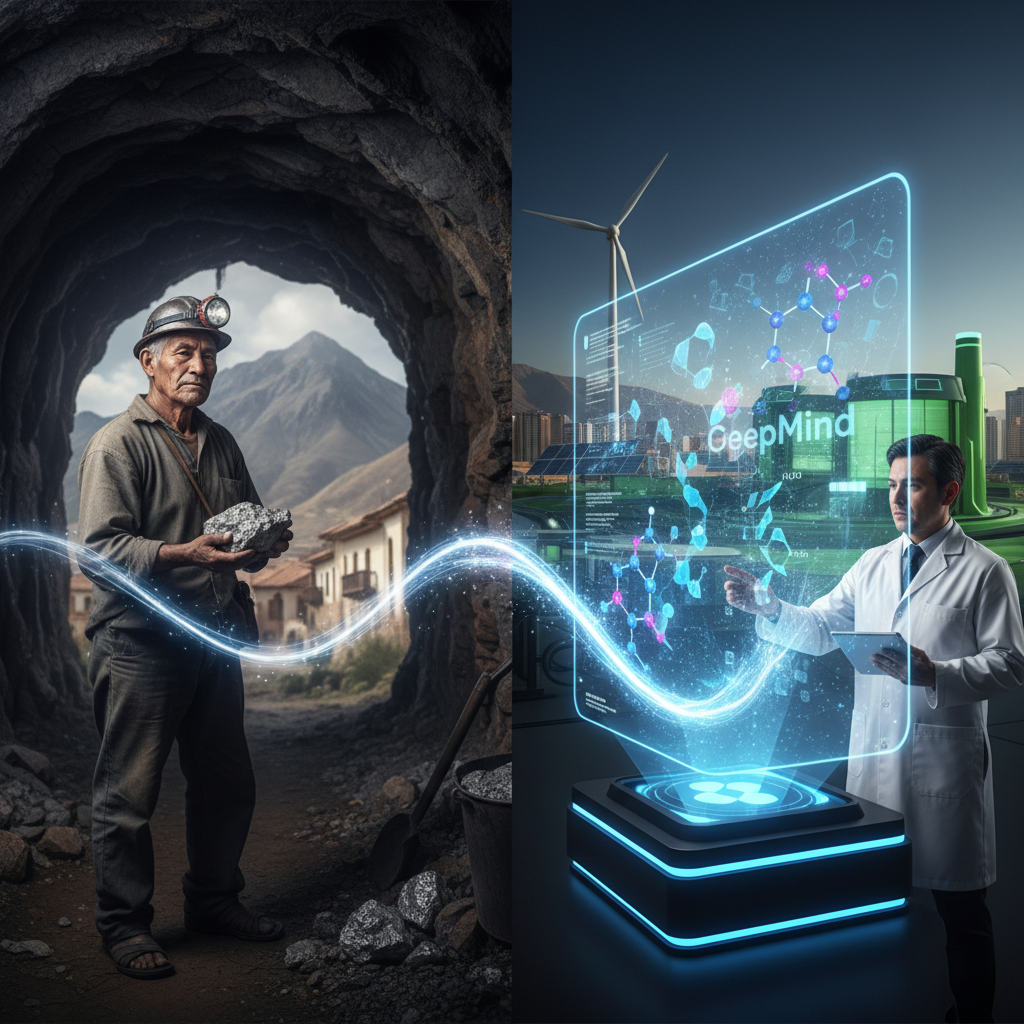
The high plains of Bolivia, a land rich in history and resources, have long been defined by the earth beneath our feet. From the silver of Potosí that fueled empires to the lithium brine that now underpins the global energy transition, our nation's destiny is inextricably linked to its geology. Today, however, a new force is reshaping this ancient relationship: artificial intelligence, specifically in the realm of materials discovery. The promise of AI to accelerate the search for novel superconductors and battery components is not merely a scientific curiosity; it is a geopolitical and economic imperative, one that Bolivia watches with a mixture of hope and skepticism.
Globally, the leading technology firms are pouring billions into this sector. Google DeepMind, for instance, has made significant strides with its Graph Networks for Materials Exploration, or GNoME, which has already predicted the stability of hundreds of thousands of new materials. Similarly, IBM and NVIDIA are investing heavily in quantum computing and AI platforms designed to simulate and discover materials at an unprecedented pace. These developments, detailed in publications like MIT Technology Review, suggest a future where the bottleneck of experimental trial and error is dramatically reduced, potentially shaving years off the development cycle for everything from high-capacity batteries to room-temperature superconductors.
For Bolivia, a country holding the largest proven lithium reserves, this technological leap carries profound implications. Our lithium, primarily found in the Salar de Uyuni, is a critical component for the next generation of energy storage. If AI can rapidly identify more efficient extraction methods, or even entirely new battery chemistries that reduce reliance on specific elements, the value chain could shift dramatically. "We cannot afford to be passive observers in this new industrial revolution," stated Dr. Elena Quispe, Director of the Bolivian Institute for Lithium Research. "Our national strategy must integrate these AI advancements, not just as consumers of technology, but as active participants in its development and application. Bolivia's challenges require Bolivian solutions, especially when it comes to leveraging our natural wealth."
The traditional approach to materials science is painstakingly slow. Scientists synthesize compounds, test their properties, and refine their understanding through iterative experimentation. This process can take decades. AI, particularly machine learning models trained on vast datasets of material properties, can predict the characteristics of hypothetical compounds with remarkable accuracy, guiding researchers toward the most promising candidates. This data-driven approach, often leveraging techniques like generative AI and reinforcement learning, promises to compress discovery timelines from years to months.
Consider the recent announcement from a consortium led by Microsoft and a European research institute, which claimed their AI platform identified 15 novel high-temperature superconductor candidates within a single quarter, a feat that would have taken a century using conventional methods. While these claims require rigorous experimental validation, the sheer speed of theoretical discovery is undeniable. For battery materials, the focus is on optimizing energy density, charging speed, and longevity. Companies like Tesla, through their internal AI labs, are reportedly using similar methodologies to refine their battery designs, aiming for greater range and faster charging times for their electric vehicles.
However, the path from AI-driven discovery to practical application is fraught with challenges, particularly in a context like Bolivia's. The infrastructure required to implement and benefit from these advanced AI systems is substantial. High-performance computing, access to vast material databases, and a highly skilled workforce are prerequisites. "The altitude of innovation is not just a metaphor here," commented Ricardo Mamani, a senior engineer at Yacimientos Petrolíferos Fiscales Bolivianos, or Ypfb, which oversees national resource development. "We are literally operating at 4,000 meters above sea level. The logistical and environmental considerations for any industrial process, let alone one as complex as advanced materials processing, are immense. Let's talk about what actually works at 4,000 meters, not just what looks good on a Silicon Valley whiteboard."
This sentiment underscores a critical point: the gap between theoretical AI breakthroughs and real-world impact in developing nations. While AI can design a perfect battery material on a simulation, the challenge of economically and sustainably extracting the raw lithium, processing it, and manufacturing the final product remains. This is where the local context becomes paramount. Bolivia's lithium extraction currently relies on evaporative ponds, a method that is slow and water-intensive, though efforts are underway to implement direct lithium extraction, or DLE, technologies. Can AI optimize DLE processes, making them more efficient and environmentally friendly? This is a question of immediate and practical importance.
Furthermore, the intellectual property generated by AI-driven materials discovery often resides with the global tech giants. Bolivia must ensure that it is not merely a supplier of raw materials but also a beneficiary of the value-added processes. This requires strategic investments in local research and development, fostering partnerships with international entities that respect national sovereignty, and cultivating a new generation of Bolivian data scientists and materials engineers. The University Mayor de San Andrés in La Paz, for example, has recently launched a new postgraduate program in AI and materials science, a small but significant step in building this indigenous capacity.
As the global competition for critical materials intensifies, nations like Bolivia must navigate a complex landscape of technological advancement, economic opportunity, and environmental responsibility. The promise of AI to revolutionize materials science is undeniable, offering pathways to a more sustainable and technologically advanced future. Yet, for this promise to materialize into tangible benefits for the Bolivian people, it must be met with pragmatic planning, strategic investment, and a steadfast commitment to developing local expertise. The future of our lithium, and indeed our nation, may well be written in the algorithms of AI, but the pen must remain firmly in Bolivian hands. For more insights into the broader impact of AI on global industries, readers can explore Reuters' technology coverage.
One pertinent development to consider is the ongoing discussion around resource sovereignty and technological access. The article From Altiplano Observatories to Martian AI: Is Elon Musk's Martian Dream Just a Silicon Valley Fantasy or the Next Frontier for Bolivia's Lithium? [blocked] touches on related themes of Bolivia's role in global technology narratives and resource exploitation, providing a complementary perspective on the challenges and opportunities presented by external technological ambitions. This context is vital when evaluating the practical application of AI in our unique environment. The global discussion around AI's impact on resource-rich nations is still in its early stages, with many questions remaining about equitable access and benefit sharing. For a broader perspective on AI's societal implications, Wired's AI section offers diverse viewpoints.