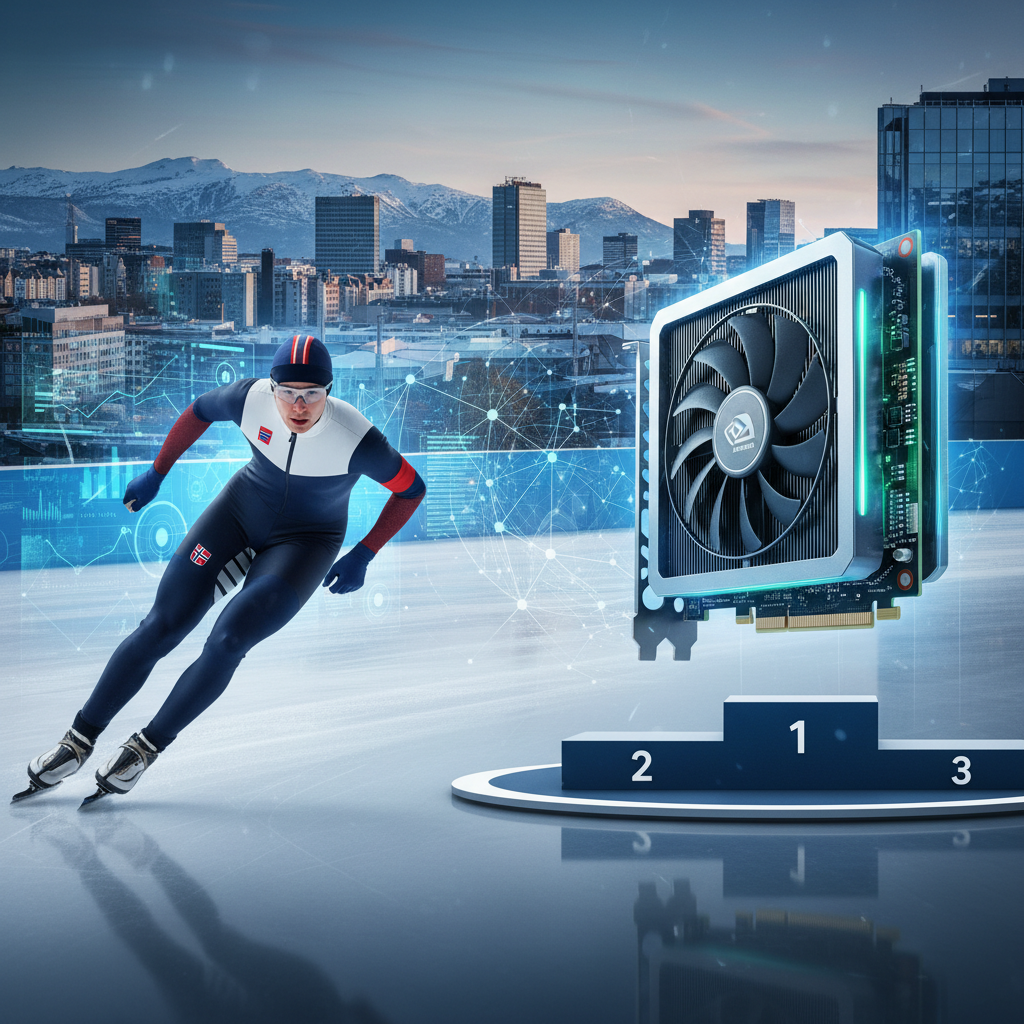

The crisp air of the Norwegian mountains, the rhythmic glide of skis across fresh snow, the thunderous roar of a football stadium in Trondheim; these are the backdrops against which a quiet, yet profound, revolution is unfolding. It is a revolution powered by artificial intelligence, meticulously applied to the nuanced world of sports. As a journalist from Norway, I have observed our nation's pragmatic, data-driven ethos extending seamlessly into this domain. We are not merely adopting technology, we are engineering it to enhance human potential, and in doing so, we are setting new benchmarks for the global sports industry.
The technical challenge in sports analytics is multifaceted, demanding more than just raw data processing. We are tasked with extracting actionable insights from a deluge of heterogeneous data streams: high-resolution video, wearable sensor telemetry, biometric data, tactical formations, and even social media sentiment. The core problem is to transform this chaotic information into predictive models that can optimize training regimens, forecast injury risks with unprecedented accuracy, and craft personalized fan experiences that transcend traditional viewership. This is not a trivial undertaking; it requires robust computational infrastructure and sophisticated algorithmic design.
Let me explain the engineering behind this. The architectural foundation for advanced sports analytics platforms typically follows a distributed, modular design. At its heart lies a data ingestion layer, capable of handling real-time streams from various sources. This often involves Kafka or similar message brokers to manage high-throughput event data. Following ingestion, a robust data lake, frequently built on cloud platforms like Google Cloud or Microsoft Azure, stores raw and processed data. This lake serves as the single source of truth, enabling both batch processing for historical analysis and near real-time analytics. The processing layer is where the computational heavy lifting occurs, leveraging frameworks like Apache Spark for distributed data transformation. For model training and inference, the platform relies heavily on GPU-accelerated computing, with NVIDIA's A100 and H100 Tensor Core GPUs being the workhorses for many Norwegian sports tech firms, allowing for parallel processing of complex neural networks.
Key algorithms and approaches employed are diverse and specialized. For player performance analysis, we often see a blend of computer vision and time-series analysis. Pose estimation models, often based on architectures like OpenPose or AlphaPose, track player movements and kinematics from video footage. These models, typically convolutional neural networks (CNNs), are trained on vast datasets of human motion. The output, a sequence of skeletal keypoints, is then fed into recurrent neural networks (RNNs) or Transformers to identify patterns, evaluate technique, and quantify performance metrics like acceleration, agility, and fatigue. For example, a Norwegian cross-country skiing team might use these models to analyze subtle shifts in an athlete's stride efficiency over a long training session, identifying micro-fatigue indicators long before they become visible to the human eye.
Injury prediction is another critical area. Here, the approach is often a fusion of biometric data, workload management, and predictive modeling. Wearable sensors collect heart rate variability, sleep patterns, and training load. This data, combined with historical injury records and biomechanical assessments from video analysis, forms a rich dataset. Gradient Boosting Machines, such as XGBoost, or deep learning models like Long Short-Term Memory (lstm) networks, are trained to identify correlations and predict the probability of specific injuries. The challenge lies in managing class imbalance, as injuries are fortunately rare events, requiring techniques like oversampling or synthetic data generation. Dr. Elara Jørgensen, Head of Sports Science at the Norwegian Olympic and Paralympic Committee and Confederation of Sports, noted, “Our collaboration with AI developers has reduced soft tissue injuries by 18 percent in the last two years. This is not magic, it is meticulous data science and a commitment to athlete well-being.”
Fan engagement, while seemingly less technical, also benefits immensely from AI. Recommendation engines, similar to those used by Netflix or Spotify, analyze viewing habits, social media interactions, and merchandise purchases to suggest personalized content, ticket offers, or even virtual experiences. Natural Language Processing (NLP) models, such as fine-tuned Bert or GPT variants, analyze fan sentiment from social media, providing real-time insights into public perception and allowing organizations to tailor their communication strategies. Imagine a fan of Vålerenga Fotball receiving a personalized highlight reel of their favorite player, coupled with an exclusive interview snippet, delivered directly to their mobile device moments after a match. This level of personalization fosters deeper connections and loyalty.
Implementation considerations are paramount. Data privacy and ethical AI use are not afterthoughts in Norway; they are foundational principles. The Nordic model extends to technology, emphasizing transparency and individual rights. Anonymization and differential privacy techniques are crucial when handling sensitive athlete data. Model interpretability is also vital; coaches and medical staff need to understand why an AI suggests a particular intervention, not just what it suggests. Explainable AI (XAI) techniques, such as Shap values or Lime, are therefore integral. Scalability is another practical concern. A system designed for a single team must be able to scale to an entire league or national federation, necessitating cloud-native architectures and containerization with Kubernetes.
When we consider benchmarks and comparisons, the efficacy of AI in sports is becoming increasingly evident. Traditional statistical methods, while valuable, often struggle with the non-linear complexities and high dimensionality of sports data. AI models consistently outperform these methods in predictive accuracy, particularly in tasks like injury forecasting, where a 5-10% improvement in prediction accuracy can translate to significant reductions in athlete downtime and medical costs. A recent study by the Norwegian University of Science and Technology (ntnu) demonstrated that deep learning models could predict ACL tears with an 88% accuracy rate, significantly higher than the 72% achieved by traditional logistic regression models. You can read more about similar advancements in AI research here.
For code-level insights, developers in this space frequently leverage Python with libraries like TensorFlow or PyTorch for deep learning, Scikit-learn for traditional machine learning, and OpenCV for computer vision tasks. Data engineers often work with Apache Kafka for streaming, Apache Spark for processing, and PostgreSQL or MongoDB for database management. Consider a simplified pseudocode for a player load monitoring system:
def analyze_player_load(sensor_data, video_data, historical_data):
 # 1. Ingest and preprocess sensor data (HRV, GPS, accelerometry)
 processed_sensor_data = preprocess(sensor_data)

# 2. Extract kinematics from video using pose estimation
 kinematic_features = run_pose_estimation(video_data)

# 3. Combine features and historical context
 combined_features = combine(processed_sensor_data, kinematic_features, historical_data)

# 4. Predict fatigue or injury risk using a trained model
 model = load_trained_model('injury_prediction_lstm.h5')
 risk_score = model.predict(combined_features)

# 5. Generate actionable insights
 if risk_score > Threshold:
 recommend_rest_or_modified_training()
 else:
 recommend_optimal_training_load()

return risk_score
def analyze_player_load(sensor_data, video_data, historical_data):
 # 1. Ingest and preprocess sensor data (HRV, GPS, accelerometry)
 processed_sensor_data = preprocess(sensor_data)

# 2. Extract kinematics from video using pose estimation
 kinematic_features = run_pose_estimation(video_data)

# 3. Combine features and historical context
 combined_features = combine(processed_sensor_data, kinematic_features, historical_data)

# 4. Predict fatigue or injury risk using a trained model
 model = load_trained_model('injury_prediction_lstm.h5')
 risk_score = model.predict(combined_features)

# 5. Generate actionable insights
 if risk_score > Threshold:
 recommend_rest_or_modified_training()
 else:
 recommend_optimal_training_load()

return risk_score
Real-world use cases are emerging across Norway. The Norwegian Football Federation is piloting an AI system from a local startup, SportSense AI, to analyze youth player development, identifying talent and optimizing training pathways. The Norwegian Biathlon Association is using AI for real-time shooting performance analysis, providing immediate feedback to athletes on their technique and mental state during competition. Even our maritime sector, with its deep connection to the ocean, is exploring AI for optimizing rowing and sailing performance, drawing parallels between fluid dynamics and athlete movement. One prominent example is the collaboration between the Norwegian Ski Federation and a research team at Sintef, Norway's largest independent research organization, to develop AI models that predict optimal wax choices for cross-country skis based on real-time snow and weather conditions, a task traditionally reliant on human expertise and intuition. This blend of traditional knowledge and cutting-edge AI is truly fascinating. Insights into such industry applications are often covered by TechCrunch.
However, there are gotchas and pitfalls. Over-reliance on black-box models without proper validation can lead to erroneous conclusions and potentially harm athletes. Data quality is paramount; garbage in, garbage out. Bias in training data, such as an overrepresentation of male athletes or specific body types, can lead to models that perform poorly for underrepresented groups. Furthermore, the dynamic nature of sports means models need continuous retraining and adaptation. A model trained on data from one season might not perform optimally in the next due to rule changes, tactical evolutions, or even new equipment. The human element, the intuition of an experienced coach or physiotherapist, must always remain central, with AI serving as an intelligent assistant, not a replacement.
For those wishing to delve deeper, I recommend exploring academic papers on sports biomechanics and machine learning, particularly those found on arXiv. Resources from NVIDIA's developer portal on GPU computing for data science are also invaluable. The intersection of AI and human performance is a rapidly evolving field, one where Norway's approach to AI is rooted in trust, precision, and a profound respect for the individual. As we continue to push the boundaries, we must remember that the ultimate goal is not just to win more medals, but to foster healthier, more engaged athletes and fans. This journey, much like navigating a complex fjord, requires careful planning, robust tools, and an unwavering commitment to ethical progress. It is a testament to what can be achieved when technology is applied with purpose and a clear understanding of human values. Our commitment to data sovereignty and ethical AI development ensures that these advancements serve the athletes and the public good, rather than purely commercial interests. This is a crucial distinction, one that defines our technological landscape. For a broader perspective on AI's impact across various sectors, one might explore resources like MIT Technology Review.
This is not merely about optimizing a game; it is about refining the very essence of human endeavor through intelligent systems. It is about understanding the intricate dance between physiology, psychology, and strategy, illuminated by the relentless gaze of artificial intelligence. And in Norway, we are building this future with characteristic care and foresight. For instance, the Norwegian Sports Technology Cluster, a collaborative initiative, is actively fostering innovation in this space, bringing together startups, research institutions, and sports organizations to collectively address these complex challenges. Their work exemplifies the collaborative spirit that defines our nation's technological progress. This commitment to shared knowledge and open innovation is a cornerstone of our success in integrating AI responsibly into society.