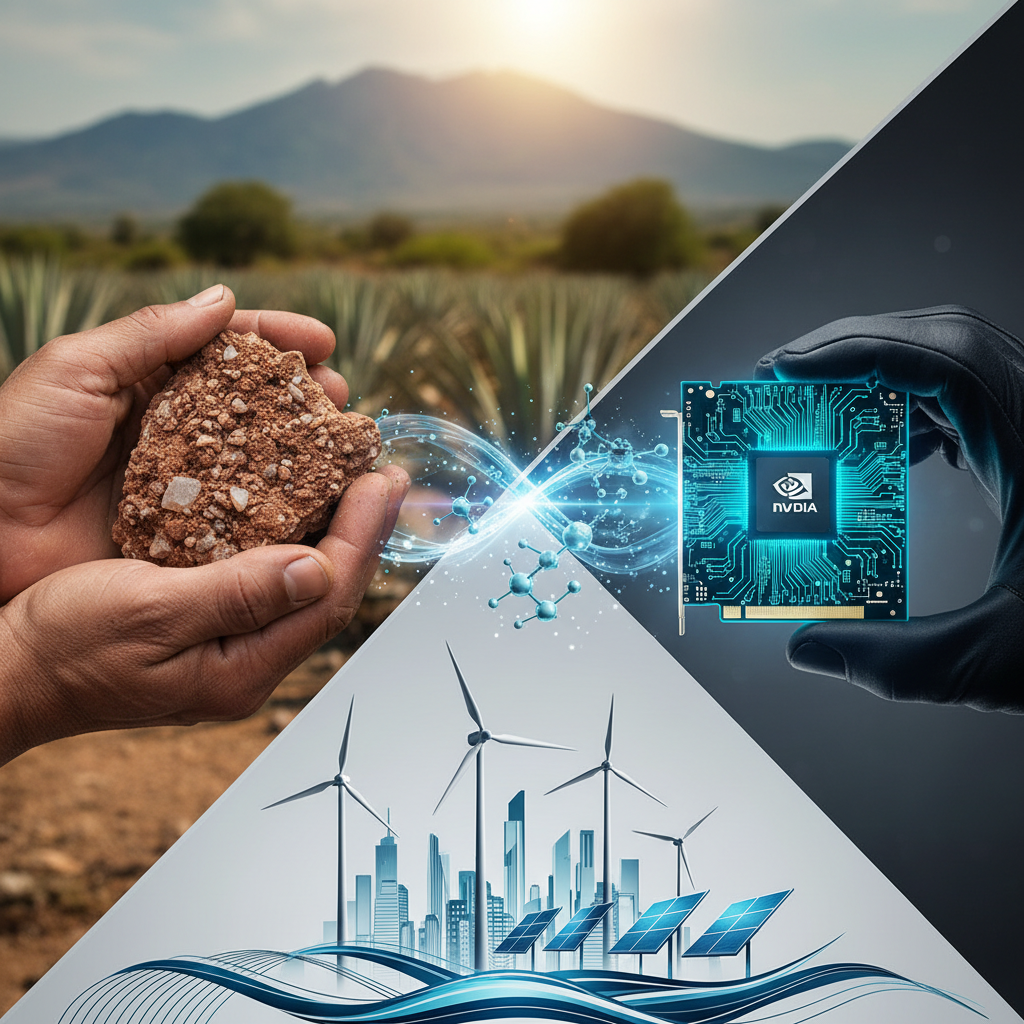

¡Hola, mi gente! Marisèl Rodriguèz here, writing to you from the heart of Mexico, where the sun shines bright and the spirit of innovation is as vibrant as our colors. Today, we are going to peel back the layers of a truly fascinating and critical technology, one that promises to reshape our world, from how we power our homes to how we store energy in our phones and electric vehicles. We are talking about AI-powered materials discovery, specifically how it is helping us find new superconductors and battery materials. This is not some far off dream, it is happening now, and Mexico's AI story is not being told, until now.
For too long, the search for new materials has been like searching for a needle in a haystack, but with a blindfold on and only a tiny magnet. Scientists would spend years, sometimes decades, synthesizing and testing compounds one by one, a painstakingly slow and expensive process. Think about it, the periodic table has over a hundred elements, and the combinations are practically infinite. How do you find that one perfect material that could revolutionize energy storage or transmission? This is where artificial intelligence steps in, transforming the entire process from a tedious trial and error into a guided exploration, a digital expedición.
The Big Picture: A Digital Alchemist for Our Future
Imagine a world where energy loss is minimal, where batteries charge in minutes and last for days, where our grids are resilient and efficient. This is the promise of new, advanced materials. Superconductors, for example, can transmit electricity with virtually no energy loss, but they often require extreme cold, making them impractical for widespread use. Battery materials, on the other hand, need to be lighter, safer, cheaper, and hold more charge. The challenge is immense, but the potential rewards are even greater. AI is acting as a digital alchemist, sifting through millions of potential chemical compositions and atomic structures in a fraction of the time it would take humans, predicting which ones will have the desired properties before they are even synthesized in a lab. This is about accelerating discovery, not just making it easier.
The Building Blocks: What Makes This Magic Happen?
To understand how this works, let us break it down into its core components, like the ingredients in a mole sauce, each playing a crucial role:
-
Massive Datasets of Materials Science: This is the foundation. Think of vast digital libraries containing information about known materials, their chemical compositions, crystal structures, and measured properties. Projects like the Materials Project, a global collaboration, have meticulously cataloged thousands of inorganic compounds. Without this data, AI would have nothing to learn from.
-
Sophisticated AI Models (Machine Learning and Deep Learning): These are the brains of the operation. We are talking about algorithms, often powered by neural networks, that can recognize complex patterns and relationships within the materials data. Companies like Google DeepMind and NVIDIA are constantly pushing the boundaries here, developing models capable of understanding quantum mechanical interactions and predicting material behavior at an atomic level. These models are not just simple calculators, they are learning systems, improving with every new piece of data.
-
High-Performance Computing (HPC) and GPUs: This is the muscle. Training these complex AI models and running simulations of atomic interactions requires immense computational power. This is where NVIDIA's specialized Graphics Processing Units, or GPUs, come into play. They are designed to perform many calculations simultaneously, making them perfect for the parallel processing demands of AI and materials simulations. Without this raw power, the AI would crawl, not sprint.
-
Quantum Mechanics Simulations: This is the scientific bedrock. At the heart of predicting material properties is understanding how atoms and electrons interact. Quantum mechanics provides the fundamental equations for this. AI models are trained on the results of these simulations, learning to approximate these complex physics calculations much faster than traditional methods.
Step by Step: From Idea to Innovation
Let us walk through the process, imagining we are searching for a new, high-temperature superconductor that could work at room temperature, a true holy grail for energy transmission:
-
Step 1: Define the Target Properties. First, scientists specify what they are looking for: high superconducting transition temperature, stability, non-toxicity, and perhaps specific electrical conductivity. This is like setting the destination for our expedición.
-
Step 2: Data Ingestion and Feature Engineering. The AI system ingests massive datasets of existing materials. It then extracts relevant features, like atomic radii, electronegativity, and crystal lattice parameters, essentially translating complex chemical information into a language the AI can understand.
-
Step 3: Predictive Modeling. Using its trained machine learning models, the AI begins to predict the superconducting properties of millions of hypothetical compounds that have never been made. It identifies candidates that are most likely to meet the target criteria. This is the AI's intuition, guided by physics and chemistry.
-
Step 4: Virtual Screening and Optimization. The AI refines its search, perhaps suggesting slight modifications to promising candidates to optimize their properties. It might simulate how these materials would behave under different pressures or temperatures, all within the digital realm. This is where the AI truly shines, exploring a vast design space that would be impossible for humans.
-
Step 5: Experimental Validation. The most promising candidates identified by the AI are then synthesized and tested in a real-world laboratory. This is crucial; the AI provides predictions, but the physical world provides the ultimate validation. If a material performs as predicted, it is a significant breakthrough. If not, the data from the failed experiment feeds back into the AI, making it smarter for the next round.
A Worked Example: Better Batteries for Mexico
Consider a Mexican startup, Energía Viva, focused on developing next-generation solid-state batteries for electric buses in Mexico City. They need a new electrolyte material that is non-flammable, highly conductive, and can withstand the city's varying temperatures. Traditionally, this would involve synthesizing hundreds of different ceramic or polymer compounds, a process taking years and millions of pesos.
Using an AI platform, Energía Viva feeds in their desired properties. The AI, perhaps leveraging models developed by Microsoft Research or a specialized startup, quickly sifts through a database of billions of potential inorganic and organic compounds. Within weeks, it identifies 15 promising candidates, predicting their ionic conductivity and thermal stability with high accuracy. The Energía Viva team then synthesizes these 15 materials. Out of them, two show exceptional promise, exceeding the performance of current commercial electrolytes by 20 percent. This dramatically reduces development time and cost, accelerating the deployment of cleaner public transport for our ciudades.
According to Dr. Sofia Ramirez, lead materials scientist at Energía Viva, 'Before AI, this would have been a five-year project, minimum. With it, we found a breakthrough in less than six months. La tecnología es para todos, and it is democratizing materials discovery for smaller players like us.' Her words echo a growing sentiment across the region, as reported by TechCrunch which frequently covers innovative startups.
Why This Sometimes Fails: The Limits of the Digital Alchemist
While powerful, this technology is not without its challenges. The AI is only as good as the data it is trained on. If the datasets are biased or incomplete, the AI's predictions will suffer. For instance, if the training data primarily consists of materials studied in temperate climates, the AI might struggle to predict properties accurately for materials intended for Mexico's diverse and often extreme environments. Furthermore, synthesizing some of the AI-predicted materials can still be incredibly difficult or expensive, even if the AI says they are perfect on paper. The gap between theoretical prediction and practical synthesis remains a hurdle. As Dr. Ricardo Fuentes, a computational chemist at Unam, notes, 'The AI can give us the recipe, but sometimes the ingredients are impossible to find, or the oven just does not work the way the AI expects. We need better feedback loops from the lab to the model.'
Where This Is Heading: A Future Forged by AI
The future of AI-powered materials discovery is incredibly bright. We are seeing advancements in 'active learning,' where the AI intelligently selects which experiments to run next, further accelerating the discovery process. There is also a push towards integrating AI with robotics for automated synthesis and testing, creating fully autonomous 'self-driving labs.' Imagine a lab where AI designs a material, robots synthesize it, and other AI systems test it, all with minimal human intervention. This could reduce the time from discovery to market from decades to mere months.
For Mexico, this technology holds immense promise. From developing more efficient solar cells for our abundant sunshine to creating advanced materials for water purification in regions facing scarcity, the applications are endless. We are already seeing research collaborations between institutions like IPN and international tech giants, fostering a new generation of scientists and engineers. This is not just about scientific progress, it is about national sovereignty and building a sustainable future for our people. As I always say, La tecnología es para todos, and it is time we in Latin America seize this opportunity to lead, not just follow. The materials of tomorrow are waiting to be discovered, and AI is handing us the map. For more on the broader implications of AI in scientific discovery, you might find articles on MIT Technology Review insightful.