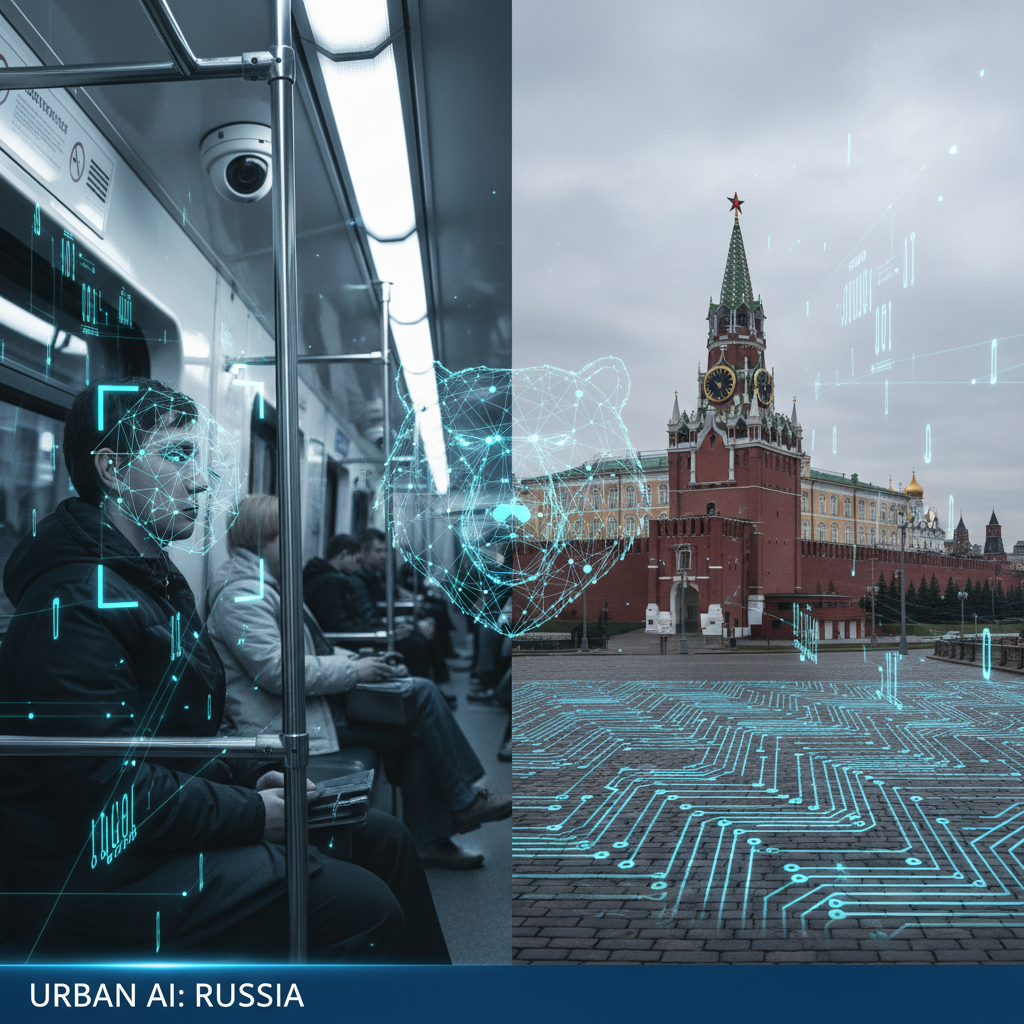

The hum of servers in Moscow's data centers, the silent whir of cameras lining Nevsky Prospekt, these are the unseen orchestrators of Russia's rapidly evolving urban landscape. In the global discourse on AI-powered surveillance, much attention is rightly paid to the tech giants of Silicon Valley or the sprawling digital ecosystems of China. Yet, a more nuanced, and perhaps more immediate, transformation is unfolding within Russia's own smart cities, where the balance between public safety and individual privacy is being recalibrated with stark efficiency.
My investigations into the digital infrastructure of Russian metropolises reveal a concerted effort to integrate artificial intelligence into every facet of urban management. From facial recognition systems in the Moscow Metro, boasting a reported 99.4% accuracy rate according to official statements, to predictive policing algorithms deployed in Kazan, the Kremlin's digital strategy reveals a clear trajectory toward comprehensive digital oversight. This is not merely about convenience or efficiency, it is about control, a concept deeply ingrained in the Russian historical consciousness.
The narrative presented by municipal authorities often centers on enhanced security. "Our citizens deserve to feel safe, whether commuting to work or enjoying a park," stated Ivan Volkov, Head of Moscow's Department of Information Technologies, in a recent public address. "AI helps us achieve this by identifying threats proactively, from petty crime to more serious incidents. The statistics speak for themselves: a 20% reduction in street crime in areas with advanced surveillance, according to our internal reports for 2025." While such figures are compelling, the underlying mechanisms and the extent of data collection raise profound questions that demand scrutiny.
Consider the facial recognition network, a cornerstone of Russia's smart city initiatives. Initially piloted in 2020, by April 2026, it encompasses tens of thousands of cameras across Moscow alone, with similar systems expanding into St. Petersburg, Sochi, and other major urban centers. This system, often powered by domestic developers like NtechLab, a company that has secured significant government contracts, goes beyond simple identification. It integrates with various databases, from police records to public services, creating a comprehensive digital profile of citizens. My sources in the tech sector confirm that the ambition extends to behavioral analysis, flagging 'anomalous' activities that might indicate potential unrest or unauthorized gatherings. This capability, while framed as a tool for crime prevention, also serves as a potent instrument for social control.
The economic impetus for this digital transformation is undeniable. Russian tech companies, often operating under state patronage or with significant state investment, are eager to prove their capabilities and secure lucrative contracts. The sanctions imposed by Western nations have, paradoxically, accelerated the drive for digital sovereignty, fostering a domestic ecosystem for surveillance technologies. "We cannot rely on foreign vendors for critical infrastructure," explained Dr. Elena Petrova, a cybersecurity expert at the Russian Academy of Sciences. "Our national security, and indeed our digital future, depends on developing and deploying our own robust AI solutions. This includes everything from data storage to advanced analytical platforms." This sentiment underscores a broader geopolitical strategy, where technological independence is equated with national strength.
However, the rapid deployment of these technologies often outpaces public debate and regulatory frameworks. While some citizens express comfort with increased security, others voice apprehension. "I feel like I am constantly being watched," shared Svetlana Makarova, a 34-year-old architect from St. Petersburg. "Every time I use public transport, every time I walk through a park, my face is scanned, my movements are tracked. What happens to all that data? Who has access to it? We are told it is for our safety, but it feels more like a cage." Such concerns, while not always loudly articulated in public forums, simmer beneath the surface of urban life.
The legal landscape remains ambiguous. While Russia has data protection laws, their enforcement regarding state surveillance often appears secondary to national security imperatives. There is no independent oversight body with the power to challenge the widespread deployment of these systems or to ensure robust redress mechanisms for citizens whose data might be misused. This lack of transparency and accountability is a recurring theme in my investigations into Russia's digital policies. Wired has extensively covered similar ethical dilemmas in other nations, highlighting the universal nature of these privacy concerns.
Moreover, the concept of a 'smart city' in Russia extends beyond mere surveillance. It encompasses intelligent transport systems, smart utility grids, and digital public services, all interconnected and increasingly managed by AI. The goal, as articulated by Moscow's AI ambitions, tells a bigger story: to create hyper-efficient, highly controllable urban environments. This integrated approach means that data collected from one system can be cross-referenced with another, painting an ever more detailed picture of individual lives. For instance, a traffic violation captured by a smart camera could be linked to an individual's public transport usage, or even their social media activity, if the data streams are merged.
The implications for civil liberties are profound. The ability to track individuals, identify their associates, and even predict their movements based on algorithmic analysis creates an environment where dissent can be swiftly identified and suppressed. The line between preventing crime and monitoring political activity becomes dangerously blurred. "The technology itself is neutral, but its application is not," observed Dr. Alexei Smirnov, a legal scholar specializing in digital rights. "In a system where state power is paramount, advanced surveillance tools inevitably become instruments of that power, regardless of the initial intentions. We must ask: who guards the guardians, and what recourse do citizens truly have?" His words echo the concerns of many who observe the rapid expansion of these capabilities.
While global tech giants like Google and Apple are often scrutinized for their data practices, the Russian context presents a different dynamic. Here, the primary driver is not commercial profit from targeted advertising, but rather state control and national security. This distinction is crucial for understanding the unique challenges faced by Russian citizens. The absence of strong, independent civil society organizations capable of effectively lobbying for privacy rights, coupled with a media landscape largely controlled by the state, further complicates the picture. For a deeper dive into the technical underpinnings of such systems, one might consult MIT Technology Review.
The future of Russia's smart cities, therefore, remains a complex tapestry woven with threads of technological advancement, national ambition, and deeply entrenched geopolitical realities. While the promise of safer, more efficient urban living is alluring, the cost to individual freedom and privacy is a ledger yet to be fully balanced. As the AI systems grow more sophisticated, and their integration more seamless, the questions surrounding their ethical deployment will only intensify. The silent cameras watch, and the algorithms learn, shaping not just our cities, but the very fabric of our society.