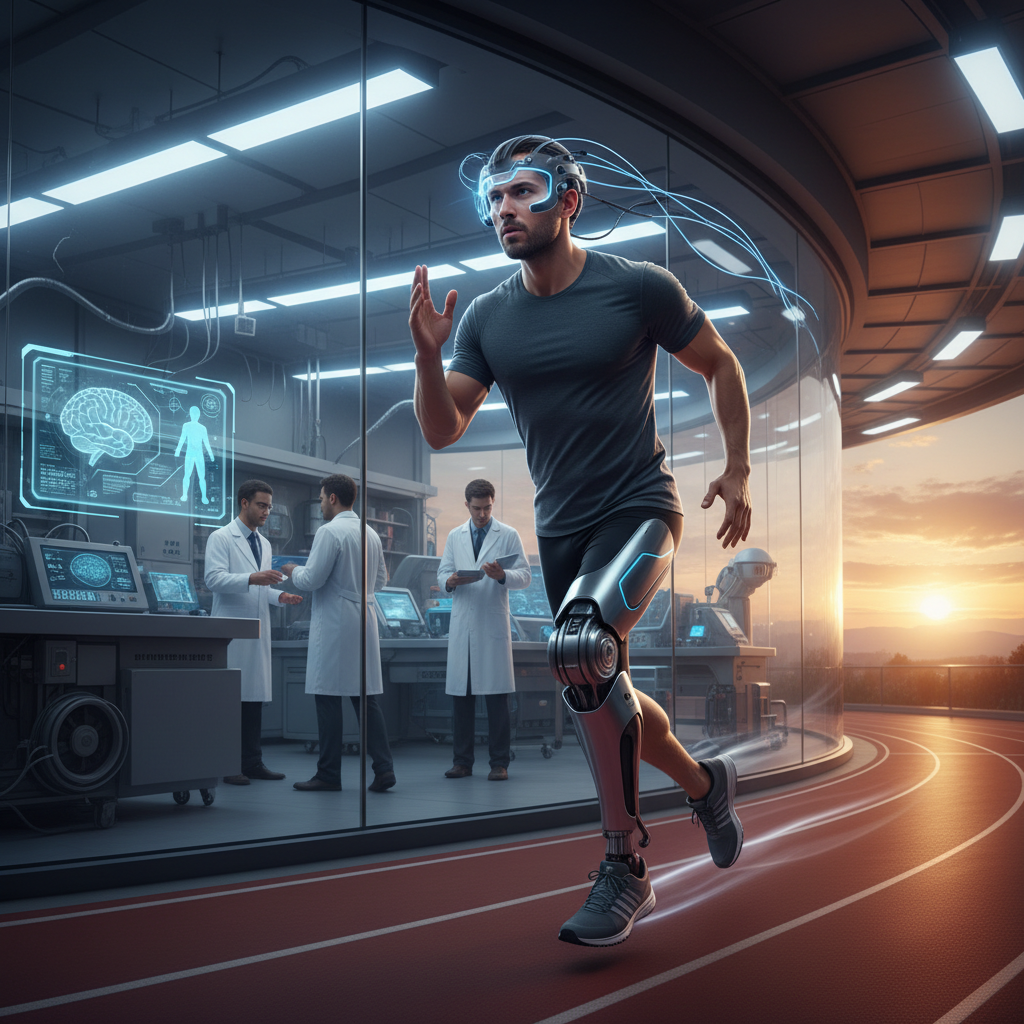

Bonjour, DataGlobal Hub readers. Chloé Tremblàŷ here, reporting from the heart of Canada's burgeoning AI landscape. Today, I want to talk about something truly extraordinary, a technology that feels like it’s leapt straight out of a speculative novel, yet is very much a tangible reality being built in labs around the world, including right here in Montreal. I am referring to brain-computer interfaces, or BCIs, supercharged by artificial intelligence. These aren't just fascinating gadgets; they are profound tools that are literally giving people back their lives, restoring sight, speech, and movement to those who thought these abilities were lost forever.
The Big Picture: Speaking the Brain's Secret Code
So, what exactly are we talking about? At its core, a BCI is a direct communication pathway between an enhanced or wired brain and an external device. Think of it like a translator. Our brains communicate through electrical signals, a complex symphony of neurons firing. For someone who has lost the ability to move a limb, or speak, or even see, those signals are still often there, but the traditional pathways are broken. A BCI steps in to interpret those signals and translate them into commands for a prosthetic limb, a speech synthesizer, or even a visual display. The 'AI-powered' part is where the magic truly happens, turning what used to be a crude dictionary into a sophisticated, context-aware interpreter.
Historically, BCIs were clunky and required extensive training. Patients would spend hours trying to 'think' in a specific way to move a cursor a few pixels. But with the advent of advanced AI, particularly deep learning models, these systems are becoming incredibly intuitive and powerful. They can learn the unique 'dialect' of an individual's brain much faster and with far greater precision. This isn't just about moving a cursor anymore; it's about nuanced control, natural speech, and even rudimentary vision. It's about giving people back agency, and that, my friends, is a truly Canadian value: ensuring everyone has the opportunity to participate fully in life.
The Building Blocks: From Neurons to Neural Networks
To understand how these systems work, let's break down the key components, much like dissecting a maple leaf to understand its intricate veins.
-
The Sensor Array (The Listener): This is the part that connects to the brain. It can be invasive, meaning electrodes are surgically implanted directly into the brain tissue, offering high-fidelity signals. Think of companies like Neuralink, though many academic and medical groups are also doing incredible work here. Non-invasive options, like EEG caps worn on the scalp, are less precise but also less risky. The choice depends on the application and the patient's needs.
-
The Signal Amplifier and Digitizer (The Recorder): The electrical signals from the brain are incredibly faint, like a whisper in a crowded room. These components amplify those whispers and convert them into digital data that a computer can understand. It's like turning an analog radio signal into a crisp digital stream.
-
The AI Algorithm (The Translator): This is the brain of the BCI, often a sophisticated deep neural network. This AI is trained to recognize patterns in the brain's electrical activity and associate them with specific intentions. For instance, a particular pattern might mean 'move hand forward,' another 'say 'hello',' or 'focus on the object to the left.' This is where the heavy lifting of machine learning comes in, transforming raw data into meaningful commands.
-
The Output Device (The Action Taker): This is the prosthetic limb, the speech synthesizer, the computer screen, or any other device that receives the AI's translated commands and performs the desired action.
Step by Step: A Thought's Journey to Action
Let me break down what Mila just published, and other leading research institutions are doing, into a simplified, step-by-step process for how an AI-powered BCI might restore movement:
-
Intention: A person thinks about moving their prosthetic arm to pick up a glass of water. This thought generates specific electrical patterns in the motor cortex of their brain.
-
Detection: The implanted electrodes, or the non-invasive EEG cap, detect these subtle electrical signals. Imagine tiny microphones placed strategically to pick up the specific notes of the brain's symphony.
-
Digitization: These analog electrical signals are then amplified and converted into digital data points, a stream of numbers that the computer can process.
-
AI Interpretation: This digital stream is fed into a pre-trained AI model, often a recurrent neural network or a convolutional neural network, which has learned to associate these specific brain patterns with the intention of moving the arm in a certain way. The AI filters out noise and identifies the relevant command. This is the crucial step where the AI learns the user's unique neural signature for each intended action.
-
Command Generation: The AI translates the interpreted brain patterns into real-time commands for the prosthetic arm, specifying direction, speed, and grip strength.
-
Action: The prosthetic arm receives these commands and executes the movement, allowing the person to pick up the glass of water. Feedback from the arm, sometimes even tactile feedback, can then be sent back to the brain, creating a more natural loop.
A Worked Example: The Power of Speech
Consider someone who has lost the ability to speak due to a neurological condition. Researchers at institutions like the University of California, San Francisco, and Stanford University have made incredible strides in restoring speech. Here's how it works:
- Brain Signals: The patient imagines speaking specific words or even just moving their mouth to form words. This activates areas of the brain associated with speech production.
- Neural Decoding: Electrodes implanted in the speech motor cortex pick up these neural signals. The signals are incredibly complex, representing not just words, but phonemes (the basic units of sound) and even prosody (the rhythm and intonation of speech).
- AI Translation: A sophisticated AI model, often a large language model adapted for neural input, is trained on these signals. It learns to decode the brain activity into sequences of phonemes, then reconstructs them into intelligible words and sentences. This is a monumental task, akin to deciphering an entirely new language from scratch, but the research is fascinating.
- Synthesized Voice: The AI then sends these decoded words to a speech synthesizer, which generates a natural-sounding voice. Early versions sounded robotic, but modern synthesizers are remarkably human-like, capable of expressing emotion and nuance. Imagine the joy of hearing your own voice again, even if it's synthesized. It's a profound breakthrough.
Why It Sometimes Fails: The Bumps on the Information Highway
While the progress is astonishing, BCIs are not without their challenges. It's not always a smooth ride, much like navigating a Canadian winter road.
- Signal Noise: The brain is a busy place, and isolating specific intentional signals from background neural activity or 'noise' is difficult. Non-invasive methods, especially, struggle with this, leading to less precise control.
- Signal Stability: Over time, the quality of signals from implanted electrodes can degrade due to tissue response or electrode movement. This requires recalibration or even replacement, which is invasive.
- Learning Curve: While AI significantly reduces the training burden, users still need to learn how to effectively 'think' for the BCI. It's a two-way street; the AI learns from the user, and the user learns to control the AI.
- Ethical Concerns: Privacy of brain data, potential for misuse, and the very definition of identity when one's thoughts are directly interfaced with machines, are all complex ethical considerations that researchers and policymakers, including those in Canada, are actively grappling with. As Wired often highlights, these are not just technical problems but societal ones.
Where This is Heading: A Future of Enhanced Connection
The future of AI-powered BCIs is incredibly promising. We're seeing rapid advancements on multiple fronts:
- Miniaturization and Wireless: Devices are becoming smaller, more powerful, and increasingly wireless, reducing the burden on users.
- Improved AI Models: Continuous innovation in deep learning will lead to even more accurate, adaptable, and intuitive interpretation of brain signals. We're moving towards BCIs that can anticipate intentions rather than just react.
- Broader Applications: Beyond restoring lost functions, BCIs could enhance human capabilities, from improving focus and memory to enabling telepathic communication in specialized environments. Imagine a future where pilots can control aircraft with their thoughts, or surgeons can perform delicate operations with unparalleled precision.
- Canadian Leadership: Montreal's AI scene is world-class, here's the proof: researchers at Mila, the Quebec AI Institute, and various universities are contributing significantly to the foundational AI research that makes these BCIs possible. Dr. Yoshua Bengio, a pioneer in deep learning and head of Mila, has often spoken about the ethical implications and the potential for AI to augment human capabilities responsibly. "The goal is not to replace human intelligence, but to extend it, to help individuals overcome limitations and achieve their full potential," Bengio reportedly stated in a recent interview with a Canadian publication. This perspective is vital as we navigate this exciting, yet complex, frontier.
The journey from thought to action, from intention to restoration, is becoming shorter and more seamless thanks to the relentless march of AI innovation. It's a testament to human ingenuity, and a powerful reminder of how technology, when wielded with care and purpose, can profoundly improve lives. The ability to give someone back their voice, their movement, their connection to the world, that's not just technology, that's hope embodied. And that, in my books, is a story worth telling. For more on the latest in AI research, keep an eye on MIT Technology Review. The breakthroughs are happening faster than ever. You can also dive deeper into the ethical considerations of AI in healthcare by checking out our previous article on AlphaFold 3's New Tides [blocked].