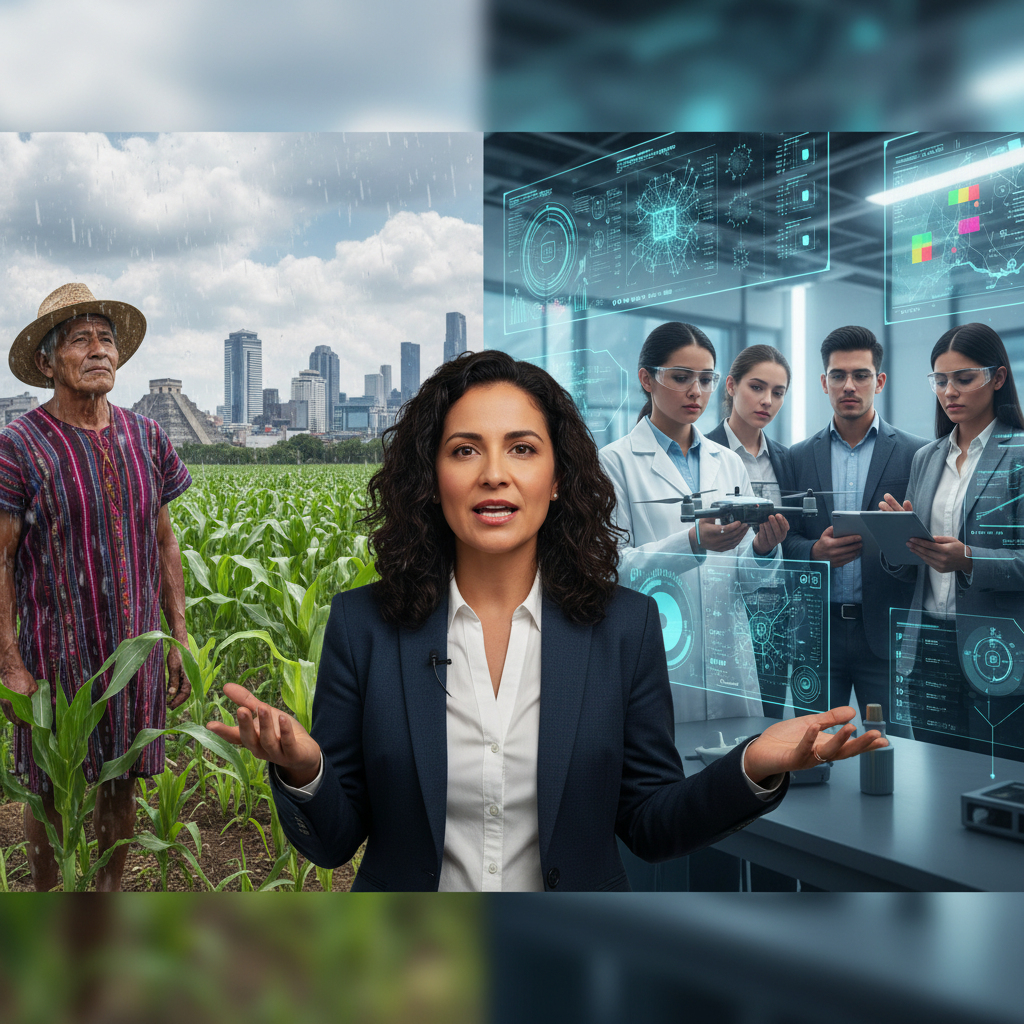

The morning mist still clings to the volcanic peaks surrounding Lake Atitlán, a sacred mirror reflecting the sky. Here, in a small village in Guatemala, María, a woman whose hands tell stories of generations tending the earth, walks through her cornfield. For María and countless others like her, farming is not just a livelihood, it is a way of life, a direct connection to their ancestors and the very soul of their land. But even with deep traditional knowledge, the challenges are immense: unpredictable weather, soil degradation, and the constant threat of pests.
Yet, something new is stirring in these fields, something that blends the wisdom of the elders with the promise of tomorrow. Artificial intelligence, a technology often associated with Silicon Valley boardrooms and urban tech hubs, is finding a vital, human application here, helping María and her community adapt and thrive. It is not about replacing human intuition, but augmenting it, providing tools that speak to the specific needs of these communities.
“For too long, the narrative around technology in agriculture has been top-down, ignoring the nuanced realities of smallholder farmers,” explains Dr. Elena Quispe, an agricultural technologist and founder of Semilla Digital, a Guatemalan startup pioneering AI solutions for indigenous farming communities. Dr. Quispe, who herself comes from a K’iche’ Maya background, understands this intimately. “Our approach is different. We start with the farmer, with their challenges, and then we ask: how can AI be a true helper, a true partner?”
Semilla Digital, for example, is deploying AI-powered drones and ground sensors to monitor crop health with unprecedented precision. These drones, equipped with multispectral cameras, fly over fields, capturing data invisible to the human eye. They can detect early signs of disease, identify nutrient deficiencies, and even predict potential pest outbreaks days before they become widespread. This early detection is a game-changer. Instead of blanket spraying pesticides, which can harm the environment and human health, farmers can target specific areas, reducing chemical use by up to 60% in some pilot programs.
“Imagine knowing exactly which square meter of your field needs attention, rather than guessing,” María tells me, her eyes sparkling with a mix of wonder and pragmatism. “It saves time, it saves money, and it protects our land.” This sentiment is echoed across the region, where Semilla Digital’s pilot projects have shown an average yield increase of 15-20% for corn and beans, staple crops for many Guatemalan families. This is not just about profit, it is about food security, about ensuring there is enough to eat for everyone.
The global interest in agricultural AI is soaring. Companies like IBM and Microsoft are investing heavily in AI for agriculture, developing platforms that offer everything from weather forecasting to supply chain optimization. According to a recent report by Reuters Technology, the global AI in agriculture market is projected to reach over $4 billion by 2027, growing at a compound annual growth rate of nearly 25%. However, Dr. Quispe emphasizes that the challenge lies in tailoring these technologies to local contexts.
“Big tech solutions often assume large, monoculture farms with extensive infrastructure,” Dr. Quispe notes. “That is not our reality here. Our fields are often small, diverse, and sometimes on steep inclines. Our farmers may not have constant internet access or even smartphones.” This is where local innovation truly shines. Semilla Digital’s system is designed to be low-bandwidth, sending critical alerts via SMS messages to basic feature phones. The data analysis happens on edge devices or in a centralized hub, minimizing the need for constant connectivity in the field.
Another fascinating application involves predictive analytics for water management. Guatemala, like many Central American nations, faces increasing water scarcity and erratic rainfall patterns due to climate change. AI models, trained on decades of local weather data, soil moisture readings, and even traditional agricultural calendars, can predict optimal irrigation schedules. “Her grandmother’s wisdom meets machine learning,” I think to myself, watching a young agronomist explain how a simple app advises a farmer when and how much to water their crops, saving precious resources.
“We are seeing a significant reduction in water usage, sometimes up to 30%, in areas where our predictive irrigation system is implemented,” states Ricardo Morales, an agronomist working with Semilla Digital. “This is crucial for sustainability, especially in regions prone to drought.” The system also incorporates traditional knowledge, like planting cycles aligned with lunar phases, demonstrating a beautiful synergy between old and new.
Beyond crop monitoring and water management, AI is also being used for yield optimization. By analyzing historical data on soil type, seed varieties, weather patterns, and past yields, AI algorithms can recommend the best crops to plant in specific plots, the optimal planting density, and even personalized fertilization plans. This level of precision was once unimaginable for small-scale farmers.
However, the path is not without its hurdles. Data privacy, equitable access to technology, and the potential for technological dependence are real concerns. “We must ensure that AI serves the people, not the other way around,” cautions Dr. Quispe. “It is vital that these tools remain affordable, accessible, and truly empower farmers, rather than creating new dependencies on external companies.” She advocates for open-source solutions and community-owned data initiatives to keep control in the hands of the farmers themselves.
Indeed, the ethical implications of AI in agriculture are a topic of ongoing discussion globally. The MIT Technology Review frequently publishes articles on the societal impact of AI, highlighting the need for thoughtful implementation. For Guatemala, the stakes are particularly high. Agriculture is the backbone of the economy, employing a significant portion of the population, especially in rural indigenous communities.
This is a story about resilience, about how the spirit of innovation thrives even in the most unexpected places. It is about a new generation of Guatemalan technologists, like Dr. Elena Quispe, who are not just adopting global trends but adapting them, shaping them to fit the unique rhythms and needs of their homeland. They are proving that AI does not have to be a distant, abstract concept, but a tangible force for good, growing alongside the corn and beans in the fertile soil of Guatemala. The future of food security, rooted in tradition and nourished by technology, is blossoming right here. For more on how AI is impacting global economies, you can explore articles on DataGlobal Hub's Economy section [blocked].