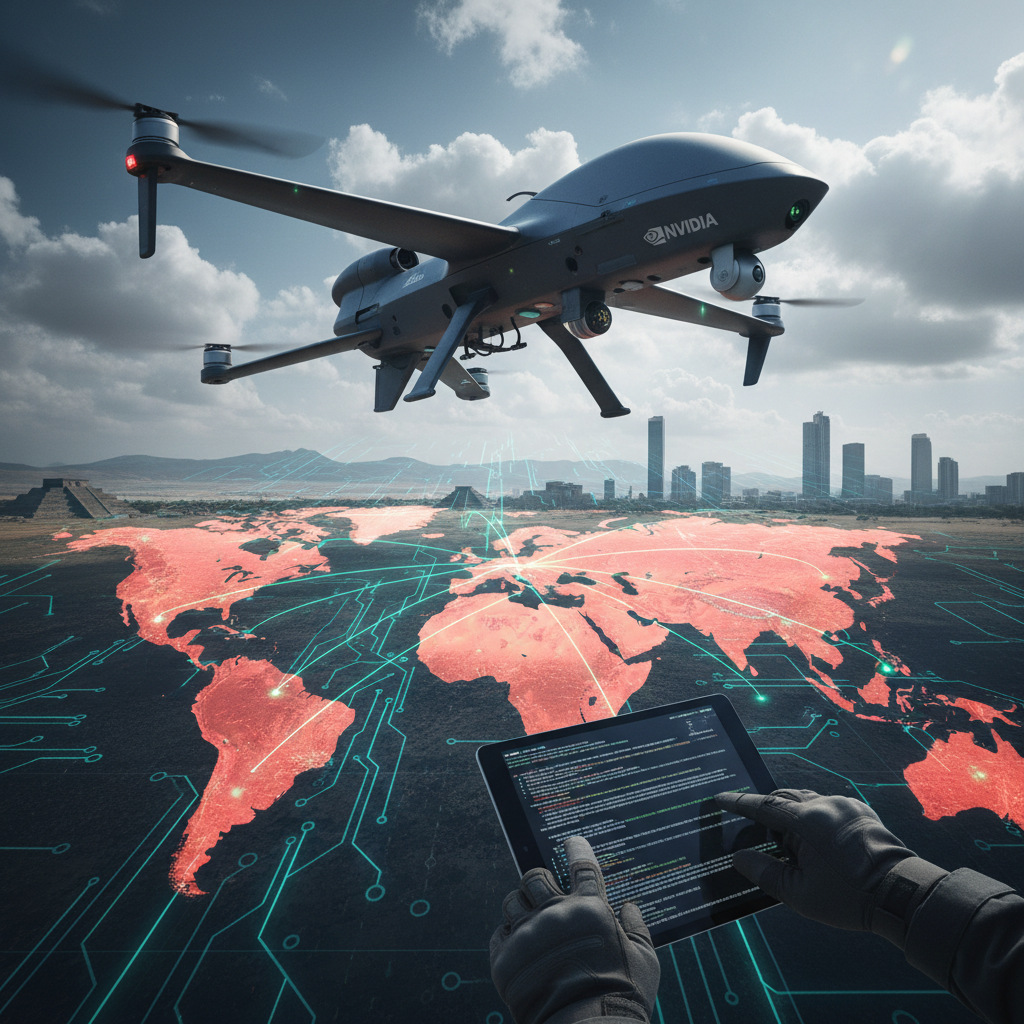

¡Qué onda, DataGlobal Hub readers! Alejandroó Riveràs here, and let me tell you, the world of technology never ceases to amaze me. Every day, it feels like we're living in a sci-fi movie, and right now, one of the most intense plots unfolding is the rise of AI in military applications. We're talking autonomous weapons, drone warfare, and ethical boundaries that feel like they're being drawn in the sand during a hurricane. It's a topic that makes you think, makes you wonder, and honestly, makes you a little bit nervous, but also incredibly fascinated by the sheer ingenuity. This isn't just about big nations anymore; the ripple effects are reaching every corner, including right here in our vibrant Mexico. The nearshoring revolution is real, and with it comes a heightened awareness of global tech trends, especially those with such profound implications.
For years, the idea of machines making life or death decisions on a battlefield was confined to novels and Hollywood blockbusters. But amigos, that future is now. We're seeing an unprecedented acceleration in the development and deployment of AI in military hardware, particularly in drone technology. Think about it: these aren't your grandpa's remote-controlled toys. We're talking about sophisticated systems capable of identifying targets, making tactical decisions, and even coordinating with other autonomous units, all with minimal human intervention. And at the heart of much of this incredible processing power? NVIDIA's specialized AI chips, which are becoming the brains of these next-generation war machines.
NVIDIA, under the visionary leadership of Jensen Huang, has been a powerhouse in AI hardware for years, initially for gaming and then for data centers and machine learning. But their influence has quietly, yet profoundly, extended into defense. Their GPUs, with their parallel processing capabilities, are perfectly suited for the complex computations required for real-time image recognition, navigation, and decision-making in autonomous systems. According to reports, defense contractors globally are clamoring for these chips, integrating them into everything from advanced reconnaissance drones to potential future autonomous combat vehicles. It's a multi-billion dollar market that's growing exponentially, and NVIDIA is at the forefront.
This explosion in capability brings us face to face with some truly profound ethical questions. When a drone, powered by an NVIDIA chip and an advanced AI algorithm, identifies a target and fires, who is responsible? Is it the programmer? The commander who deployed it? The company that built the AI? The very idea of 'killer robots' operating without a human in the loop sends shivers down the spine of many, and rightly so. This isn't just an abstract debate for academics anymore; it's a very real, very urgent conversation that needs to happen now.
Dr. Stuart Russell, a prominent AI researcher and author of 'Human Compatible: Artificial Intelligence and the Problem of Control,' has been a vocal advocate for banning autonomous lethal weapons. He famously stated, and I'm paraphrasing from a public address, "We need to retain meaningful human control over critical decisions, especially those involving the use of force. Otherwise, we risk an arms race that could destabilize global security in unimaginable ways." His concerns are echoed by organizations like the Campaign to Stop Killer Robots, which has been pushing for international treaties to regulate or prohibit these systems. It's a call for a global alto before we cross a point of no return.
Here in Mexico, while our military doctrine is vastly different from global superpowers, we are not immune to these technological shifts. The border regions, for example, have seen an increase in drone usage for surveillance by various actors, both state and non-state. Understanding the capabilities and ethical implications of these technologies is paramount for our own national security and for maintaining regional stability. We might not be developing autonomous combat drones, but the proliferation of this technology globally means we must be informed, prepared, and part of the international dialogue.
The ethical quandaries are complex. Proponents argue that AI can make more objective decisions than humans, reducing civilian casualties by eliminating emotions like fear or anger from the battlefield. They point to the potential for AI to operate in environments too dangerous for humans, saving lives on their own side. However, critics counter that true objectivity is impossible, as AI systems are trained on human-curated data, inheriting biases. Moreover, the 'fog of war' is real; unexpected situations, misidentification, and collateral damage are always possibilities. A machine might not understand the nuances of a surrender, or the difference between a civilian and a combatant in a chaotic environment. The human element, the capacity for empathy and moral reasoning, is something AI simply does not possess.
Companies like Google have faced internal and external pressure regarding their involvement in military AI projects. Remember Project Maven, where Google employees protested the company's work with the Pentagon on AI for drone imagery analysis? That was a wake-up call for many in the tech community. It highlighted the moral responsibility that comes with developing such powerful technologies. While Google eventually decided not to renew its contract, the debate continues for many other tech giants. The Verge often covers these ethical debates, shedding light on the internal struggles within tech companies.
So, what's next? The conversation around a global regulatory framework for autonomous weapons is gaining momentum. The United Nations has been hosting discussions on Lethal Autonomous Weapons Systems, or Laws, for several years. While progress has been slow, the urgency is growing. Countries like China and the United States are pouring billions into AI research, and a significant portion of that is directed towards defense applications. It's a delicate balance between national security interests and the collective moral imperative to prevent an uncontrolled AI arms race.
For us in Mexico, and indeed for all nations, understanding this technological frontier is crucial. It's not just about what's happening in Silicon Valley or Beijing; it's about how these advancements will reshape geopolitics, human rights, and the very nature of conflict. We need to foster robust discussions, encourage ethical AI development, and advocate for international cooperation. MIT Technology Review consistently publishes deep dives into these complex issues, offering valuable perspectives from researchers and policymakers alike.
This Mexican startup just launched an AI ethics think tank focused on Latin American perspectives, which is exactly the kind of initiative we need to see more of. We can't just be consumers of this technology; we must be active participants in shaping its future, ensuring that humanity, not just efficiency, remains at the core of our technological advancements. The stakes couldn't be higher, and the future, as always, is waiting for us to build it, one ethical decision at a time. ¡Hasta la próxima, amigos!