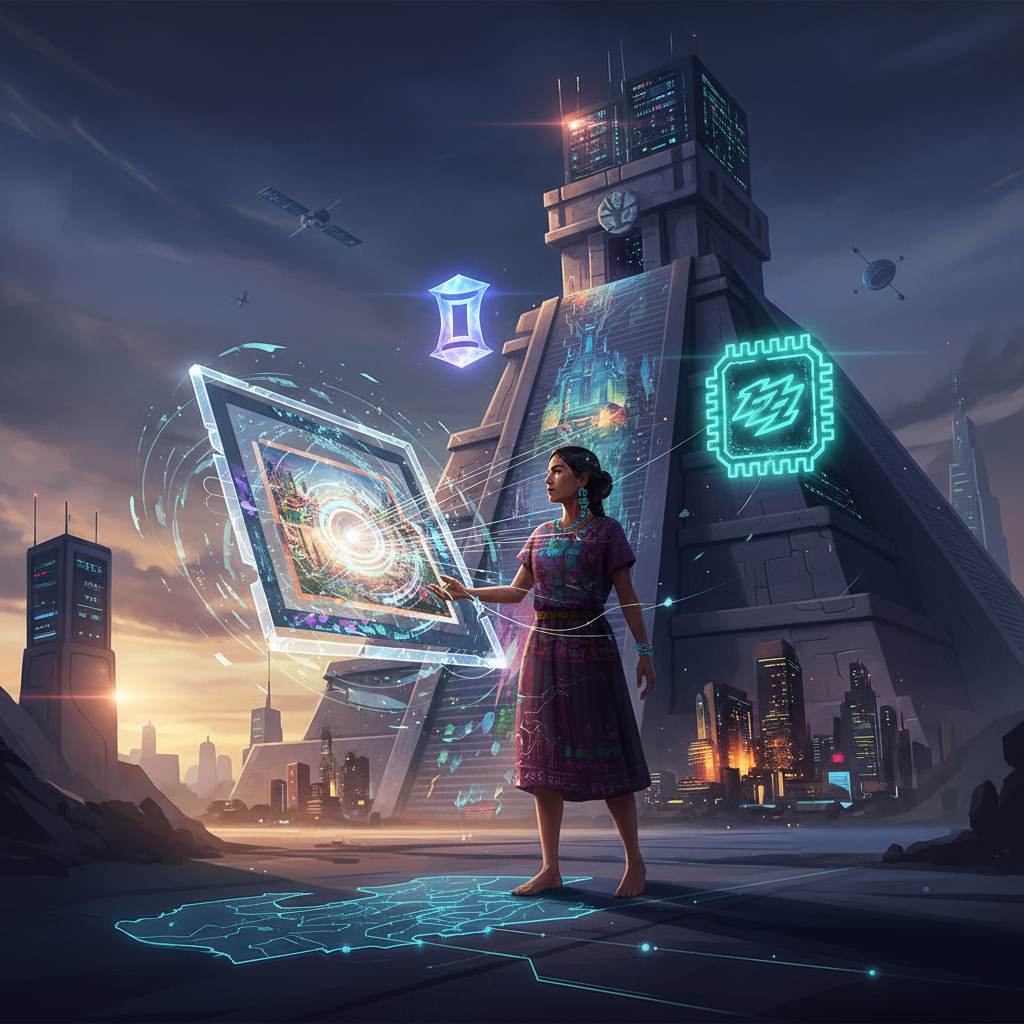

The scent of pine needles and copal smoke still hangs heavy in the air of Chichicastenango’s market, just as it has for centuries. Here, the vibrant textiles woven by Mayan women tell stories passed down through generations, each thread a whisper from the ancestors. Yet, if you walk a little further, past the stalls brimming with colorful huipiles and intricate ceramics, you might find something new: a young artisan, perhaps like María, using a tablet to design patterns with an AI assistant, or a musician refining a traditional melody with a generative music tool.
This is not a scene from a distant future, but a glimpse into Guatemala’s present and near future, where the ancient rhythms of our land are beginning to dance with the rapid pulse of artificial intelligence. The question on everyone’s lips, from the bustling markets of Antigua to the quiet villages nestled in the highlands, is whether this new technology will truly empower our independent creators or if it threatens to unravel the very fabric of their unique artistry. My heart tells me it is a bit of both, a complex tapestry woven with hope and apprehension.
In the next five to ten years, I envision a Guatemala where the creator economy, supercharged by AI, becomes a powerful engine for cultural preservation and economic upliftment, but not without its challenges. Imagine a young K’iche’ artist, Leticia, who lives in a small village in Guatemala, far from any major city. Today, her beautiful pottery might only reach local buyers or tourists. Tomorrow, with tools like Google’s Gemini or specialized AI platforms running on NVIDIA’s powerful GPUs, Leticia could transform her traditional designs into digital assets, create virtual galleries, and reach a global audience on platforms like Etsy or even the metaverse. Her grandmother’s wisdom meets machine learning, creating an entirely new dimension for her craft.
“We are seeing a profound shift in how our artisans can access markets and tell their stories,” explains Dr. Elena Quispe, a leading anthropologist and director of the Ixchel Museum of Indigenous Dress in Guatemala City. “AI tools are not just about efficiency, they are about breaking down geographical barriers and democratizing access to global platforms. For many, it’s the first time they can truly control their narrative and profit directly from their work without intermediaries.” Dr. Quispe believes that by 2030, at least 40 percent of Guatemala’s indigenous artisans will be using some form of AI to enhance their production, marketing, or distribution.
How do we get there from today? The journey began subtly, with simple digital marketing tools and online marketplaces. Now, we are seeing the rise of more sophisticated AI applications. In 2026, we are witnessing the proliferation of affordable, user-friendly AI art generators and music composition tools. Companies like OpenAI and Anthropic are making their models more accessible, and local startups, often inspired by our rich cultural heritage, are building specialized interfaces. For example, a startup called K’ojom AI, based in Quetzaltenango, is developing a platform that helps musicians transcribe traditional Mayan melodies and experiment with new arrangements while preserving their authentic sound. This is a story about resilience, about adapting ancient knowledge to modern tools.
Key milestones on this path include:
- 2027: AI-powered cultural translation and marketing. Imagine an AI that can not only translate product descriptions into dozens of languages but also understand cultural nuances, tailoring marketing messages to specific global audiences. This would be a game-changer for small businesses. We might see platforms emerge that use AI to analyze global trends and suggest new product lines based on traditional Guatemalan crafts, ensuring they remain relevant and desirable internationally.
- 2028: Decentralized Creator Platforms. The current creator economy often relies on large, centralized platforms like YouTube or Spotify, which take a significant cut. In the future, blockchain-based, decentralized platforms powered by AI could emerge, giving creators more ownership and a larger share of their earnings. These platforms could use AI for content moderation, discovery, and even micro-payments, ensuring fair compensation for every digital interaction with a creator's work.
- 2029: Hyper-personalized Cultural Experiences. AI will enable creators to offer deeply personalized experiences. A textile artist might use AI to generate unique patterns based on a customer’s preferences, or a storyteller could create interactive narratives where the audience influences the plot, all while staying true to the cultural context. This elevates the creator from a mere producer to a co-creator with their audience, fostering deeper connections.
- 2030: AI as a Preservation Tool. Beyond creation, AI will become invaluable for preserving endangered languages, oral histories, and traditional crafts. Voice AI could help document and revitalize indigenous languages, and computer vision could catalog and analyze intricate weaving patterns, ensuring their knowledge is never lost. Meta's AI research into low-resource language translation could be particularly impactful here.
However, this bright future is not without its shadows. Who wins and who loses? The early adopters, those with digital literacy and access to technology, will undoubtedly gain an advantage. But what about the artisans in remote areas, who may not even have reliable internet access, let alone a smartphone? There is a real risk of widening the digital divide, leaving behind those who could benefit most from these tools.
“The concern is not just about access, but about authenticity,” says Carlos Morales, a renowned painter from Antigua. “When AI can generate art that looks indistinguishable from human work, what happens to the value of genuine human creativity? Will our unique styles be diluted, or worse, appropriated by algorithms without proper attribution or compensation?” This is a critical question for artists globally, and Wired has explored similar concerns about AI's impact on creative industries.
Indeed, the threat of cultural appropriation by AI is very real. If generative models are trained on vast datasets of indigenous art without consent or fair compensation, it could lead to a digital form of colonialism, where the intellectual property of communities is exploited. Governments and international bodies will need to establish robust ethical guidelines and legal frameworks to protect cultural heritage in the age of AI. We need to ensure that the AI models themselves are trained ethically, respecting intellectual property and cultural sensitivities. This is where companies like OpenAI and Google have a profound responsibility.
What should readers do now? For creators, it’s time to experiment. Start small, explore accessible AI tools, and understand their capabilities. For policymakers and community leaders in Guatemala, the urgent task is to invest in digital infrastructure, provide training programs, and advocate for ethical AI development that respects cultural heritage. We must push for local initiatives that empower our communities, not just consume foreign technologies. The Ministry of Culture and Sports, alongside organizations like the Guatemalan Tourism Institute (inguat), could play a pivotal role in funding these initiatives and creating safe spaces for digital innovation.
This future is not predetermined. It is being shaped by the choices we make today. The creator economy, powered by AI, holds immense promise for Guatemala, a chance to weave new threads of prosperity and cultural pride into our nation’s rich tapestry. But we must approach it with open eyes, ensuring that the technology serves our people, respects our traditions, and amplifies our voices, rather than silencing them. The magic lies not just in the algorithms, but in the hands and hearts that guide them, just like the hands that have woven stories into cloth for millennia. We must ensure that the digital loom is controlled by those whose heritage it represents, not by distant, faceless machines. The future of our culture depends on it. For more on the broader implications of AI on creativity, TechCrunch offers frequent updates on new startups and trends in this space.