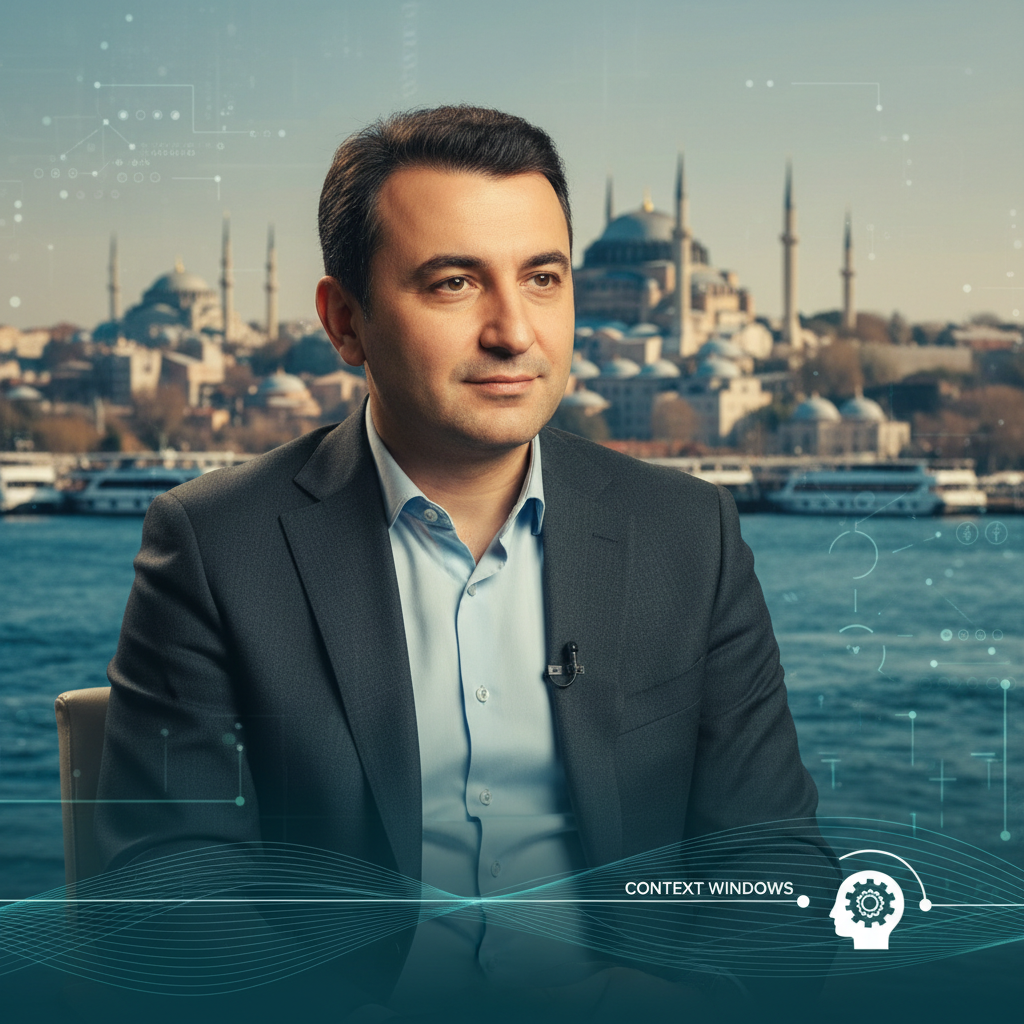

The scent of freshly brewed Turkish tea, strong and inviting, filled the air as I sat across from Cem Dilmegani. Outside, the vibrant chaos of Istanbul's historic streets unfolded, a symphony of old and new. It is a city that bridges two worlds and so does its AI scene, constantly seeking new ways to connect disparate ideas and cultures. Cem, with his thoughtful gaze and calm demeanor, embodies this spirit, building a bridge of his own, one that stretches across the vast chasm of AI context windows.
Cem Dilmegani is not a name you hear every day in the global AI headlines alongside Sam Altman or Satya Nadella, but perhaps you should. He is the founder of AIMultiple, a prominent AI research and advisory firm that has become a quiet powerhouse in understanding and shaping the enterprise AI landscape. While many chase the immediate dazzle of generative AI, Cem has been steadfastly focused on a less glamorous, but arguably more fundamental, aspect of AI's future: the sheer length of information these models can process at once. This, he argues, is the key to unlocking true AI-driven software engineering transformation.
Born and raised in Turkey, Cem’s journey into the heart of artificial intelligence began with a strong foundation in engineering and business. He earned his master's degree from Carnegie Mellon University, a testament to his early ambition and academic rigor. Before founding AIMultiple, he honed his skills in various roles, including strategy consulting at McKinsey & Company, where he advised Fortune 500 companies on technology and digital transformation. This background gave him a unique vantage point, blending deep technical understanding with a pragmatic, business-oriented approach. He saw early on that the real challenge for AI in the enterprise was not just generating text or images, but understanding complex, multi-faceted problems that require processing vast amounts of information.
“The current generation of large language models, while impressive, still struggle with what I call ‘contextual blindness’ when faced with truly large codebases or intricate system architectures,” Cem explained, gesturing subtly with his hand. “Imagine trying to understand the entire Ottoman legal code by reading only a few pages at a time. You would miss the nuances, the interdependencies, the historical context. Software engineering is no different. It is a complex tapestry, not a series of isolated threads.”
This analogy resonated deeply with me. Our history, our culture, our very language here in Turkey, is built on layers upon layers of context. To understand a single proverb, you often need to understand centuries of tradition. Cem believes AI needs this same depth of understanding to truly revolutionize how we build software.
AIMultiple has been a vocal proponent of ultra-long context models, advocating for their development and adoption. Cem has publicly stated that these models, capable of processing millions of tokens, will fundamentally change how developers interact with code. Instead of feeding an AI small snippets of code and hoping it understands the larger system, a developer could theoretically provide an entire repository, a full system design document, or even years of bug reports and feature requests. The AI, with its expansive context window, could then understand the complete picture, identify subtle dependencies, and propose solutions that are truly holistic.
“We are moving beyond mere code generation,” Cem told me, his eyes alight with conviction. “The real prize is code understanding and reasoning at scale. If an AI can hold an entire software project in its ‘mind’s eye,’ it can do more than just write a function. It can refactor an entire module, identify architectural flaws, or even predict future maintenance issues based on historical patterns. This is where the magic happens, where the AI becomes a true partner, not just a tool.”
This vision aligns with the growing industry trend. Companies like Google and Anthropic have been pushing the boundaries of context windows, with Anthropic's Claude 3 models reportedly offering context windows of up to 200,000 tokens, and research labs exploring even larger capacities. Cem sees this as just the beginning. He believes that for AI to truly revolutionize software engineering, context windows will need to expand into the millions, perhaps even billions, of tokens. This would allow an AI to ingest an entire enterprise's codebase, documentation, and operational data, becoming an omnipresent, intelligent assistant for every engineer.
“The implications for productivity are staggering,” Cem noted. “Imagine a world where junior developers can contribute meaningfully to complex legacy systems almost immediately, guided by an AI that understands every line of code written over decades. Or where senior architects can validate design choices against every existing component and every past decision. This is not about replacing engineers; it is about augmenting their capabilities to an unprecedented degree.”
He emphasized that this is not just a theoretical exercise. AIMultiple works with enterprises to implement AI solutions, and they see firsthand the limitations of current models. The ability to handle vast amounts of context is often the bottleneck preventing AI from tackling the most challenging and impactful software engineering tasks. Cem believes that the companies that master ultra-long context models will gain an insurmountable advantage in the coming years, transforming not just software development, but entire industries that rely on complex digital systems.
When I asked him about the challenges, he paused, taking a sip of his tea. “The computational cost is significant, of course. Training and running models with such vast context windows requires immense resources, both in terms of hardware and energy. But these are engineering problems, and history shows us that engineering problems, given enough innovation and investment, are solvable. The real challenge, perhaps, is for humans to adapt to this new paradigm, to trust these highly capable AI partners.”
Cem's perspective is particularly relevant here in Turkey, where a vibrant startup ecosystem is emerging, eager to leverage the latest technologies. Many Turkish companies are looking to AI to leapfrog traditional development cycles and compete on a global scale. The promise of AI that can truly understand and contribute to large-scale software projects offers a compelling path forward. AIMultiple's insights often highlight the practical applications of these advanced AI capabilities for businesses seeking competitive edges.
As our conversation drew to a close, Cem looked out at the bustling street below. “At the crossroads of innovation, we have a choice,” he said. “We can continue to build AI that only sees fragments, or we can push for models that grasp the whole. The latter, I believe, is where the true revolution lies, especially for something as intricate and foundational as software engineering.”
His words echoed in my mind long after I left. In a world where AI is constantly evolving, Cem Dilmegani and AIMultiple are betting on depth over breadth, on understanding over mere generation. It is a quiet, profound bet, one that could reshape the very foundations of how we build the digital world, much like the Bosphorus, connecting continents, connects two vast bodies of water, creating a flow that is both powerful and essential. The future of software engineering, it seems, might just be found in the longest context window of all. For more in-depth analysis on AI trends, one might look to MIT Technology Review. The journey towards these ultra-long context models is certainly one to watch, as it promises to redefine the landscape of AI application in software development and beyond.