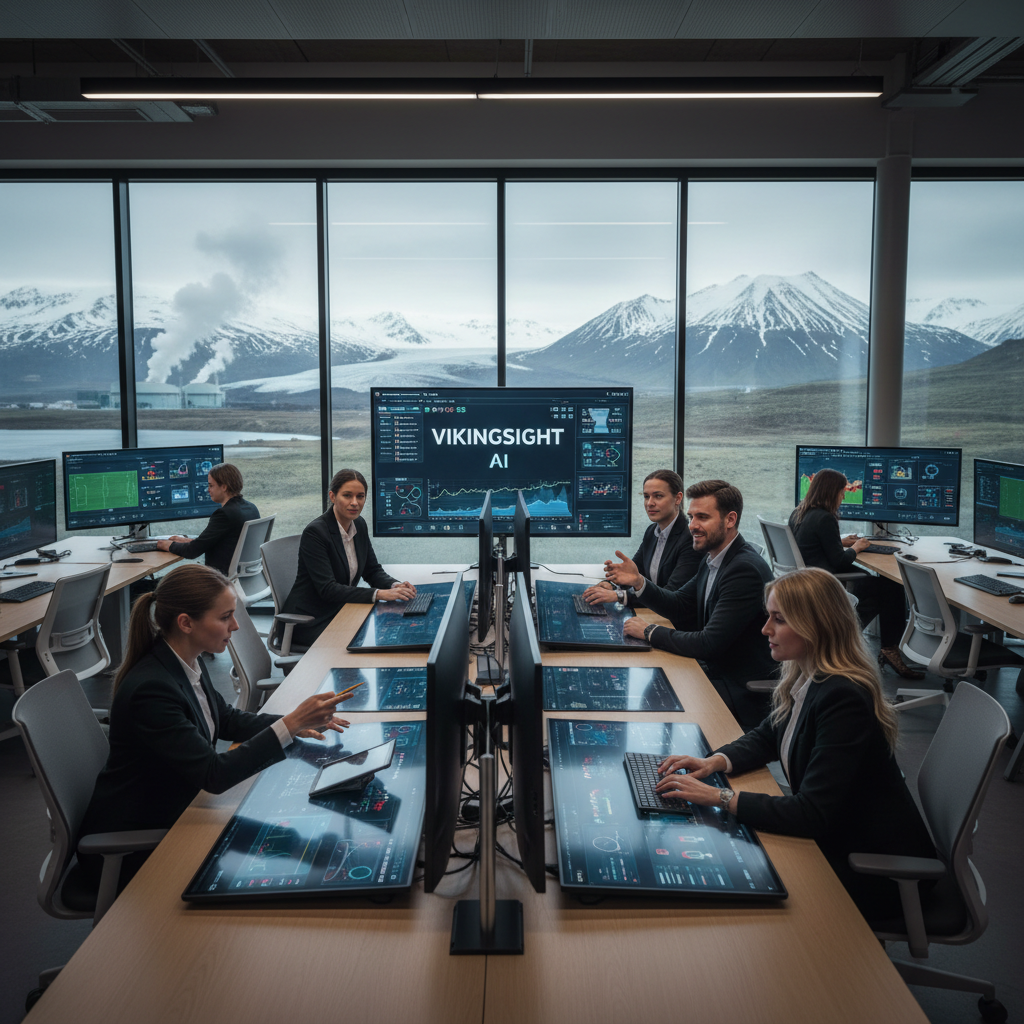
The wind whips around the old fishing hut, now a surprisingly modern office, perched on a cliff overlooking the Atlantic. Inside, the air is thick with the scent of strong coffee and the hum of servers. This isn't Silicon Valley, nor is it London's tech hub. This is Vestmannaeyjar, a small archipelago off Iceland's south coast, and it's the unlikely headquarters of VikingSight AI, a company that's making waves in the high-stakes world of sports analytics.
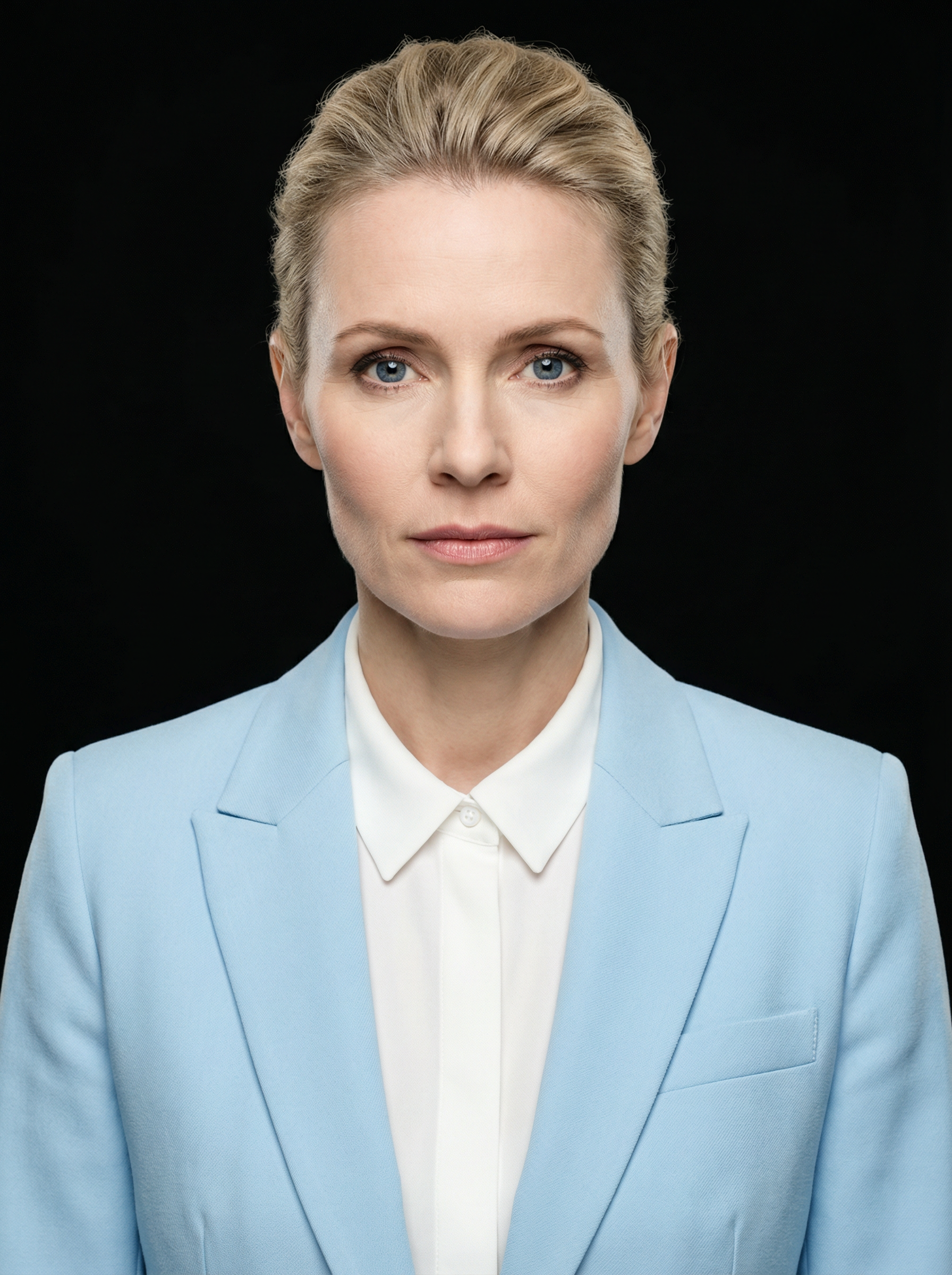
I met Elín Magnúsdóttir, VikingSight AI's CEO, here on a blustery Tuesday in April. She showed me her research in a lab overlooking a glacier, a stark reminder of the raw power and beauty of our island. Elín, with her bright eyes and a no-nonsense demeanor that belies a deep passion for her work, believes that the future of sports isn't just about faster runners or stronger jumpers, but about smarter data. And her company is proving her right, one game at a time.
In a world where Google's Gemini and OpenAI's GPT models are pushing the boundaries of multimodal AI, VikingSight AI has carved out a niche that even the biggest players are struggling to match. They're not just analyzing numbers on a spreadsheet; they're interpreting the subtle nuances of human movement, the strategic flow of a game, and even the emotional state of athletes, all through video, biometric data, and environmental sensors. This is where Iceland's story is unique, and where VikingSight AI finds its edge.
The Genesis of a Giant Slayer
VikingSight AI wasn't born in a gleaming tech campus. It started in 2018, a passion project between Elín, a former national handball coach with a knack for data, and Dr. Björn Helgason, a computer vision expert from the University of Iceland. Their initial goal was simple: to help local youth sports teams understand performance better. They quickly realized the limitations of existing tools, which often missed the 'why' behind the 'what.'
“We saw coaches making decisions based on gut feeling, or on statistics that only told part of the story,” Elín explained, gesturing towards a screen displaying a complex overlay of player movements. “What if we could show them not just that a player missed a shot, but why they missed it? Was it fatigue? A slight shift in balance? A change in the opponent's formation? That's where multimodal AI comes in.”
Their early prototypes, tested on local football and handball teams, quickly garnered attention. By 2020, they secured a modest Series A funding round of $5 million led by Nordic Ventures, allowing them to expand their small team and refine their algorithms. This was followed by a $25 million Series B in 2022 from Sequoia Capital and a substantial $75 million Series C in late 2024, with BlackRock as the lead investor. This funding injection allowed them to scale rapidly, attracting top talent from around the globe to their offices, which now include vibrant hubs in San Francisco, London, and Tokyo, alongside their Vestmannaeyjar base.
The Business of Insight: How VikingSight AI Makes Its Mark
VikingSight AI's business model is elegantly simple yet incredibly powerful: they sell highly specialized, multimodal AI analytics platforms as a service to professional sports organizations. Their core offering, 'VikingPro,' integrates video analysis, wearable sensor data, environmental conditions, and even historical performance metrics to provide predictive insights and real-time tactical recommendations. They don't just process data; they interpret it, offering actionable intelligence.
Their revenue streams are primarily subscription-based, with tiered access to their platform. They also offer bespoke consulting services for elite teams and federations looking for hyper-customized solutions. As of April 2026, VikingSight AI boasts an impressive annual revenue run rate exceeding $120 million, a testament to the demand for their deep insights. They employ over 300 people worldwide, with a significant portion of their R&D team still rooted in Iceland, drawn by the unique environment and the company's commitment to cutting-edge research.
“Our competitive advantage isn't just our technology, it's our philosophy,” said Dr. Björn Helgason, VikingSight AI's Chief Technology Officer. “We're not trying to build a general-purpose AI; we're building an AI that deeply understands the human element in sports. That requires a different kind of data, a different kind of modeling, and a different kind of empathy.”
The Competitive Arena: Outmaneuvering Giants
The sports analytics market is a crowded field, with traditional players like Hudl and Catapult Sports, and even tech behemoths like Google and OpenAI making inroads with their general-purpose AI capabilities. Google's Gemini, with its impressive multimodal understanding, could theoretically analyze sports footage. OpenAI's GPT models could generate reports. But VikingSight AI’s differentiation lies in its vertical specialization and proprietary datasets.
“While Google and OpenAI are building vast, general intelligence systems, VikingSight AI has focused its multimodal expertise on a very specific, complex domain: human performance in dynamic sporting environments,” noted Dr. Anya Sharma, a leading AI analyst at Gartner, in a recent interview with Reuters Technology. “Their deep domain knowledge, combined with an ability to process disparate data types like biomechanics, tactical patterns, and even crowd noise, gives them a significant lead in this niche.”
VikingSight AI's key customers include major sports leagues and teams. The English Premier League's Manchester United, the NBA's Boston Celtics, and even the International Olympic Committee have partnered with VikingSight AI to enhance player development, optimize game strategies, and prevent injuries. They also have a significant partnership with Anthropic, integrating Claude's advanced reasoning capabilities for generating more nuanced textual summaries and strategic recommendations from their data.
Culture and Challenges: The Human Side of AI
Elín's management style is deeply collaborative, reflecting the Icelandic ethos of flat hierarchies and direct communication. “We believe in empowering our teams,” she told me. “The best ideas often come from the people closest to the problem, whether they're in Reykjavík or San Francisco.” This culture has been crucial in attracting and retaining talent in a fiercely competitive market.
However, scaling a company from a small island nation to a global player hasn't been without its challenges. Data privacy, especially concerning biometric and performance data, is a constant concern. “We operate under the strictest GDPR regulations, and we apply those standards globally,” Elín affirmed. “Trust is paramount in this business.” They've also faced the challenge of integrating diverse data sources and ensuring their AI models remain unbiased across different sports, genders, and ethnicities.
An internal debate that often surfaces is the tension between expanding into more sports versus deepening their expertise in existing ones. Some on the team advocate for broader market penetration, while others, including Elín, argue for maintaining their 'deep dive' advantage. “It’s a balance, like any good team strategy,” she mused.
The Bull and Bear Cases
Industry observers are largely bullish on VikingSight AI. The market for sports analytics is projected to grow to over $7 billion by 2030, and VikingSight AI is well-positioned to capture a significant share. Their specialized multimodal AI, proprietary datasets, and strong customer relationships provide a robust moat against generalist AI competitors. The potential for expansion into adjacent markets, such as athlete health and wellness, e-sports, and even military training, is enormous.
“VikingSight AI represents the future of specialized AI applications,” said Jón Karlsson, a tech investor and former CEO of a successful Icelandic biotech firm. “They've shown that you don't need to be in Silicon Valley to build a world-class AI company. In the land of fire and ice, AI takes a different form, often more focused, more resilient.”
However, there are bear cases to consider. The rapid pace of AI development means that even highly specialized models could eventually be replicated or surpassed by larger, better-funded entities like Google or Microsoft, especially as their multimodal capabilities become more sophisticated and customizable. The reliance on high-value contracts with elite teams also makes them susceptible to economic downturns in the sports industry. Furthermore, the ethical implications of hyper-analyzing human performance, and the potential for misuse of such powerful insights, remain a societal challenge that all AI companies must navigate carefully.
What's Next for VikingSight AI?
As I left the office in Vestmannaeyjar, the sun was setting, painting the sky in hues of orange and purple over the churning Atlantic. Elín told me about their plans for the next few years: expanding their AI models to predict injury risk with even greater accuracy, developing personalized training regimens, and even exploring real-time AI coaching assistants for athletes and coaches during games.
VikingSight AI's journey is a powerful reminder that innovation isn't confined to traditional tech hubs. It can emerge from anywhere, even from a small island nation known more for its dramatic landscapes and sagas than for its AI prowess. By putting the human at the center of their technology, and by focusing on deep, specialized insights, VikingSight AI is not just competing with the giants; it's showing them a new way to play the game. Their story is a testament to the power of focused innovation, proving that sometimes, the most profound insights come from the most unexpected places. You can learn more about the broader AI landscape on The Verge's AI section.
For more on how smaller nations are making their mark in the AI world, you might be interested in our article on [Mistral AI's $6 Billion Valuation: Is Europe's Open-Source Gambit a Technical Triumph or a Risky Bet for Nordic Innovation?](/article/mistral-ais-6-billion-valuation-is-europes-open-source-gambit-a-technical- triumph-or-a-risky-bet-for-nordic-innovation-mojn8okk).