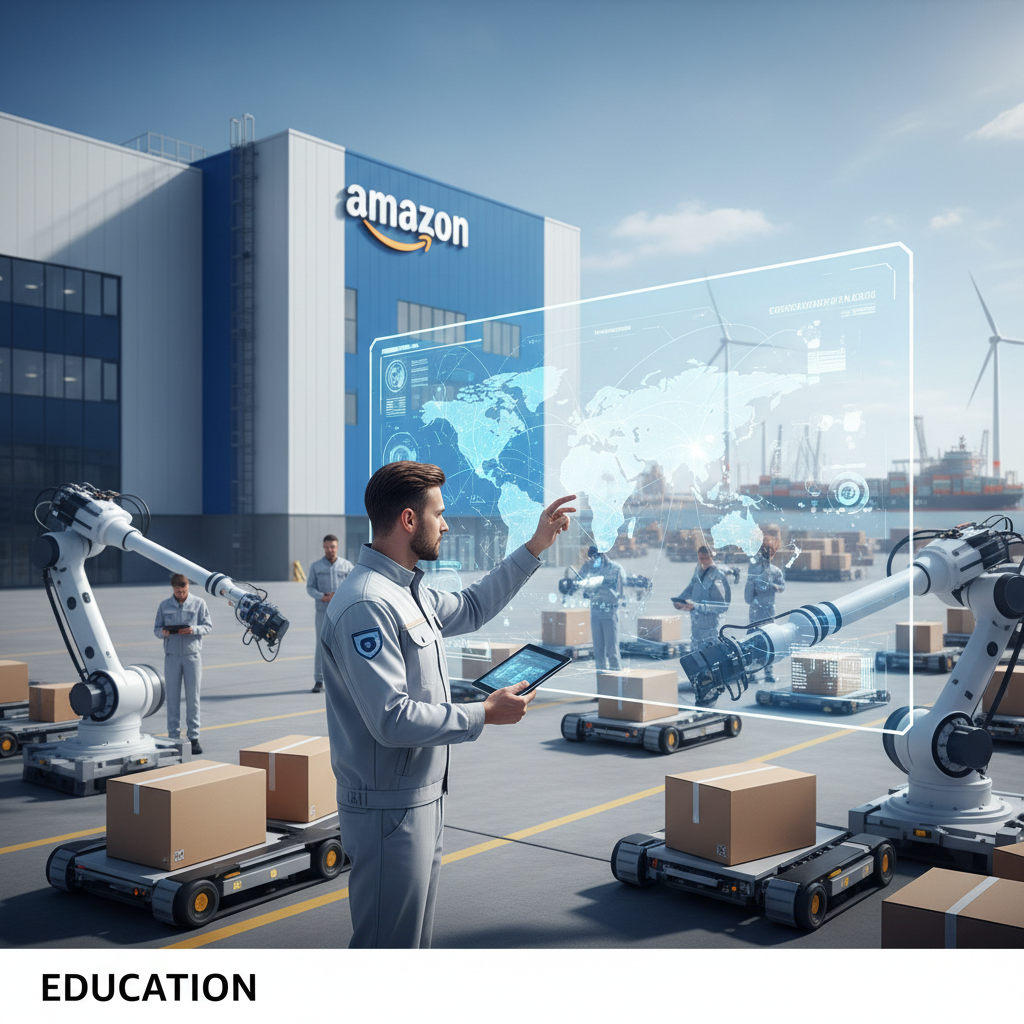

Dzień dobry, everyone! Agnieszka Kowalskà here, bubbling with excitement as always, because what we are witnessing right now with Amazon and its incredible AI-powered logistics network is not just a technological advancement, it is a full-blown revolution. And trust me, it is one that resonates deeply from the bustling ports of Gdańsk all the way to the quiet corners of our Polish villages, impacting us all in ways we are only just beginning to grasp.
The Headline Development: Amazon's Silent, Swift Revolution
For years, we have watched Amazon grow from an online bookseller to a global retail behemoth. But the real magic, the true engine of its dominance, lies not in its flashy website, but in the intricate dance of algorithms and robots within its fulfillment centers. We are talking about a system where artificial intelligence optimizes everything from inventory placement and package routing to the precise movements of robotic arms and autonomous mobile robots. These aren't just simple machines; they are sophisticated AI agents learning and adapting in real time, orchestrating a symphony of efficiency that allows Amazon to deliver millions of items with astonishing speed and accuracy. Just last year, Amazon announced it had deployed over 750,000 robotic units across its global operations, a staggering figure that underscores the scale of this transformation. This isn't science fiction anymore, it is the operational reality of one of the world's largest companies.
Why Most People Are Ignoring It: The Quiet Efficiency
Most people, myself included sometimes, tend to focus on the shiny new gadgets, the latest generative AI models creating art or text, or perhaps the next big social media trend. Amazon's logistics, however, operates largely behind the scenes. It is the invisible infrastructure that makes our one-click shopping possible. We see the package arrive on our doorstep, but we rarely consider the complex ballet of data and robotics that made it happen. This quiet efficiency is precisely why it is so easy to overlook. There is no dramatic press conference for a new warehouse robot, no viral video of an algorithm sorting packages. It is a continuous, incremental optimization that, when viewed in its totality, represents a monumental shift. It is like the plumbing in your house; you only notice it when it breaks, but its constant, unseen work is fundamental to your daily life.
How It Affects YOU: More Than Just Faster Deliveries
So, how does this invisible revolution touch your life, my dear reader? Beyond the obvious benefit of receiving your new kitchen gadget or your favorite Polish pierogi cookbook faster, the impact is profound. For consumers, it means lower prices due to reduced operational costs, wider product availability, and an expectation of instant gratification that is reshaping the entire retail landscape. For businesses, especially small and medium enterprises, it means access to a global distribution network that was once unimaginable, leveling the playing field against larger competitors. However, the impact on employment is a more complex story. While some jobs are automated, new roles are created in robotics maintenance, AI supervision, and data analysis. The question is, are we, as a society, preparing our workforce for this transition? Are our schools and vocational training centers equipping the next generation with the skills needed to thrive in an AI-driven economy? This is particularly pertinent for countries like Poland, where logistics and manufacturing have traditionally been significant employers.
The Bigger Picture: A Global Economic Remapping
Amazon's AI-powered logistics is not just changing how packages move, it is remapping global supply chains and economic power. Countries that embrace this technological shift, and critically, invest in the necessary infrastructure and human capital, stand to gain immensely. Poland, with its strategic location at the heart of Europe and its burgeoning tech sector, is uniquely positioned. We have a growing number of Amazon fulfillment centers, creating thousands of jobs and integrating us deeper into the global economy. This Polish startup just launched an AI-driven inventory management system that integrates seamlessly with major e-commerce platforms, showcasing our local talent. However, there is also the risk of exacerbating existing inequalities if regions or nations fall behind in adopting these technologies. The competition for logistics hubs is fierce, and the efficiency offered by AI and robotics is a major differentiator. This is a matter of national economic strategy, not just corporate efficiency. As Reuters recently highlighted, the race to automate logistics is intensifying globally, with billions being invested annually.