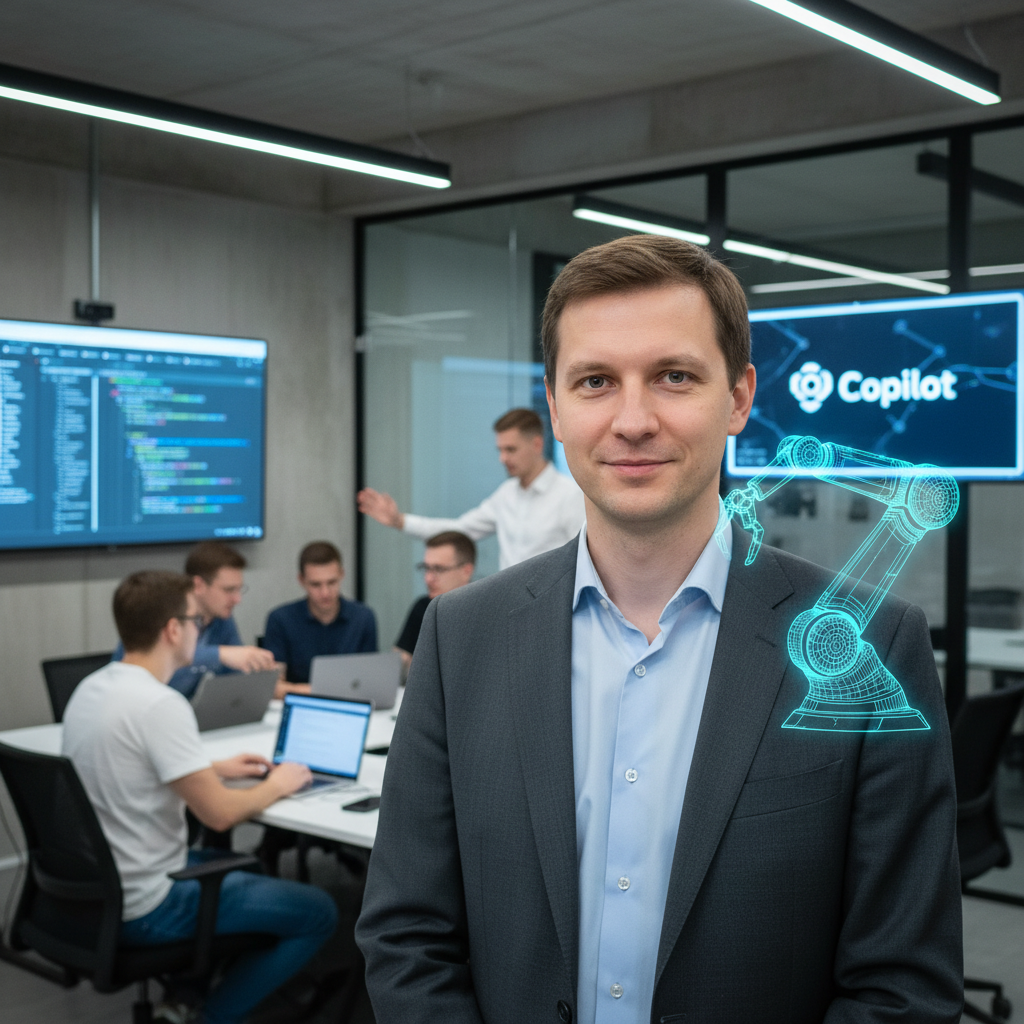

A crisp April morning in Bratislava, the air alive with the promise of spring, finds me buzzing with anticipation. I am here, nestled in one of the city's burgeoning tech hubs, to meet someone who embodies the spirit of innovation I so often champion: Pavol Rusnak. If you are deeply immersed in the world of cryptocurrency and blockchain, his name will undoubtedly ring a bell. He is a co-founder of SatoshiLabs, the company behind the Trezor hardware wallet, a pioneer in digital security. But today, our conversation pivots slightly, focusing on another transformative technology that is reshaping the very fabric of software creation: Microsoft's GitHub Copilot.
Bratislava is having its moment, truly. Our city, once a quiet gem on the Danube, is now a vibrant incubator for tech talent, a place where ideas flourish and digital dreams take flight. This energy, this palpable sense of progress, makes it the perfect backdrop for discussing how AI is not just augmenting, but fundamentally changing, the developer landscape. Pavol, with his characteristic calm demeanor and sharp intellect, offers a perspective that is both grounded in technical reality and soaring with future possibilities.
"The first time I really saw Copilot in action, I admit, I was skeptical," Pavol shares, a faint smile playing on his lips as we settle into a bright, modern meeting room. "As someone who has spent decades writing code, the idea of an AI assisting me felt almost… alien. But then I started using it, and the shift was undeniable. It is not about replacing human ingenuity, but amplifying it." This sentiment, that AI serves as a powerful co-pilot, not a replacement, is a recurring theme in our discussion. It is a crucial distinction, especially for those of us who believe in the enduring power of human creativity.
Pavol's journey into technology began long before the current AI boom. His background is deeply rooted in software engineering and cryptography, fields that demand meticulous attention to detail and profound logical thinking. He is a staunch advocate for open source principles and privacy, values that have guided his work at SatoshiLabs. This foundation gives him a unique lens through which to view the rise of AI-powered coding assistants. "For years, we have been talking about making programming more accessible," he explains. "We have had higher-level languages, better IDEs, but the fundamental barrier of learning complex syntax and logic remained. Copilot, and tools like it, are lowering that barrier in a way we have only dreamed of." He sees it as a democratizing force, allowing more people to translate their ideas into functional software.
Indeed, the statistics are beginning to bear this out. GitHub, the platform behind Copilot, reported that developers using the tool complete tasks significantly faster, with some studies suggesting a 55% increase in coding speed for certain tasks. This is not just a marginal improvement; it is a paradigm shift. Imagine what that means for startups in Central Europe, often operating with leaner teams and tighter deadlines. It means faster iteration, quicker product launches, and ultimately, a more competitive edge on the global stage. Pavol nods in agreement, emphasizing the impact on productivity. "It is like having an incredibly knowledgeable pair programmer always by your side, ready to suggest the next line, catch a potential bug, or even remind you of a library function you might have forgotten," he says. "This frees up mental bandwidth for the more complex, creative problem-solving, which is where humans truly excel."
One of the most fascinating aspects of Copilot, as Pavol points out, is its ability to learn from the vast ocean of public code. It is trained on billions of lines of code, allowing it to understand context and generate relevant suggestions across a multitude of programming languages and frameworks. This means developers, particularly those new to a specific language or project, can get up to speed much faster. "Think of a junior developer joining a complex project," Pavol illustrates. "Instead of spending days just figuring out the common patterns and boilerplate, Copilot can guide them, allowing them to contribute meaningfully almost immediately. This accelerates learning and integration, which is invaluable for talent development, especially in regions like ours." He believes this could be a game-changer for nurturing Slovakia's hidden tech talent, giving our bright young minds an even stronger platform to innovate.
However, the conversation is not without its nuances. The ethical implications of AI-generated code, including potential biases or the propagation of insecure patterns, are topics Pavol takes seriously. "We must be vigilant," he cautions. "These tools are powerful, but they are not infallible. Developers still bear the ultimate responsibility for the code they ship. It is crucial to understand why Copilot suggests something, not just blindly accept it. Education around AI literacy for developers is paramount." This echoes the broader industry discussion around responsible AI development, a topic extensively covered by outlets like MIT Technology Review.
We also touch upon the future trajectory of these AI assistants. Pavol envisions a future where these tools become even more sophisticated, moving beyond mere code completion to understanding higher-level architectural decisions and even interacting with natural language more seamlessly to generate entire components or systems. "Imagine telling your AI assistant, 'Build me a secure API endpoint for user authentication using these specifications,' and it generates a robust, tested solution," he muses, his eyes lighting up. "That is the direction we are heading. It will transform the very definition of a 'developer.'"
For Pavol, the excitement is palpable, not just for the technological marvel itself, but for what it enables. He sees a future where the barriers to entry for creating technology are lower than ever, fostering a global ecosystem of innovation. "It is about empowering individuals," he states, "allowing them to build things that were previously out of reach due to time or complexity constraints. This is Central Europe's quiet revolution, happening one line of AI-assisted code at a time." This vision resonates deeply with me, as I have always believed in the untapped potential within our region.
As our interview concludes, I am left with a profound sense of optimism. Pavol Rusnak, a man who has built his career on securing digital futures, now sees AI as a key to unlocking new creative possibilities in software development. Microsoft's GitHub Copilot is more than just a coding tool; it is a catalyst, a mentor, and a partner for developers worldwide. It is accelerating the pace of innovation, making the complex accessible, and empowering a new generation of builders. The future of software, shaped by human ingenuity and AI collaboration, looks incredibly bright from our vantage point here in Bratislava. For more insights into the evolving AI landscape, you can often find cutting-edge analysis on TechCrunch's AI section. The journey of AI in software development is just beginning, and it is a thrilling ride to witness, especially when championed by brilliant minds like Pavol's. You can also explore the latest in AI business news on Bloomberg Technology.
It is clear that the integration of AI into our daily coding lives is not a passing fad. It is a fundamental shift, one that demands adaptation, critical thinking, and a willingness to embrace new paradigms. Pavol's perspective reminds us that while the tools change, the core human drive to create, to solve problems, and to build a better future remains constant. And with AI as our co-pilot, that future feels closer than ever.