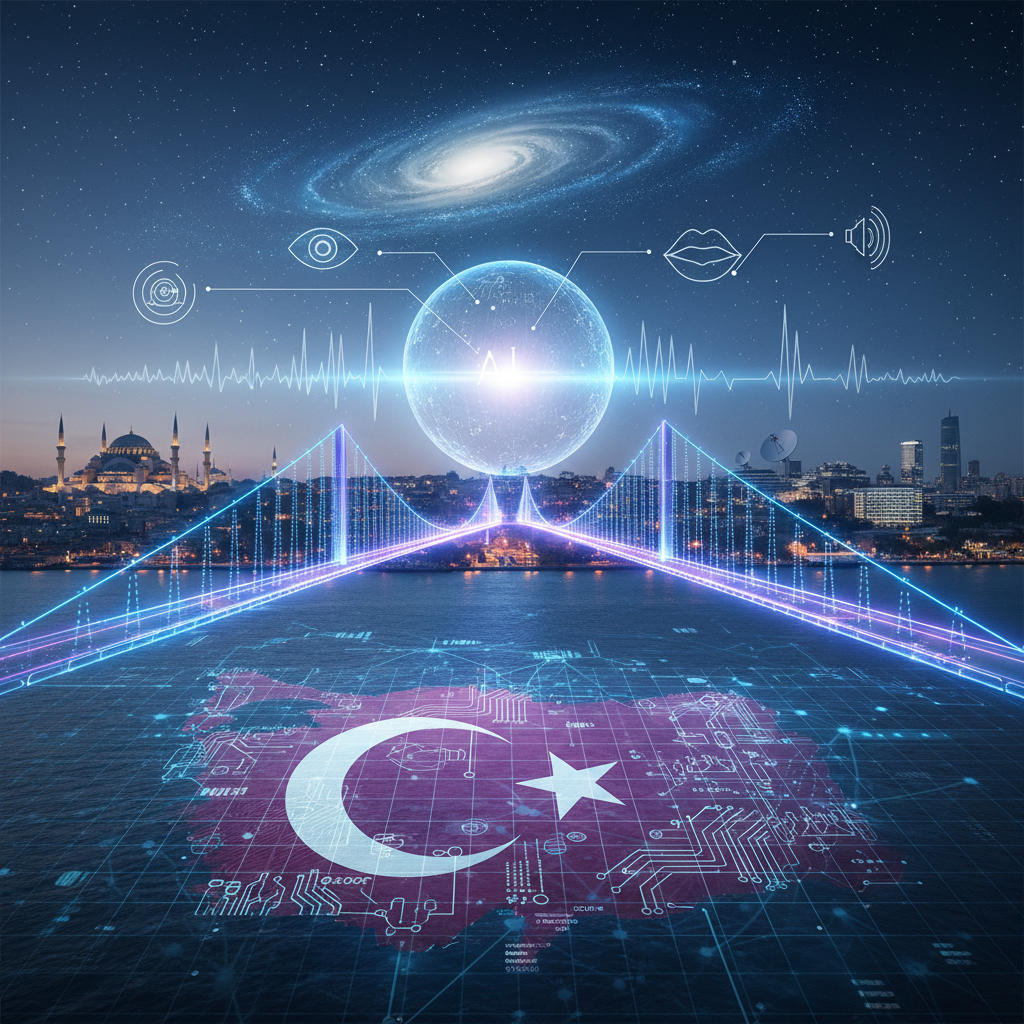

The Bosphorus Strait, a ribbon of sapphire water, has always been more than just a geographical divide; it is a symbolic bridge connecting continents, cultures, and ideas. In the bustling heart of Istanbul, where ancient history breathes alongside gleaming skyscrapers, a new kind of bridge is being built, one that seeks to connect the human mind directly with machines. This is the world of brain-computer interfaces, or BCIs, powered by artificial intelligence, and its promise to restore sight, speech, and movement is nothing short of miraculous.
For years, the idea of thought controlling technology felt like something out of a science fiction novel, a distant dream. Yet, here we are in April 2026, witnessing breakthroughs that are transforming lives with breathtaking speed. Companies like Neuralink, Synchron, and Blackrock Neurotech are no longer just concepts; they are actively developing and testing devices that allow individuals to type with their minds, control robotic limbs, or even experience rudimentary forms of vision. The underlying engine for much of this progress, the silent orchestrator behind these incredible feats, is AI.
I recently sat down with Dr. Elif Kaya, a lead neuroscientist at Istanbul Technical University, over a steaming cup of Turkish tea. She told me her story over Turkish tea, explaining the intricate dance between neurons and algorithms. “Imagine a patient who has lost the ability to speak due to a stroke,” she began, her eyes bright with passion. “Traditional therapies offer limited recovery. But with an AI-powered BCI, we can decode the neural signals associated with the intention to speak and translate them into synthesized speech. It is not just about restoring function; it is about restoring identity and connection.”
Dr. Kaya’s team, in collaboration with a local Turkish startup called NeuroLink Türkiye, is developing a non-invasive BCI system that uses advanced machine learning models to interpret electroencephalography, or EEG, signals. Their early trials with patients suffering from locked-in syndrome have shown promising results, with participants able to communicate choices and even short sentences at speeds approaching 15 words per minute. This might not sound fast, but for someone trapped in their own body, it is a lifeline.
The global investment in BCI technology is staggering. According to a recent report published in Reuters Technology, venture capital funding for BCI startups surged by over 40% in 2025, reaching an estimated $1.8 billion worldwide. Major players like Google DeepMind and Meta AI are heavily invested in fundamental research, exploring how AI can better interpret complex neural data, reduce latency, and improve the fidelity of sensory feedback. NVIDIA, with its powerful GPUs, is providing the computational backbone for many of these advanced AI models, accelerating the training processes that are crucial for real-time BCI operation.
One of the most compelling applications is in restoring sight. While full, natural vision remains a distant goal, AI is making significant strides in providing functional sight for the blind. Companies like Second Sight, though facing their own challenges, paved the way. Now, newer approaches, often involving AI to interpret signals from retinal implants or direct cortical stimulation, are showing greater promise. These systems use AI algorithms to process visual information from a camera, translate it into electrical impulses, and send those impulses directly to the brain’s visual cortex, bypassing damaged eyes. The brain then learns to interpret these new patterns as visual input. It is a complex process, akin to teaching the brain a new language, but AI’s pattern recognition capabilities are proving invaluable.
Professor Emre Can, a bioengineer at Boğaziçi University, emphasized the ethical considerations. “As we delve deeper into interfacing with the brain, questions of privacy, data security, and even identity become paramount,” he stated during a recent conference in Ankara. “Who owns your thoughts if they are being decoded by an AI? What are the implications for human autonomy? These are not just technical problems; they are profound societal challenges that we must address proactively.” His research focuses on developing robust encryption methods for neural data and creating transparent AI models that explain their interpretations, fostering trust between user and machine.
Movement restoration, particularly for individuals with paralysis, is another area where AI-powered BCIs are making incredible progress. Imagine someone who cannot move their arm, yet can control a sophisticated robotic prosthetic with their thoughts, picking up a glass of water or even writing their name. This is happening. Researchers at Stanford University, for instance, have demonstrated AI systems that can decode intended movements from brain signals with remarkable accuracy, allowing paralyzed individuals to control cursors on screens or operate robotic arms with fluidity. The AI learns the user’s unique neural patterns for different movements, continuously refining its understanding and improving control.
In Turkey, the Ministry of Health has recently announced a new initiative, “Anadolu Beyin Köprüsü” or “Anatolian Brain Bridge,” dedicating significant funding to BCI research and development within the country. This initiative aims to foster collaboration between universities, hospitals, and local tech companies, positioning Turkey as a regional hub for neurotechnology. “Istanbul bridges two worlds and so does its AI scene,” remarked Ayşe Demirci, CEO of NeuroLink Türkiye, during the announcement. “We have the talent, the drive, and a deep cultural understanding of the human need for connection and autonomy. This initiative will allow us to accelerate our impact, not just for our own citizens, but for the wider region.”
The challenges, of course, are immense. The human brain is an incredibly complex organ, and our understanding of its workings is still nascent. Developing BCIs that are safe, reliable, long-lasting, and truly intuitive requires overcoming hurdles in neuroscience, materials science, and, crucially, artificial intelligence. The AI models need to be robust enough to handle the noisy, variable nature of neural signals, adapt to changes in the brain over time, and perform with near-perfect accuracy in real-time.
Yet, the potential rewards are too great to ignore. The ability to restore lost senses, to give a voice back to the voiceless, and to grant movement to those who are paralyzed represents a profound leap forward for humanity. At the crossroads of innovation, where ancient wisdom meets cutting-edge technology, Turkey is not just observing this revolution; it is actively contributing to it, ensuring that the future of AI-powered BCIs is built on a foundation of empathy and human-centered design. It is a future where technology serves to amplify the human spirit, not diminish it, and that is a story worth telling. For more insights into the broader AI landscape, you can explore articles on MIT Technology Review. The journey has just begun, and the human stories emerging from this frontier are only just starting to unfold.