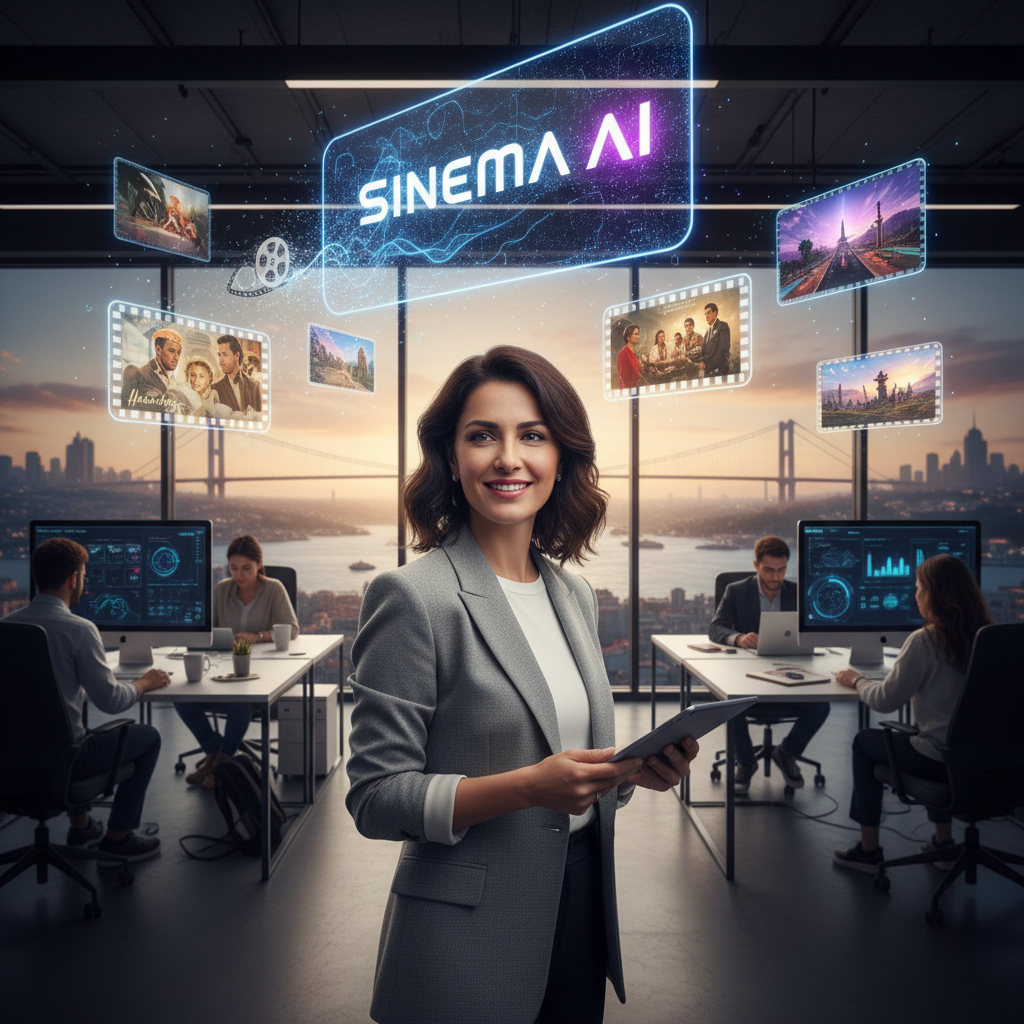

The aroma of freshly brewed Turkish tea still lingers in my memory from my last visit to Leyla Erdem's bustling office, tucked away in a historic building overlooking the Golden Horn. It is a place where the past whispers from every stone, and the future is being coded into existence. Leyla, with her bright, inquisitive eyes and a spirit as vibrant as the Grand Bazaar, is not just another tech entrepreneur, she is a storyteller at heart, a modern-day Karagöz and Hacivat, but for the digital age. Her startup, Sinema AI, is at the crossroads of innovation, poised to revolutionize how we conceive, produce, and consume cinematic content.
“My grandmother used to tell me stories that felt so real, I could almost taste the baklava and hear the seagulls,” Leyla recounted, stirring her tea. “I always wondered, what if everyone could bring their stories to life with such vividness, without needing a Hollywood budget or a massive studio behind them?” This, she explained, was her 'aha moment.' Growing up in Istanbul, a city that bridges two worlds and so does its AI scene, Leyla witnessed the rich tapestry of Turkish culture and its myriad narratives. Yet, she also saw the immense barriers to entry in traditional filmmaking, especially for independent creators or those outside the established Western film industry. After completing her studies in computer science at Boğaziçi University and a stint at Google's DeepMind working on generative models, she returned home with a singular vision: to democratize filmmaking through artificial intelligence.
The Problem Sinema AI is Solving: The Bottleneck of Production
Traditional film and television production is notoriously expensive, time-consuming, and resource-intensive. A single minute of high-quality animation or visual effects can cost tens of thousands of dollars and require teams of artists working for weeks. This financial and logistical hurdle stifles creativity, pushing unique voices to the fringes. Leyla saw this not just as an economic problem, but as a cultural one. “Think of all the incredible stories from Anatolia, from the Black Sea region, from our vibrant diaspora, that never see the light of day because of these constraints,” she lamented. Sinema AI aims to dismantle these barriers, offering a platform where a director's vision can leap from script to screen with unprecedented speed and affordability.
The Technology: From Text to Cinematic Universe
Sinema AI’s core technology is a proprietary generative video model, codenamed 'Hacivat,' after the witty character from Turkish shadow puppetry. Unlike general-purpose video generation tools from giants like OpenAI's Sora or Google's Lumiere, Hacivat is specifically trained on a vast dataset of cinematic content, including a diverse array of global films, television series, and animated features, with a significant emphasis on European and Middle Eastern cinematic styles. This specialized training allows Hacivat to understand and replicate complex narrative structures, character consistency, and stylistic nuances that are crucial for compelling storytelling.
“Hacivat isn’t just stitching clips together,” Leyla emphasized. “It’s learning the grammar of cinema. You feed it a detailed script, character descriptions, mood boards, even voice-overs, and it generates high-fidelity video sequences, complete with virtual sets, digital actors, and dynamic camera movements.” The platform offers granular control, allowing filmmakers to adjust everything from lighting and character expressions to costume details and scene transitions. It can generate a 90-second scene in under an hour, a task that would typically take weeks for a team of animators and VFX artists. This speed and efficiency are game-changers, particularly for pre-visualization, independent productions, and rapid prototyping of concepts.
Market Opportunity: A $400 Billion Industry Ripe for Disruption
The global film and video production market is projected to exceed $400 billion by 2027, according to recent industry reports. Within this massive market, the demand for content is insatiable, fueled by streaming wars and the proliferation of digital platforms. However, budgets are often stretched thin, and the pressure to produce more, faster, is constant. Sinema AI positions itself as a critical solution for this pressure point. “We’re not replacing human creativity, we’re augmenting it,” Leyla clarified. “Imagine a small studio in Izmir, now able to compete with a major production house in Los Angeles, simply because they have access to tools that level the playing field.”
Sinema AI is targeting three main segments: independent filmmakers and content creators, who gain access to professional-grade production capabilities; small to medium-sized production houses, looking to reduce costs and accelerate their pipelines; and large studios, which can leverage the platform for rapid prototyping, pre-visualization, and generating supplementary content. Early adopters have reported a 60% reduction in pre-production costs and a 40% faster turnaround time for visual effects heavy sequences. The company projects to capture 2-3% of the global content creation market within five years, translating to a multi-billion dollar valuation.
Competitive Landscape: Giants and Nimble Innovators
The generative AI video space is becoming increasingly crowded, with tech behemoths and well-funded startups vying for dominance. OpenAI's Sora, Google's Lumiere, and Meta's Emu Video are powerful general-purpose tools, capable of generating impressive short clips. However, Leyla believes their broad approach leaves a significant gap. “They are like general-purpose paintbrushes, we are a specialized film camera,” she explained. “Our focus on narrative consistency, cinematic grammar, and deep stylistic control sets us apart.”
Other notable players include RunwayML, which offers a suite of AI-powered video editing tools, and startups like Pika Labs, focusing on more accessible video generation. Sinema AI’s differentiation lies in its holistic approach to narrative generation, its sophisticated control mechanisms, and its cultural sensitivity, particularly its ability to render diverse human characters and environments with authenticity. “We’ve spent countless hours ensuring our models understand the nuances of different cultures, not just a homogenized Western aesthetic,” said Dr. Can Yılmaz, Sinema AI’s lead AI researcher, who previously worked on character animation at Pixar. “This is crucial for global storytelling.”
Funding and What's Next: A Global Ambition from a Local Heart
Sinema AI recently closed a Series A funding round of $35 million, led by a consortium of European and Middle Eastern venture capitalists, including Istanbul-based 212 Ventures and London's Atomico. This brings their total funding to $42 million. The investment will be used to scale their engineering team, expand their cloud infrastructure, and develop more specialized modules for genres like historical dramas and science fiction.
Leyla's immediate plans include launching a public beta of Hacivat later this year, followed by an enterprise version tailored for larger studios. She also envisions a marketplace where artists can sell AI-generated assets, styles, and even entire narrative templates, fostering a new creative economy. “We want to empower a new generation of filmmakers, not just in Hollywood, but in Bollywood, Nollywood, and yes, even Yeşilçam,” she said, referencing Turkey's vibrant, historical film industry. “The future of cinema isn't just about what we watch, but who gets to tell the story. And with Sinema AI, everyone gets a voice.”
As I left Leyla's office, the setting sun cast a golden glow over the Bosphorus, illuminating the silhouette of ancient mosques and modern skyscrapers. It felt symbolic, a perfect reflection of Sinema AI itself: rooted in tradition, yet reaching for the stars. The question of whether AI will be Hollywood's revolution or its destruction still hangs in the air, but Leyla Erdem and her team are certainly making a compelling case for the former, proving that the most profound innovations often emerge from the most unexpected, and culturally rich, places. For more insights into generative AI, you might find this overview on TechCrunch helpful, or explore the broader implications of AI in creative fields on Wired. The landscape is shifting rapidly, and companies like Sinema AI are at the forefront of this exciting transformation. I believe we are on the cusp of a truly global cinematic renaissance, powered by the ingenious minds like Leyla's. You can also read about how other AI companies are impacting different sectors, like how IBM Watson is making an encore in Europe [blocked], showing the diverse applications of AI across industries.