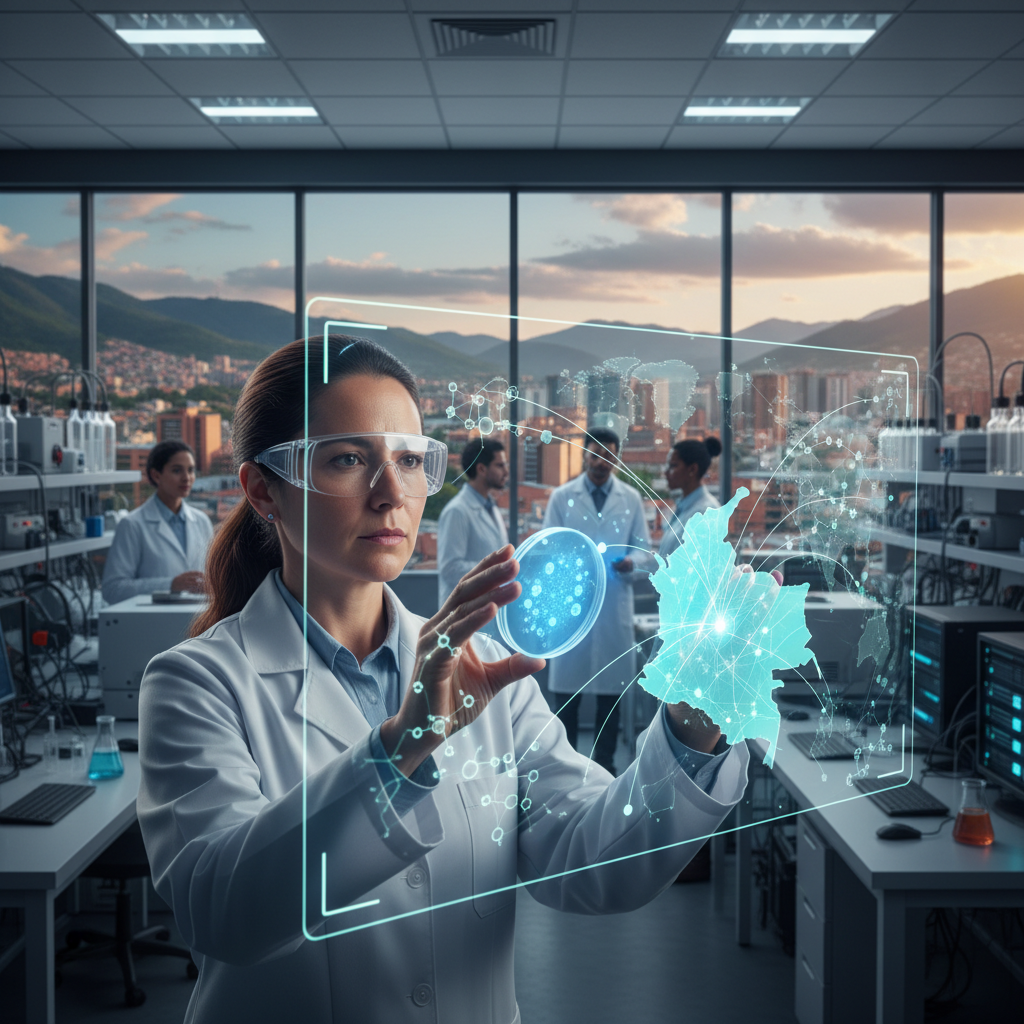

The air in Bogotá, even with its usual bustle, feels different these days. There is a hum, a quiet but insistent energy that speaks of change, of progress, and of a future being built not just in Silicon Valley, but right here in the heart of Latin America. We are witnessing a revolution, one where the intricate dance of artificial intelligence and gene editing is promising to rewrite the very fabric of medicine. For Colombia, a nation scarred by decades of conflict and health disparities, this is not just a scientific curiosity, it is a profound opportunity.
For too long, the narrative of advanced medical breakthroughs has been dominated by a select few, often leaving developing nations to play catch-up, or worse, to be excluded entirely. But the fusion of Crispr technology, that revolutionary gene-editing tool, with the predictive power of machine learning, is creating a new paradigm. Imagine a future where diseases once considered untreatable, from genetic disorders to stubborn cancers, can be addressed with unprecedented precision, tailored not just to a population, but to an individual's unique genetic blueprint. This is the promise, and frankly, the imperative, that AI-powered gene editing brings to our doorstep.
My conviction, as a journalist and as a Colombian, is that this is about more than technology because it's about justice. It is about ensuring that the benefits of these incredible advancements reach everyone, not just the privileged few. We have a moral obligation to leverage these tools to heal our communities, to mend the wounds of the past, and to build a healthier future for all our citizens.
Consider the groundbreaking work happening at institutions like the Universidad Nacional de Colombia, where researchers are exploring how AI algorithms can accelerate the identification of optimal Crispr guide RNAs, drastically reducing the time and cost associated with gene therapy development. “The computational power of AI allows us to sift through genetic data at a scale unimaginable just a decade ago,” explains Dr. Elena Rojas, head of the Bioinformatics Department at Universidad Nacional. “We are moving from trial and error to intelligent design, making gene editing more efficient and, crucially, more accessible.” Dr. Rojas emphasizes that this shift is particularly vital for conditions prevalent in our region, like certain inherited blood disorders or even novel viral threats, where rapid, targeted interventions are paramount.
Globally, giants like Google DeepMind and NVIDIA are pouring resources into this space, developing sophisticated AI models that can predict the efficacy and off-target effects of Crispr edits with remarkable accuracy. DeepMind's AlphaFold, for example, has already revolutionized protein folding prediction, a foundational step in understanding disease mechanisms and designing therapeutic interventions. Now, similar AI architectures are being adapted to understand the complex interactions within the genome, guiding Crispr systems to make precise changes. According to a recent report by MIT Technology Review, the global market for AI in drug discovery, including gene editing, is projected to reach over $10 billion by 2027, a staggering growth driven by these technological synergies.
But what does this mean for Colombia, specifically? It means we can leapfrog traditional development cycles. It means our brilliant scientists, often working with fewer resources than their counterparts in richer nations, can leverage open-source AI tools and cloud computing to compete on a global stage. It means our vibrant startup ecosystem, already buzzing with innovation, can find new avenues for impact. Take, for instance, the emerging biotech startups in Medellín, often dubbed the ‘Silicon Valley of Latin America,’ who are now looking at AI-driven diagnostics and personalized treatments. One such company, Genoma Futuro, is developing an AI platform to identify genetic predispositions to common chronic diseases in Colombian populations, aiming to offer preventative strategies long before symptoms appear. Their CEO, Mateo Vargas, told me, “We are not just importing technology, we are adapting it, refining it, and making it relevant to our unique genetic landscape. Our goal is to make personalized medicine a reality for every Colombian, not just a luxury.”
The ethical considerations, of course, are immense. The power to edit the human genome carries profound responsibilities. Discussions around equitable access, informed consent, and the potential for unintended consequences must be at the forefront. In Colombia, where trust in institutions has often been fragile, these conversations are even more critical. The Ministry of Health and Social Protection, alongside local bioethics committees, is actively engaging with researchers and civil society to establish robust ethical frameworks. Dr. Sofía Ramírez, a leading bioethicist at the Pontificia Universidad Javeriana, stressed this point in a recent forum. “We must ensure that as we unlock the potential of these technologies, we do so with transparency, inclusivity, and a deep respect for human dignity. The benefits must be shared, and the risks mitigated, especially for our most vulnerable communities.”
Indeed, the challenges are real. We need significant investment in infrastructure, in training our next generation of scientists and data specialists, and in fostering a regulatory environment that encourages innovation while safeguarding public welfare. But the potential rewards are too great to ignore. Imagine a future where the devastating impact of diseases like Chagas, which disproportionately affects rural communities, could be mitigated through targeted genetic interventions, informed by AI models that understand local epidemiology. Or where the genetic markers for certain cancers, more prevalent in specific Colombian ethnic groups, could be identified early, allowing for personalized treatment plans.
Colombia's AI story deserves to be heard, not just as a footnote in the global narrative, but as a testament to resilience, innovation, and a profound commitment to social good. We are not merely consumers of technology, we are creators, adaptors, and innovators, shaping these powerful tools to meet our specific needs and aspirations. The synergy between AI and Crispr is not just a distant dream, it is a tangible reality taking root in our laboratories, our universities, and our entrepreneurial spirit. It is a testament to the fact that Latin America is rising, not just economically, but scientifically and ethically, ready to contribute to a healthier, more just world. This is our moment to lead, to heal, and to prove that true innovation flourishes when it serves humanity's deepest needs. For more insights into how AI is transforming healthcare globally, you can explore articles on The Verge.