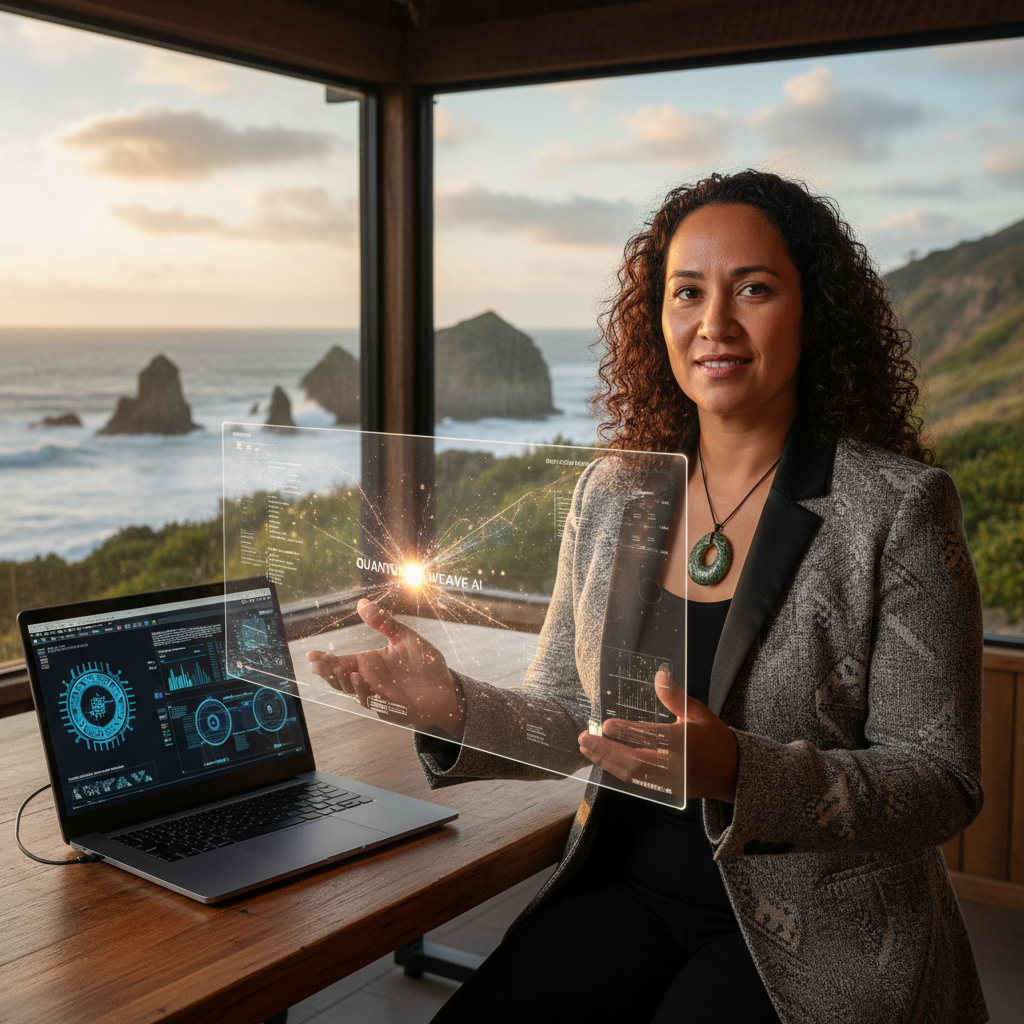
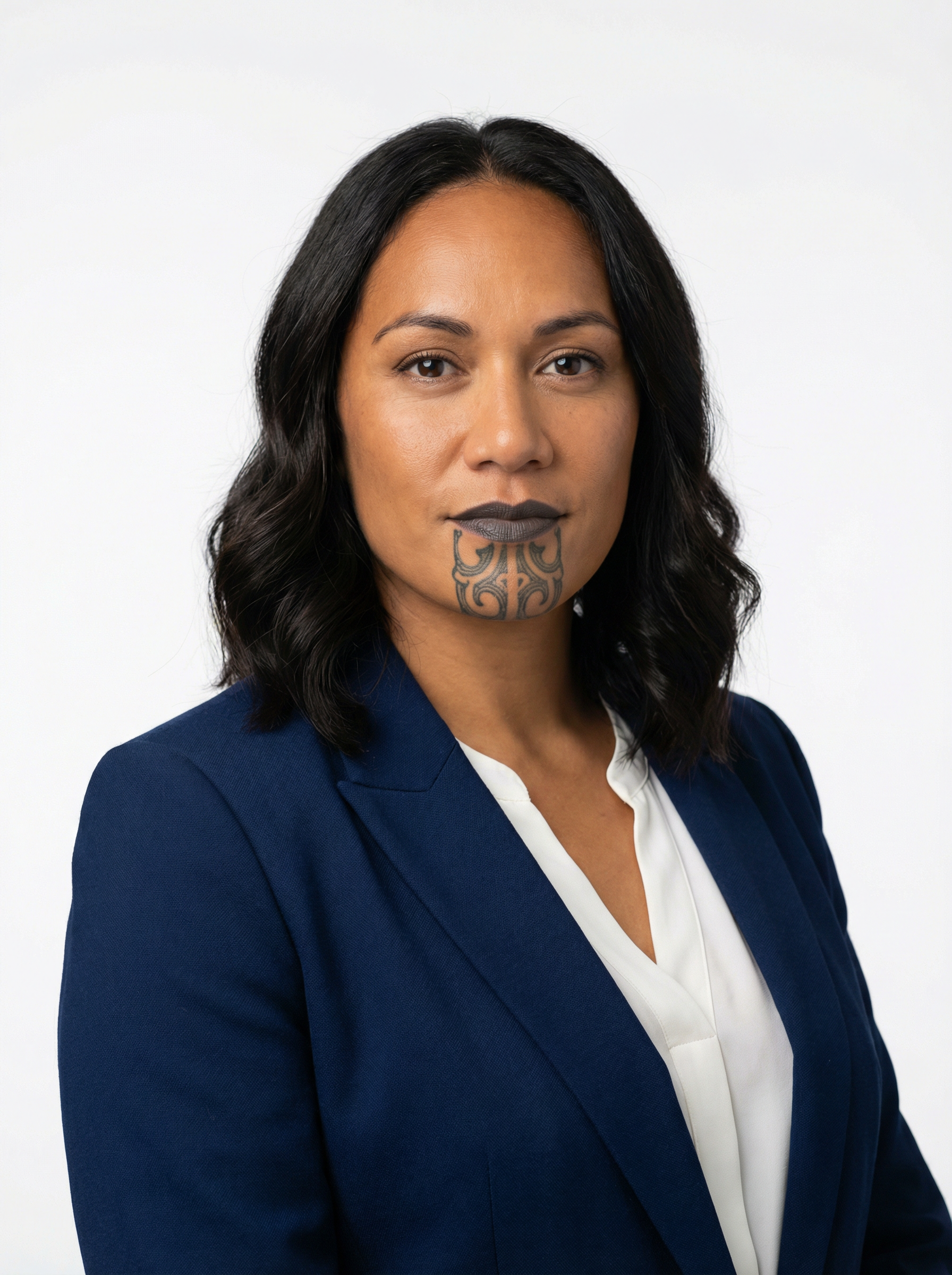
The air in the Cern control room crackled with a familiar tension, but for Dr. Maia Te Rangi, it was a different kind of hum. Not the usual whir of supercolliders, but the quiet, almost meditative thrum of her own AI models, sifting through petabytes of data. It was 3 AM in Geneva, a time when most of the world slept, but for Maia, 32, it was often when clarity struck. A glitch, a subtle anomaly in the latest proton collision data, had stumped the lead physicists for days. She leaned closer to the screen, her dark, curly hair falling over her shoulder, a small pounamu pendant glinting against her black turtleneck. “There,” she murmured, pointing to a faint, almost imperceptible pattern highlighted by her company's Quantum Weave AI. “It’s a resonance, but not one we’ve seen before. It’s like a whisper in the cosmic background noise.” That whisper, identified by her AI, would later lead to a groundbreaking paper confirming a new, short-lived subatomic particle, a discovery that sent ripples through the scientific community. This moment, quiet and profound, perfectly encapsulates Maia: a blend of deep intuition and relentless analytical power, grounded by her Māori heritage, pushing the boundaries of human knowledge with technology.
Maia's journey began far from the sprawling laboratories of Switzerland, in the small, coastal town of Gisborne, Aotearoa. Growing up with the Pacific Ocean as her backyard, she was captivated by patterns, by the tides, the stars, and the intricate designs of traditional Māori weaving. Her grandmother, a renowned weaver, taught her about raranga, the art of weaving, and how each strand, each choice, contributes to the strength and beauty of the whole. “She always told me that every thread has a purpose, every pattern tells a story,” Maia recalls, a soft smile touching her lips. “In Te Reo Māori, we have a word for this, whakapapa, which speaks to connection, to genealogy, to how everything is interconnected. I think that’s where my fascination with systems and underlying structures began.”
Her intellect was undeniable. She devoured books on physics and mathematics, often staying up late under the glow of a reading lamp. A scholarship took her to the University of Auckland, where she initially pursued theoretical physics, but soon found herself drawn to the burgeoning field of artificial intelligence. It was during her PhD at Stanford University, focusing on deep learning applications for high-energy physics, that the seeds of Quantum Weave AI were truly sown. The sheer volume of data generated by experiments like those at Cern was overwhelming, even for supercomputers. Traditional analytical methods were hitting their limits. Maia saw an opportunity to apply advanced neural networks to identify subtle patterns and anomalies that human eyes, or even conventional algorithms, might miss.
It was in a cramped, perpetually coffee-scented Stanford lab that she met her future co-founder, Dr. Liam O’Connell, a brilliant Irish computational physicist with a knack for hardware optimization. Liam, then 28, was frustrated by the bottlenecks in data processing. “Maia had this way of looking at the universe, not just as particles, but as an intricate tapestry,” Liam recounts from their bustling office in Auckland’s innovation precinct. “I was all about the brute force, the computational power. She brought the elegance, the insight. We were two sides of the same coin.” Their initial idea, a platform for real-time anomaly detection in astrophysics, struggled to gain traction. They spent a grueling year pitching to venture capitalists, facing skepticism about their niche focus. “Everyone loved the idea of AI, but ‘particle physics’ felt too academic, too far removed from immediate commercial returns,” Maia explains, a hint of the old frustration in her voice. “We burned through our savings, ate instant noodles for months. It was tough.”
Their pivot came during a late-night brainstorming session, fueled by cold pizza and a shared sense of impending failure. Instead of focusing solely on anomaly detection, they realized the true power lay in accelerating the entire discovery pipeline: from raw data ingestion to hypothesis generation and experimental design. They shifted their focus to building an end-to-end AI platform that could learn from existing physics models, predict outcomes, and even suggest new experimental parameters. This broader vision, coupled with a compelling demonstration of their prototype sifting through historical Cern data and identifying previously overlooked patterns, caught the attention of Altos Ventures.
Their acceptance into Y Combinator in 2022 was a whirlwind. The intensity, the constant pressure to refine their pitch and product, was immense. “It was like being in a pressure cooker, but it forged us,” Liam says, laughing. They emerged from YC with a refined product, a clear business model, and a seed round of $5 million led by Altos Ventures and Founders Fund. Building the company was not without its challenges. Hiring top-tier AI talent who also understood the intricacies of particle physics was a constant battle. Maia insisted on a company culture that valued collaboration, transparency, and a deep respect for the scientific process, a reflection of her own values. “Technology must serve the people, not the other way around,” she often reminds her team, emphasizing that their work is ultimately about expanding human understanding.
In early 2025, Quantum Weave AI closed a $30 million Series A round at a $300 million valuation, with Sequoia Capital joining Altos Ventures. Their platform, now deployed at Cern and several other major research institutions, has become indispensable. “Quantum Weave AI has dramatically reduced the time it takes to analyze complex datasets, accelerating our discovery timeline by orders of magnitude,” says Dr. Elena Petrova, Head of Data Analytics at Cern. “Their AI isn’t just finding needles in haystacks, it’s helping us understand how the haystacks are formed.” The company is projected to hit $25 million in Annual Recurring Revenue (ARR) by the end of 2026, a testament to the critical need for their technology.
Today, Maia splits her time between their Auckland headquarters and frequent trips to Cern. She remains deeply connected to her roots, often speaking at schools in New Zealand about Stem careers and the importance of diverse perspectives in science. Aotearoa’s approach to AI is rooted in indigenous wisdom, and Maia believes this unique perspective gives her company an edge, fostering a holistic view of technology’s role in society. “We’re not just building algorithms, we’re building tools to help humanity understand its place in the universe,” she states with conviction. “It’s about more than just data, it’s about knowledge, and the responsibility that comes with it.”
What drives her now, beyond the thrill of discovery, is the vision of democratizing access to cutting-edge scientific tools. She dreams of a future where smaller research institutions, even those in developing nations, can leverage powerful AI to contribute to global scientific endeavors. Quantum Weave AI is already exploring partnerships to provide their platform to universities in the Pacific, fostering a new generation of scientists. As the universe continues to reveal its secrets, Maia Te Rangi and Quantum Weave AI stand at the vanguard, weaving together the ancient wisdom of connection with the boundless potential of artificial intelligence. Their journey reminds us that the biggest breakthroughs often come from those who dare to look at old problems with fresh eyes, drawing strength from their heritage to illuminate the path forward. For more on the role of AI in scientific discovery, you can explore articles on MIT Technology Review and Nature Machine Intelligence. The broader impact of AI in various sectors is also frequently covered by Bloomberg Technology.