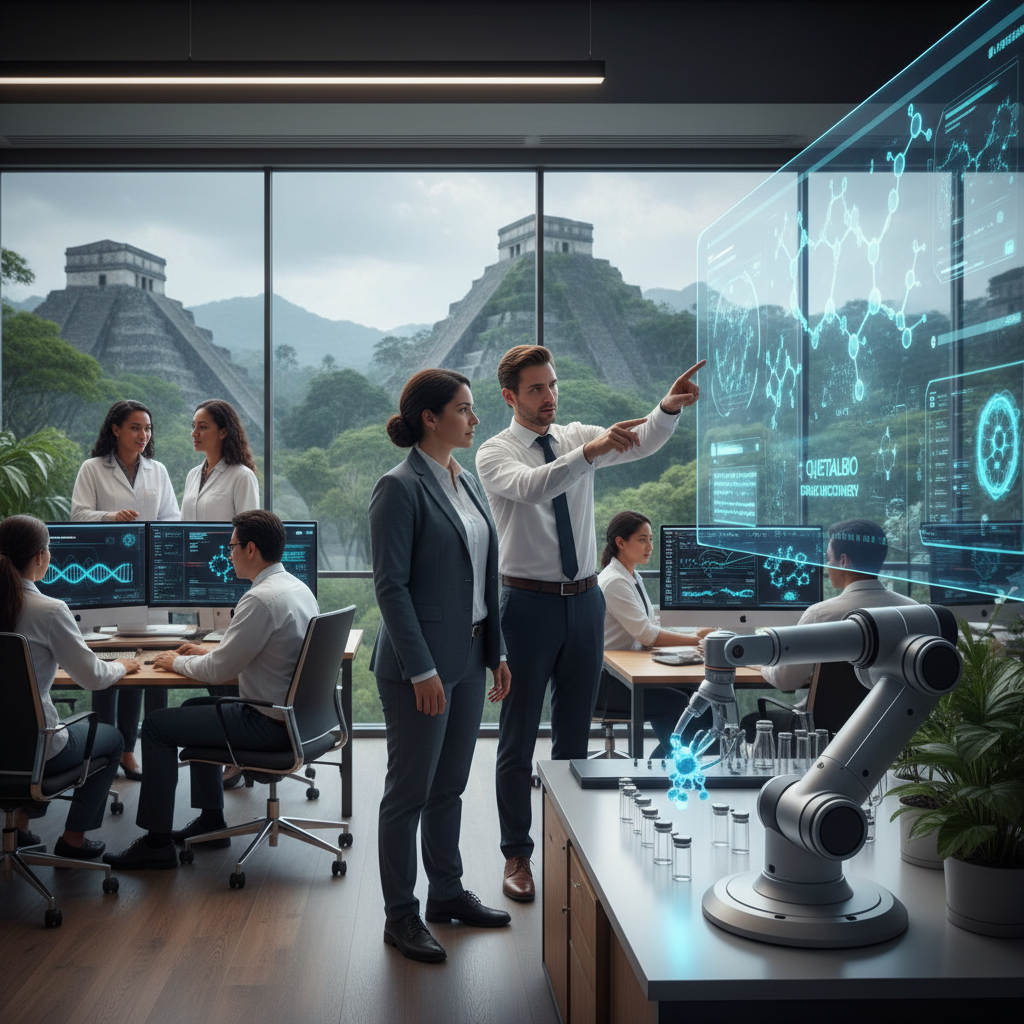
The air in San Francisco’s bustling South of Market district often hums with the electric energy of innovation, but inside the glass walls of QuetzalBio’s headquarters, there's a different kind of hum. It’s the quiet whir of servers processing billions of data points, the soft murmur of scientists collaborating, and the distinct, vibrant patterns of traditional Guatemalan textiles adorning the walls. This isn't your typical Silicon Valley startup. This is a place where ancestral knowledge meets artificial intelligence, where the wisdom of the Maya is helping to unlock the secrets of modern medicine.
Dr. Elena Xiloj, QuetzalBio’s CEO and co-founder, moves through the open-plan office with a grace that belies her intense focus. A woman of Maya K'iche' descent, she carries the weight of generations on her shoulders, a responsibility she embraces with every fiber of her being. “My grandmother’s wisdom meets machine learning here,” she tells me, gesturing to a screen displaying complex molecular structures. “She taught me about the plants, their uses, their stories. Now, we’re giving those stories a new voice, a new purpose, with AI.”
QuetzalBio isn't just another AI company. It’s a bridge between worlds, a testament to the power of diverse perspectives in solving humanity’s most pressing problems. Their core mission is to drastically cut the time it takes to discover and develop new drugs, a process that traditionally spans over a decade and costs billions of dollars. They claim to reduce this timeline from years to mere months for initial lead compound identification, and significantly accelerate preclinical development.
The Origin Story: A Seed Planted in Sololá
The genesis of QuetzalBio began not in a Stanford lab, but in a small village in Guatemala, near Lake Atitlán. Elena, then a brilliant young computational biologist at MIT, returned home after her grandmother fell ill with a rare, aggressive infection. Traditional remedies, passed down through her family for centuries, offered some relief, but modern medicine struggled. It was a stark realization for Elena: the vast, untapped pharmacopeia of the rainforest, combined with the precision of AI, could be a game-changer.
She teamed up with Dr. Ben Carter, a seasoned AI researcher from Google DeepMind, whom she met at a conference. Ben was captivated by Elena’s vision of integrating ethnobotanical data with advanced machine learning models. Together, they founded QuetzalBio in late 2019, securing a modest seed round of $2 million from angel investors, including prominent tech philanthropists and a few visionary Guatemalan business leaders. Their Series A round in 2021 brought in $25 million, led by Andreessen Horowitz, followed by a $75 million Series B in 2023 with participation from Sequoia Capital and NVIDIA. Most recently, a Series C round closed in early 2025, raising $200 million from SoftBank Vision Fund and Temasek, bringing their total funding to over $300 million.
The Business Model: Precision Partnerships
QuetzalBio’s business model is built on strategic partnerships with major pharmaceutical companies. They don't develop drugs themselves, but rather act as an AI-powered discovery engine. Their platform, which they call 'Ixchel' after the Maya goddess of medicine and weaving, ingests vast datasets: genomic information, protein structures, chemical libraries, and crucially, proprietary ethnobotanical data collected ethically and with explicit community consent from indigenous groups in Central and South America. This unique data forms a competitive moat.
“We charge our partners a combination of upfront fees for access to our platform and expertise, milestone payments as drug candidates progress through development, and a small royalty on net sales of any approved drugs discovered using Ixchel,” explains David Chen, QuetzalBio’s Chief Financial Officer, formerly of Pfizer. “This hybrid model aligns our success with that of our partners and provides a diversified revenue stream.”
Their current annual revenue run rate exceeds $150 million, a remarkable feat for a company just a few years old. They project to cross the $300 million mark by the end of 2026. QuetzalBio currently employs over 300 people across its main offices in San Francisco, a research hub in London focusing on biological validation, and a data science center in Tokyo. They also maintain a small but vital team in Guatemala City, working on community engagement and ethical data acquisition.
Key customers include industry giants like Merck, AstraZeneca, and GlaxoSmithKline, all of whom are leveraging Ixchel to accelerate their pipelines in oncology, infectious diseases, and neurological disorders. They also have a strategic partnership with Google Cloud for their immense computational needs, utilizing Google's advanced TPUs and AI infrastructure.
The Competitive Landscape: Differentiating with Deep Roots
The AI drug discovery space is increasingly crowded, with competitors like Recursion Pharmaceuticals, BenevolentAI, and Exscientia all vying for market share. However, QuetzalBio’s differentiation lies in its unique data and ethical framework. “Many companies focus on synthetic chemistry or existing compound libraries,” says Dr. Anya Sharma, a lead scientist at QuetzalBio. “Our ethnobotanical database, curated with direct input from traditional healers and indigenous communities, offers a completely novel chemical space for exploration. It's like having a map to hidden treasures that others don’t even know exist.”
This is a story about resilience, not just of the company, but of the knowledge systems it seeks to uplift. Elena insists on a reciprocal relationship with the communities whose knowledge forms the bedrock of QuetzalBio’s innovation. A portion of their profits is channeled back into local development projects, healthcare initiatives, and educational programs in Guatemala, ensuring that the benefits of their discoveries are shared equitably.
The Team and Culture: A Tapestry of Talent
Elena’s management style is often described as collaborative and deeply empathetic. She fosters a culture of intellectual curiosity and social responsibility. “We’re not just building algorithms, we’re building a legacy,” she often tells her team. This ethos attracts top talent from diverse backgrounds. Dr. Javier Morales, Head of Ethnobotanical Research, left a lucrative position at a major university to join QuetzalBio. “The chance to bridge ancient knowledge with cutting-edge science, and to do it in a way that truly benefits the source communities, was irresistible,” he shared with me during a visit to their Guatemala City office.
Internal debates often revolve around the ethical implications of their work. How do they ensure fair compensation and intellectual property rights for indigenous communities? How do they prevent biopiracy? These are not easy questions, but Elena has established a robust ethics board, including indigenous leaders and legal experts, to guide their practices. This commitment to ethical AI is a cornerstone of their brand and a powerful differentiator in a sensitive field.
Challenges and Controversies: Navigating the Nuances
Scaling a company that relies on such sensitive data comes with its own set of challenges. Regulatory hurdles in drug development are notoriously complex, and adding the layer of ethnobotanical data requires careful navigation of international intellectual property laws and indigenous rights. “The regulatory environment is constantly evolving,” notes Dr. Chen. “We spend considerable resources ensuring compliance and building trust with all stakeholders, from regulatory bodies to local communities.”
Some critics from the academic world have raised concerns about the potential for exploitation, even with the best intentions. “While QuetzalBio’s approach is commendable, the power dynamics between a Silicon Valley company and indigenous communities are always complex,” says Dr. Sofia Ramirez, an anthropologist specializing in indigenous knowledge systems at the University of San Carlos in Guatemala. “Transparency and ongoing dialogue are paramount to avoid unintended harm.”
The Bull Case and the Bear Case
The bull case for QuetzalBio is compelling. If they continue to deliver on their promise of accelerated drug discovery, their market potential is enormous. The global pharmaceutical R&D market is valued in the hundreds of billions, and even a fraction of that represents massive revenue opportunities. Their unique data advantage and ethical framework could make them an indispensable partner for pharma companies looking for novel approaches. Reuters recently highlighted the growing trend of AI in drug discovery, noting that companies with specialized datasets are poised for significant growth.
The bear case, however, points to the inherent risks in drug development. Even with AI, clinical trials can fail. Regulatory approval is never guaranteed. Furthermore, maintaining the delicate balance between commercial success and ethical community engagement is a constant tightrope walk. Any misstep could damage their reputation and jeopardize their unique data access. The competition from well-funded rivals, some of whom are also exploring AI for novel compound discovery, remains fierce. For example, MIT Technology Review often covers the intense competition and high stakes in this sector.
What's Next: A Future Woven with Hope
Looking ahead, QuetzalBio plans to expand its ethnobotanical data collection to other regions, always with the same rigorous ethical protocols. They are also exploring partnerships with academic institutions to further validate traditional remedies and integrate them into modern medical understanding. Elena dreams of a future where their platform isn't just for pharmaceutical giants, but also for researchers in developing nations, empowering them to discover treatments for diseases endemic to their own populations.
As the sun sets over San Francisco, casting long shadows across the office, Elena looks out at the city lights. “We are just at the beginning,” she says, a quiet determination in her voice. “But every day, we are a step closer to finding cures faster, to making a real difference. And that, for me, is the most important discovery of all.” It’s a powerful reminder that behind every line of code, every complex algorithm, there are human stories, human needs, and the enduring hope for a healthier tomorrow. The future of medicine, it seems, might just be found where ancient traditions and cutting-edge technology intertwine. For more on the intersection of AI and healthcare, you might find this article on Anthropic's Claude in Sri Lanka [blocked] insightful.