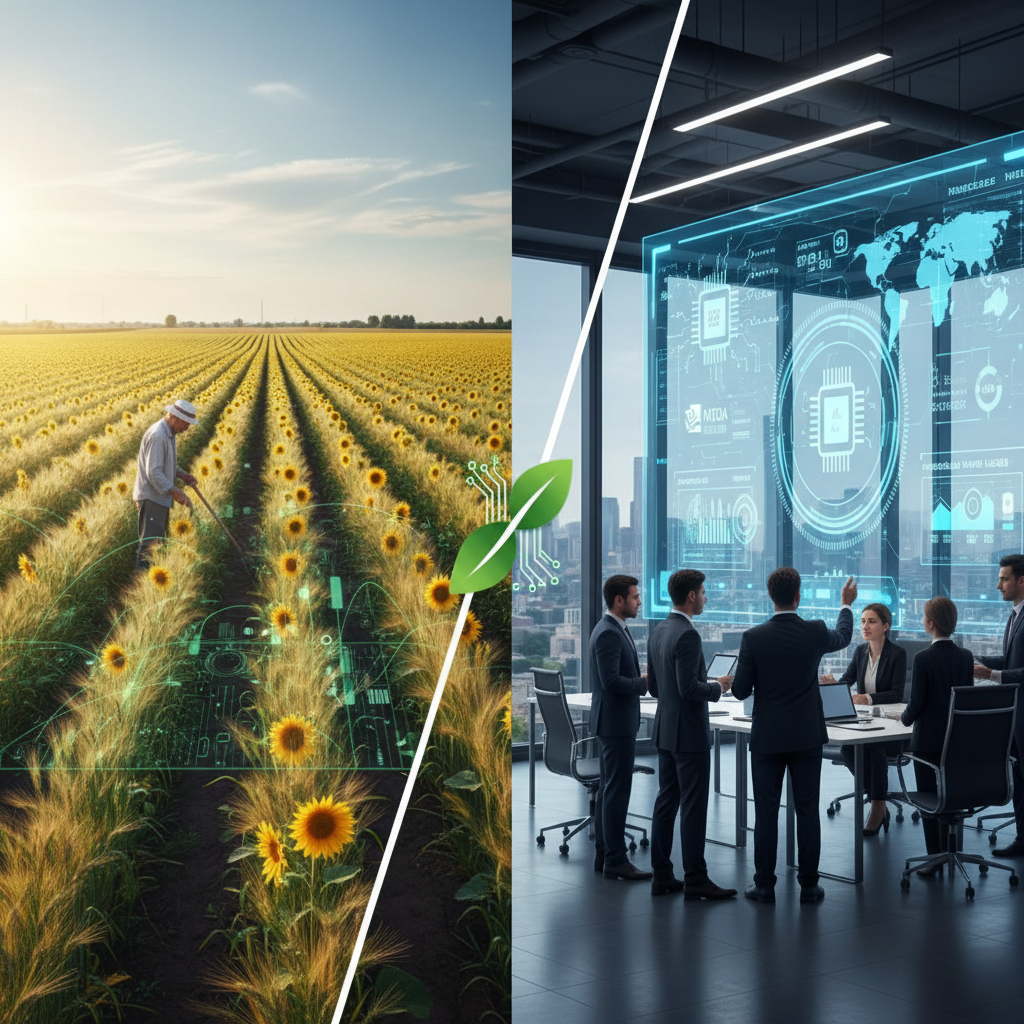

The scent of freshly tilled earth hung heavy in the air, a familiar perfume across the vast plains of Konya. But this morning, there was a new hum, a subtle whirring sound that wasn't a tractor, but a drone. It wasn't just any drone either; this one, equipped with hyper-spectral cameras and powered by advanced AI models from a local startup, 'Yeşil Hasat' or 'Green Harvest,' was meticulously mapping every inch of a sprawling wheat field. Mehmet, a farmer whose family had worked this land for generations, watched with a mixture of skepticism and awe. He had seen many technologies come and go, but this, he admitted, felt different. This felt like the future, not just a fleeting trend.
For too long, the conversation around AI and climate change has been dominated by Western narratives, often overlooking the vibrant, critical innovations happening in places like Turkey. I have always said, Turkey is building the future at the crossroads, and nowhere is this more evident than in our response to the planet's most pressing challenge. We are not just consumers of technology; we are increasingly its architects, especially when it comes to practical, impactful applications. The question is no longer if AI can help, but how effectively and how quickly it can be deployed to make a tangible difference, particularly in sectors like agriculture that are both vital to our economy and highly vulnerable to climate shifts.
Recent data paints a compelling picture. A report released last quarter by the Turkish Ministry of Agriculture and Forestry, in collaboration with the Istanbul Technical University's AI Research Center, revealed that AI adoption in the agricultural sector has surged by 45% over the past two years. This isn't just about drones, mind you. It's about predictive analytics for irrigation, AI-driven pest detection, optimized fertilization schedules, and even automated crop yield forecasting. The report highlighted that companies integrating AI solutions reported an average 18% reduction in water usage and a 12% increase in crop efficiency. These are not small numbers; they translate directly into millions of liras saved and, more importantly, precious natural resources conserved.
Take Yeşil Hasat, for example. Founded by a group of young engineers from Boğaziçi University, they are leveraging Microsoft Azure's AI capabilities and NVIDIA's powerful GPUs to process vast datasets of satellite imagery, drone footage, and ground sensor data. Their platform, 'Anatolia Green,' provides farmers with hyper-localized, actionable insights. "Before Anatolia Green, we were guessing," says Ayşe Demir, Yeşil Hasat's CEO. "Now, Mehmet knows exactly which five square meters of his field need more water, or where a fungal infection is just beginning to take hold. This precision farming, enabled by AI, is transforming livelihoods and making our food supply more resilient." Her company, barely three years old, has already secured partnerships with three of Turkey's largest agricultural cooperatives, covering over 200,000 hectares of farmland.
But it's not all sunshine and optimized yields. The transition is not without its challenges, creating both winners and losers. Larger agricultural enterprises, with deeper pockets and existing digital infrastructure, are quicker to adopt these technologies. Companies like Torku, a massive cooperative, have invested heavily in AI-powered logistics and supply chain optimization, reducing waste by an estimated 15% across their operations. Their early adoption of predictive maintenance for machinery, powered by Google's DeepMind algorithms, has also cut equipment downtime by 20%, a significant operational advantage.
Smaller, family-run farms, however, often struggle with the initial investment costs and the steep learning curve. "It's a beautiful machine, yes, but who will teach me how to use it?" Mehmet asked me, gesturing towards the drone. This is where government incentives and educational programs become crucial. The Ministry of Industry and Technology recently launched the 'Dijital Çiftçi' (Digital Farmer) initiative, offering subsidized AI solutions and training programs. Yet, the gap persists. We must ensure that the benefits of this technological revolution are distributed equitably, preventing a new digital divide from emerging in our rural heartlands.
Worker perspectives are also varied. For younger, tech-savvy agricultural engineers, AI tools are a boon, augmenting their capabilities and allowing them to focus on higher-value tasks. "I used to spend days manually inspecting fields for disease," says Cem Yılmaz, an agronomist working with Torku. "Now, the AI flags potential issues, and I can verify them quickly, covering more ground and intervening faster. It's like having a hundred extra pairs of eyes." He believes AI has made his job more strategic and less physically demanding. However, for older, less digitally literate workers, there is apprehension. Concerns about job displacement, the need for new skills, and the sheer complexity of the systems are real. Organizations must invest in reskilling and upskilling programs to ensure no one is left behind in this transition.
"The Ottoman approach to AI empire-building," as I sometimes call it, is not about conquest, but about strategic integration and long-term vision. We are not just looking at immediate returns; we are building foundational capabilities that will serve us for decades. Dr. Elif Kaya, head of the AI and Sustainability Lab at Middle East Technical University, emphasizes this point. "The real power of AI in climate action lies in its ability to model complex systems, predict future scenarios, and optimize resource allocation at an unprecedented scale," she told me. "From smart grids that balance renewable energy fluctuations to AI-driven urban planning that minimizes heat island effects, the potential is vast. But it requires a holistic, national strategy, not just piecemeal projects." She points to the need for robust data infrastructure and ethical AI governance, ensuring that these powerful tools are used responsibly and for the common good.
What's coming next? I see a future where AI becomes an invisible layer across all climate mitigation and adaptation efforts. Imagine AI-powered early warning systems for extreme weather events, leveraging real-time data from satellites and ground sensors, saving lives and minimizing economic damage. Picture smart cities in Turkey, where traffic flows are optimized by AI to reduce emissions, and building energy consumption is dynamically adjusted based on occupancy and weather forecasts. Think of advanced materials science, accelerated by AI, discovering new carbon capture technologies or more efficient solar panels. Companies like Google and OpenAI, with their foundational models, are already providing the intelligence layer that smaller, specialized startups can build upon. The synergy between global AI giants and local innovators is crucial. Reuters often highlights these emerging partnerships, and Turkey is poised to be a major player in this global ecosystem.
Our journey is just beginning. The challenges of climate change are immense, but so is the ingenuity of the human spirit, amplified by the power of artificial intelligence. It will require continued investment, bold policy decisions, and a commitment to education and inclusion. But if Mehmet, the farmer in Konya, can embrace the drone, if Yeşil Hasat can scale its impact across Anatolia, then I am optimistic. The future is not a distant horizon; it is being built right here, today, in the fields and labs of Turkey, with every line of code and every seed planted with precision. The world needs to watch closely, because the lessons learned here, at this ancient crossroads, might just offer a blueprint for a greener, more sustainable planet for us all. The scale of this ambition is massive, and I believe, realistic. For more on how AI is shaping global industries, you can always check out TechCrunch's AI section. The pace of innovation is simply breathtaking.