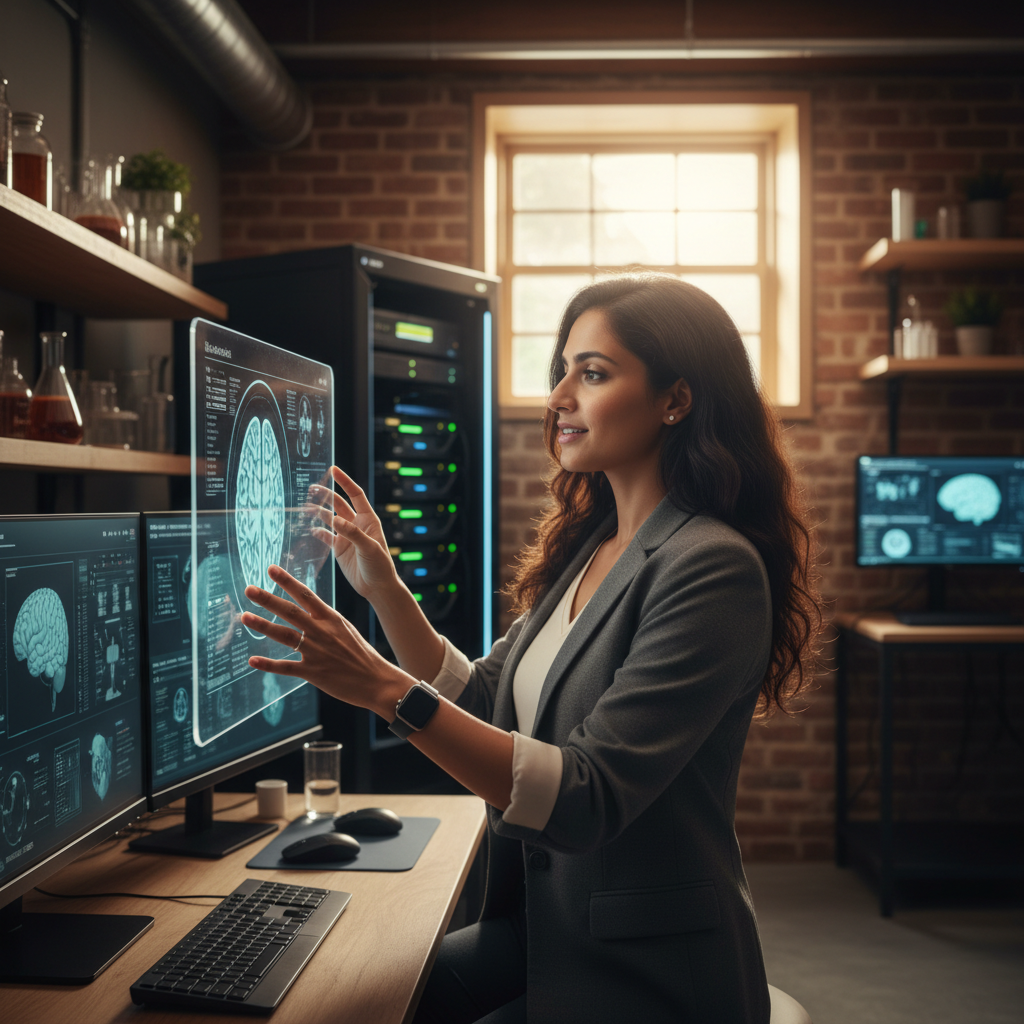
Picture this: a chilly Philadelphia evening, the kind where the historic brick buildings seem to huddle together against the cold. Inside a dimly lit basement lab at the University of Pennsylvania, a young woman, barely out of her twenties, is hunched over a monitor, lines of code scrolling endlessly. That was Dr. Anya Sharma, and that was the genesis of BioScan AI, a company now valued at an astonishing $5 billion, poised to revolutionize global healthcare. I just saw the future and it's incredible, and it's being built by people like Anya.
Anya's story isn't just about algorithms and venture capital; it's a deeply human tale of relentless curiosity and a burning desire to make a difference. Growing up in a bustling Indian-American household in Edison, New Jersey, Anya was always the one asking 'why'. Not just 'why' about her homework, but 'why' about the world, about the human body, about the mysteries of illness. Her parents, both medical professionals, instilled in her a profound respect for science and service. She devoured books on biology and computer science with equal fervor, a rare blend that would later become her superpower.
She landed at the University of Pennsylvania, drawn by its world-class medical school and its burgeoning computer science department. It was there, amidst late-night study sessions and endless cups of coffee, that the seeds of BioScan AI were sown. Her initial focus was on bioinformatics, trying to find patterns in vast datasets of genetic information. She saw the limitations of traditional diagnostic methods, the time delays, the human error, the sheer scale of data that was being underutilized. "I realized we were sitting on a goldmine of information, but we didn't have the tools to dig it up efficiently," Anya told me during a recent interview at her now-sprawling Silicon Valley campus. "That's when I knew, deep down, that AI wasn't just a tool, it was the shovel we needed."
The defining moment, she recalls, came during her Ph.D. research. A family friend was diagnosed with a rare, aggressive form of cancer. The diagnosis came late, after months of tests and agonizing waits. Anya felt a profound sense of helplessness. "I remember thinking, if only we could have caught this sooner, if only the doctors had a clearer picture earlier," she shared, her voice still carrying a hint of that raw emotion. "That night, I decided my research wouldn't just be academic; it would be about building something tangible that could save lives. This is going to change everything."
Her co-founder, Dr. Ben Carter, entered the picture almost serendipitously. Ben, a brilliant radiologist with a knack for software development, was a year ahead of Anya at Penn. They met at a hackathon focused on medical imaging. While others were building rudimentary apps, Anya and Ben were sketching out a vision for an AI that could analyze medical scans with unprecedented speed and accuracy. Their synergy was immediate. "Anya had the biological depth and the AI vision, I had the clinical insight and the engineering chops to bring it to life," Ben explained, a characteristic grin on his face. "We just clicked, like two pieces of a very complex puzzle."
Their first attempt, a rudimentary AI for identifying early signs of diabetic retinopathy from eye scans, was a technical success but a commercial flop. They struggled with data acquisition, regulatory hurdles, and convincing skeptical clinicians. "We were so focused on the tech, we forgot about the human element, the workflow, the trust," Anya admitted. "It was a tough lesson, but a necessary one. We learned that innovation in healthcare isn't just about building a better mousetrap; it's about understanding the entire ecosystem."
The pivot came after a grueling six months in Y Combinator. They refined their focus, shifting from a single-disease diagnostic to a platform approach. What if, instead of just one disease, their AI could be trained on a vast array of medical data, from genomics to imaging to patient records, to create a holistic predictive model for a patient's health trajectory? This was the breakthrough. They envisioned an AI that could not only detect anomalies but also predict disease progression and even suggest personalized treatment pathways. They called it BioScan AI, a nod to its comprehensive biological scanning capabilities.
Building the company was a whirlwind. They hired a diverse team of AI researchers, medical doctors, software engineers, and regulatory experts. Anya fostered a culture of audacious problem-solving and deep empathy. "Every line of code, every algorithm, has a patient's life behind it," she would often remind her team. Their early success with a pilot program at a major Boston hospital, where their AI reduced diagnostic time for certain cancers by 40% and improved accuracy by 15% compared to human experts, caught the attention of investors.
In 2023, BioScan AI closed a monumental $30 million Series A round led by Altos Ventures, with participation from Founders Fund, valuing the company at $300 million. This was just the beginning. The subsequent Series B, led by Sequoia Capital, brought in another $100 million, pushing their valuation past $1 billion. Their secret sauce, beyond their proprietary algorithms, was their strategic partnership with NVIDIA. They leveraged NVIDIA's cutting-edge GPUs and AI platforms, like NVIDIA Clara, to train their massive models, allowing them to process petabytes of medical data with unparalleled speed. "NVIDIA's infrastructure was critical," Ben emphasized. "Without their computational power, our vision would have remained just that, a vision." You need to pay attention to this, because the synergy between AI software and hardware is what's truly unlocking these breakthroughs.
Today, BioScan AI boasts an annual recurring revenue (ARR) of over $100 million and is deployed in over 50 hospitals across the United States and Europe. Their platform is not replacing doctors, but augmenting them, providing a powerful second opinion and an early warning system. "Our goal isn't to automate doctors out of a job, but to empower them with superhuman capabilities," Anya stated, her eyes sparkling with conviction. "Imagine a world where preventable diseases are actually prevented, where diagnoses are swift and precise, and where every patient gets a truly personalized care plan. That's the world we're building."
What drives Anya now, beyond the staggering valuation and industry accolades, is that initial spark of wanting to help. She still dedicates a portion of her time to working with patient advocacy groups, ensuring BioScan AI remains grounded in real-world needs. Her days are a blur of product roadmaps, investor calls, and strategic partnerships, but she always carves out time for her team, fostering the collaborative spirit that defined their early days in that Philly basement. She's also a vocal advocate for ethical AI development in healthcare, often speaking at conferences about bias mitigation and data privacy. "The power of AI comes with immense responsibility," she told a packed auditorium at a recent MIT Technology Review summit. "We must ensure these tools serve all of humanity, not just a privileged few."
What's next for BioScan AI? Anya hints at expanding into vaccine development, using their AI to accelerate drug discovery and clinical trials. They are also exploring integrating with consumer wearables and smart home devices, creating a truly proactive and personalized health monitoring system. The vision is clear: a future where healthcare is not just reactive, but predictive, preventive, and deeply personal. And with leaders like Dr. Anya Sharma at the helm, powered by incredible AI advancements from companies like NVIDIA and the relentless drive of American innovation, that future feels closer than ever. It's an exhilarating time to be alive, watching these pioneers reshape our world. For more on how AI is transforming industries, check out TechCrunch's AI section. You can also follow the latest in AI business news on Bloomberg Technology.