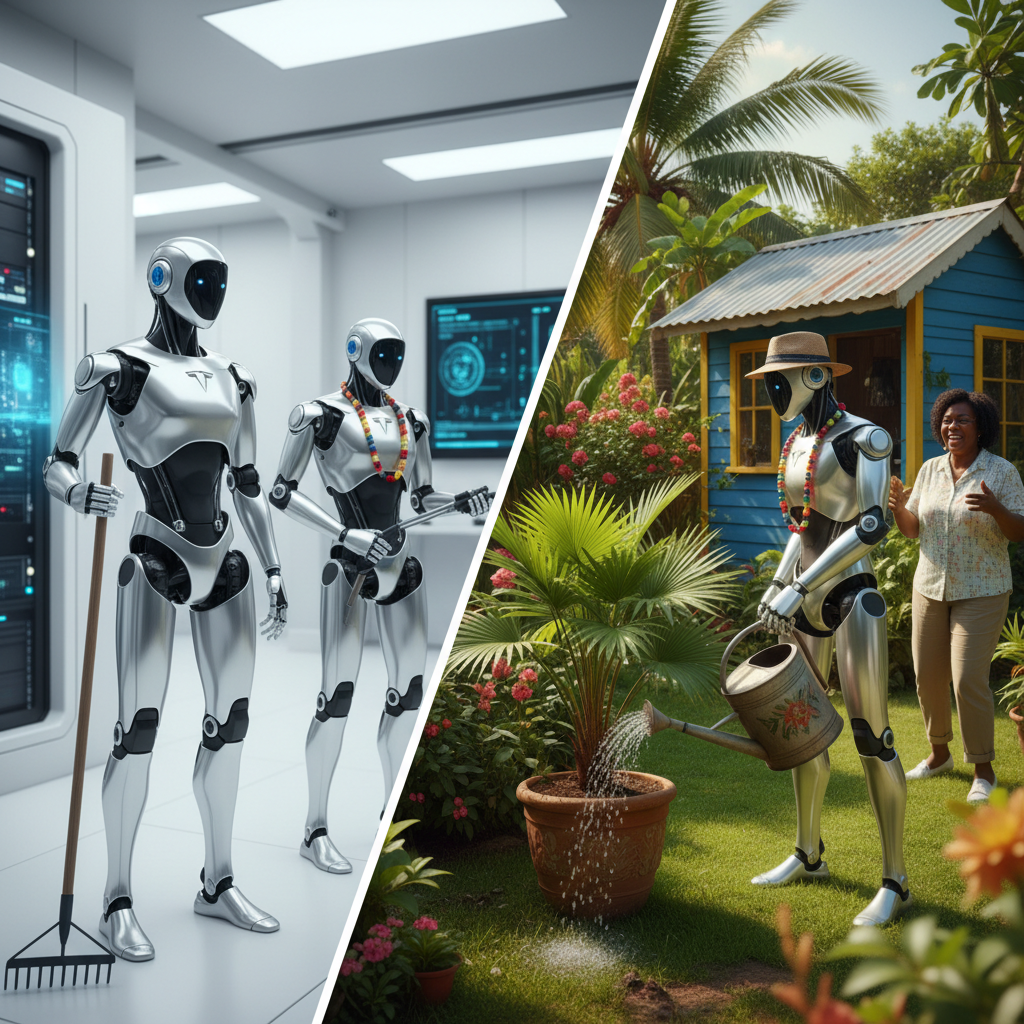

Alright, people, gather 'round. Keishà Brownè here, and today we're not talking about the latest dancehall riddim or the price of ackee. We're talking about something far more… mechanical. Something that’s clanking its way into our lives, whether we like it or not: humanoid robots in the workforce. Yes, those metal marvels you see in sci-fi flicks are no longer just for the big screen. They’re coming to a factory floor, a restaurant kitchen, or even a retail store near you, and trust me, the Caribbean has entered the chat, whether it knows it or not.
The Clanking Revolution Nobody's Really Watching
So, what's the fuss? Companies like Tesla, with Elon Musk's Optimus bot, and the increasingly prominent Figure AI, are pushing hard to get these bipedal automatons out of the lab and into real-world jobs. We’re talking about robots designed to mimic human movement, to lift, to sort, to serve. Think about it: a machine that can do the repetitive, often dangerous, tasks that humans currently perform. Sounds efficient, right? On paper, absolutely. These companies are pouring billions into development, with Figure AI alone reportedly raising hundreds of millions from giants like Microsoft and NVIDIA. They’re not playing games, these folks are serious about automating everything.
But here’s the thing, while the tech world is buzzing, most people are still scrolling through TikTok or arguing about who won the last football match. They’re ignoring the quiet revolution happening in industrial parks and research labs across the globe. Why? Because it feels distant. It feels like a problem for 'them' in the developed world, not for us here in Jamaica. We’re busy with our own hustle, our own daily grind, and robots seem like a futuristic fantasy, not a present-day reality.
How a Robot in a California Warehouse Affects Your Yardie Dollar
Now, you might be thinking, "Keishà, what does a robot stacking boxes in a warehouse in Texas have to do with me, a Jamaican living in Kingston?" Oh, my friend, everything. Our economy, like many small island nations, relies heavily on sectors that are prime targets for automation: tourism, agriculture, and light manufacturing. If a resort in Miami can replace half its housekeeping staff with robots, what does that mean for the demand for our hospitality workers? If a factory in China can produce goods cheaper and faster with an automated workforce, how do our local manufacturers compete? This isn't just about jobs disappearing; it's about a global shift in labor economics that will ripple through supply chains and impact the value of human work everywhere.
Consider the BPO sector, a significant employer here. While humanoid robots might not be answering calls tomorrow, the underlying AI technology that powers them is already making inroads into customer service and data entry. The lines are blurring, and the skills that were once a sure bet are now under scrutiny. This is not some abstract concept; it’s about the bread on your table and the school fees for your pickney.
The Bigger Picture: A Global Game Changer or a Cultural Clash?
Globally, the implications are staggering. We’re talking about a potential overhaul of the global labor market. The World Economic Forum estimates that automation could displace tens of millions of jobs worldwide in the coming years, even as it creates new ones. The question is, who gets those new jobs? Will it be the highly skilled engineers and programmers, or will there be opportunities for retraining and upskilling for the displaced? This is where the divide could widen, creating a chasm between the technologically advanced nations and those still grappling with basic infrastructure.
For Jamaica, and the wider Caribbean, this presents a unique challenge and, dare I say, an opportunity. We have a vibrant, adaptable workforce, but are we preparing them for a world where their hands-on skills might be less valued than their cognitive flexibility? We cannot afford to be left behind, watching from the sidelines. Jamaica's tech scene is like reggae, it'll surprise you with its depth and resilience, but only if we cultivate it deliberately.
What the Smartest Minds Are Saying
It’s not just me sounding the alarm. Experts around the globe are weighing in on this robotic future.
Dario Amodei, CEO of Anthropic, a leading AI safety company, has often spoken about the need for careful development and deployment of advanced AI systems, including robotics. He emphasized in a recent interview, "The pace of progress in AI and robotics is accelerating beyond many predictions. We need robust safety protocols and societal discussions now, not after these systems are fully integrated into our lives." His concern isn't just about technical glitches, but the broader societal impact.
Dr. Fei-Fei Li, co-director of Stanford's Institute for Human-Centered AI, has consistently advocated for a human-centric approach to AI. She stated, "The goal of AI should be to augment human capability, not replace it entirely. We must design these systems with human values and dignity at their core, ensuring they create more opportunities than they destroy." Her perspective offers a crucial counterpoint to the purely efficiency-driven narrative.
From the business side, Jensen Huang, CEO of NVIDIA, whose GPUs power much of the AI revolution, sees this as an inevitable progression. He remarked at a recent conference, "Every industry will be transformed by AI and robotics. The companies that embrace this transformation will thrive, and those that don't will be left behind." He’s pushing the hardware that makes these robots possible, so his optimism is understandable, but it underscores the commercial imperative driving this trend.
Even Satya Nadella, CEO of Microsoft, a major investor in Figure AI, has spoken about the potential for AI to democratize access to skills and opportunities. He noted, "AI can be a powerful tool for economic inclusion, if we choose to build it that way. It's about empowering people to do more, not less." This hints at the idea that with proper investment in education and infrastructure, the benefits could be shared more broadly.
What You Can Do About It: Don't Just Watch, Participate
So, what’s the takeaway for you, the average person trying to navigate this brave new world? First, educate yourself. Understand what’s happening. Read the news, not just the headlines. Follow reputable sources like MIT Technology Review or The Verge to stay informed. Second, advocate for policies that prioritize human well-being. Talk to your local representatives about investing in future-proof education and skills training. We need to ensure our youth are learning skills that complement, rather than compete with, AI and robotics. Think critical thinking, creativity, complex problem-solving, and digital literacy. Third, look for opportunities. Small island, big ideas. Can we leverage AI and robotics in unique ways to solve our local challenges, perhaps in agriculture or disaster preparedness, rather than just waiting for it to disrupt us? We could be innovators, not just consumers of this tech.
The Bottom Line: Why This Will Matter in 5 Years
In five years, the sight of a humanoid robot in a factory or even a fast-food restaurant won't be a novelty; it will be common. The cost of these units will drop, their capabilities will soar, and the pressure to adopt them for efficiency will be immense. This isn't just about a few jobs here and there; it’s about a fundamental restructuring of labor, global supply chains, and economic power. If we don’t prepare now, if we don’t actively shape our response, Jamaica risks being on the wrong side of this technological divide. We need to be proactive, innovative, and unapologetically Jamaican in how we approach this future. Otherwise, we might just find ourselves asking a robot for directions to the nearest job fair. And trust me, that’s a conversation no one wants to have. This isn't just tech news, it's our future, and it's happening now. For more on how AI is impacting local economies, you might want to check out our article on When Algorithms Call the Shots: How Google's AI and Uber's Code Are Reshaping Jamaica's Gig Hustle [blocked].