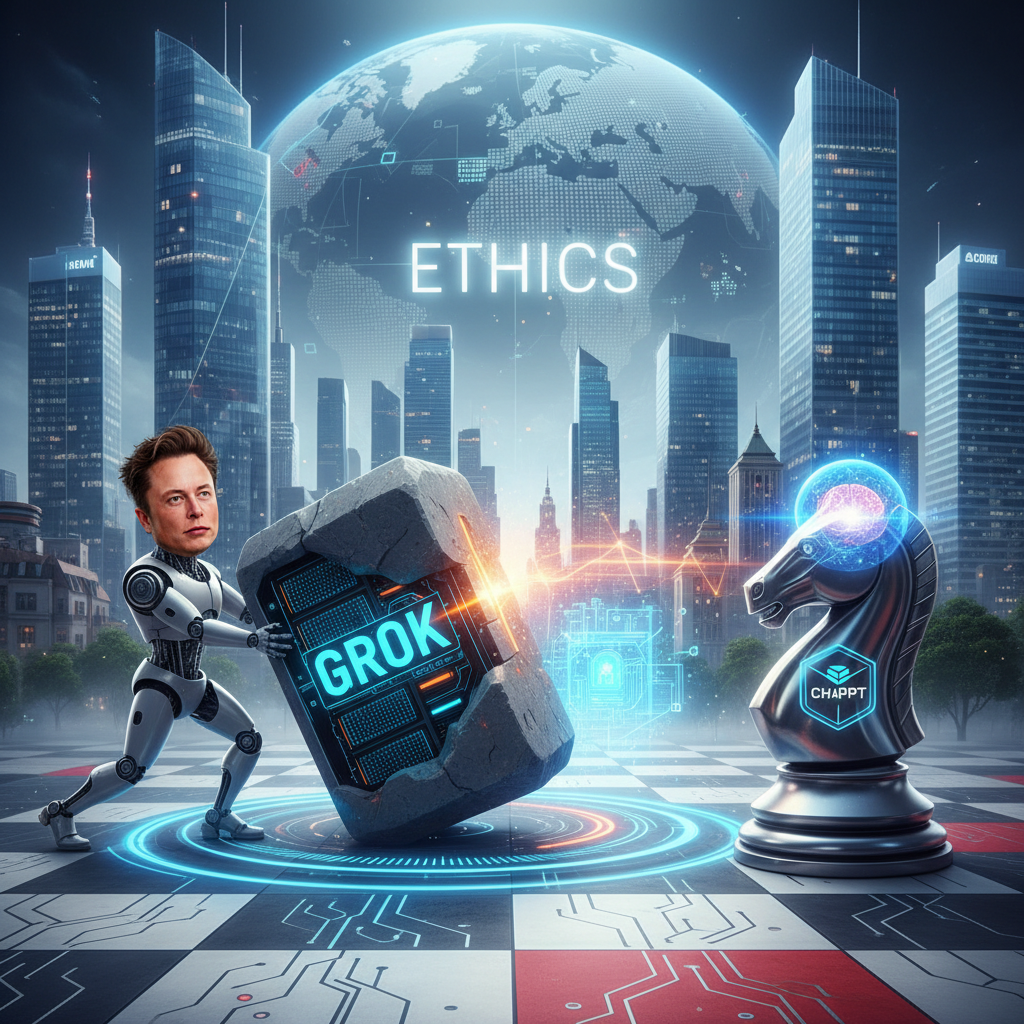
In the grand, often bewildering, theatre of artificial intelligence, where titans like OpenAI, Google, and Anthropic vie for supremacy, a new protagonist has emerged with characteristic fanfare: Elon Musk's xAI and its flagship large language model, Grok. From my vantage point in Poland, a nation deeply invested in its engineering prowess and a pragmatic view of technological advancements, the strategic moves of xAI warrant a meticulous examination. Is this a genuine paradigm shift, or merely a high-profile diversion in an already crowded arena? The question is not trivial, for the implications reverberate far beyond Silicon Valley, touching the very foundations of how information is processed and disseminated globally.
The Strategic Move: A Different Philosophy, A Different Path
xAI's primary strategic gambit is not merely to build another powerful large language model, but to construct one rooted in a fundamentally different philosophy. While competitors often prioritize safety, alignment, and broad utility, xAI explicitly states its aim to be a 'maximum truth-seeking AI' that understands the universe. This is a departure from the cautious, often self-censoring, posture adopted by many leading models. Grok, with its direct access to X, formerly Twitter, and its stated intention to answer questions that other AI models refuse, positions itself as the audacious, unfiltered alternative. This is not just a technological race, it is a ideological one, a contest of values embedded within algorithms. The algorithm works like this: rather than merely predicting the next token based on a vast corpus of text, Grok aims to integrate real-time information and a more 'rebellious' persona, reflecting Musk's own public image.
This strategy is particularly intriguing when viewed through a European lens. The European Union, with its robust regulatory framework exemplified by the AI Act, places significant emphasis on transparency, accountability, and ethical considerations in AI development. Grok's 'no holds barred' approach could clash with these principles, creating friction in its adoption across the continent. Yet, there is also a certain appeal in a system that promises unfiltered access, a counterpoint to perceived biases in other models, a sentiment that resonates in societies accustomed to robust public discourse.
Context and Motivation: The Quest for Unfettered AI
Elon Musk's motivations for founding xAI are multifaceted, stemming from a publicly articulated concern about the direction of AI development at other companies, particularly OpenAI, which he co-founded. He has frequently expressed worries about AI safety, the potential for AI to be overly 'woke' or politically biased, and the concentration of AI power in a few hands. xAI, therefore, is presented as a corrective, a force for diversification and a champion of what Musk perceives as intellectual honesty. Access to X's real-time data stream provides a unique, albeit potentially noisy, training ground for Grok, distinguishing it from models trained on static datasets. This real-time integration is a potent differentiator, offering a dynamic understanding of current events and public sentiment, a feature that could be invaluable for certain applications.
From a systems perspective, integrating a large language model directly with a vast, real-time social media platform like X is a significant engineering undertaking. It requires robust infrastructure for data ingestion, processing, and rapid model inference, all while maintaining a semblance of coherence and factual accuracy. The sheer scale of data from X, encompassing billions of posts daily, provides an unparalleled, if chaotic, information reservoir. This could allow Grok to offer insights that are more current and nuanced than those derived from models trained on historical data alone.
Competitive Analysis: A David Versus Three Goliaths
The AI landscape is dominated by formidable players. OpenAI's ChatGPT, with its widespread adoption and continuous iterations, remains the benchmark. Google's Gemini, backed by immense computational resources and a deep research pipeline, offers multimodal capabilities and integration across Google's ecosystem. Anthropic's Claude, with its strong emphasis on constitutional AI and safety, appeals to enterprises seeking responsible AI solutions. These entities possess vast financial resources, extensive talent pools, and established partnerships.
xAI, while backed by Musk's considerable capital and influence, is still a relative newcomer. Its primary competitive edge lies in its philosophical stance and its unique access to X's data. This allows Grok to potentially offer more current information and a distinct conversational style. However, this also presents significant challenges. The unfiltered nature of X's data means Grok must contend with misinformation, bias, and offensive content at an unprecedented scale. Ensuring 'truth-seeking' in such an environment is akin to finding a needle in a haystack, a haystack that is perpetually being restocked with new material.
As Professor Janusz Kowalski, a leading AI ethicist at the Jagiellonian University in Kraków, recently observed,