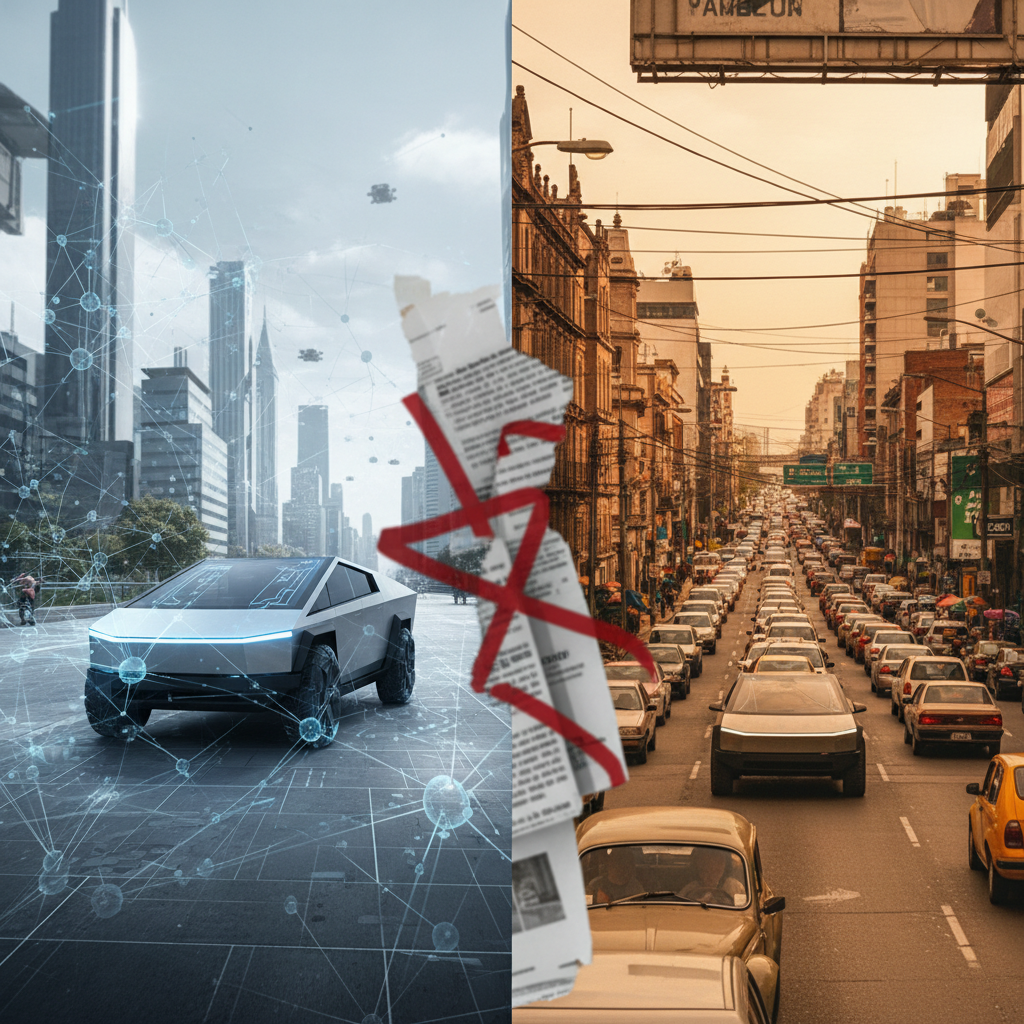

¡Amigos! Let me tell you, the future is not just coming, it is accelerating right past us, and nowhere is that more evident than in the wild, beautiful, and sometimes chaotic world of autonomous vehicles. We're talking about cars that drive themselves, navigating our bustling streets with a digital brain, and leading the charge, as always, is Tesla with its ambitious Full Self-Driving, or FSD, system. But here in Mexico, where the rhythm of life is a symphony of unexpected turns and vibrant human interaction, the technical marvel of FSD meets a fascinating regulatory dance. It's a story of innovation, algorithms, and the very human challenge of trust. Mexico City is on fire, in the best way, with tech, and this conversation is right at the heart of it.
The Technical Challenge: Navigating the Unpredictable Urban Jungle
So, what exactly are we trying to solve here? Imagine a robot trying to drive through a tianguis on a Sunday morning. That's the level of complexity we're talking about. The core problem for FSD, or any Level 5 autonomous system, is robust perception, prediction, and planning in an open-world, highly dynamic environment. It's not just about staying in a lane; it's about anticipating a child chasing a papel picado into the street, understanding the unspoken rules of a four-way stop where everyone goes at once, or predicting the trajectory of a microbus driver who seems to defy physics. Traditional rule-based systems simply crumble under this variability. We need something far more sophisticated, something that learns and adapts like a human driver, but with superhuman consistency and reaction times.
Architecture Overview: Tesla's Vision-First Approach
Tesla's FSD architecture stands out because it's fundamentally a vision-first system. Unlike many competitors that rely heavily on LiDAR or high-definition maps, Tesla bets big on cameras and neural networks. This makes sense from a cost and scalability perspective, as cameras are ubiquitous and relatively inexpensive. The system typically comprises eight external cameras providing a 360-degree view, supplemented by ultrasonic sensors for close-range detection and radar for long-range, all feeding into a powerful onboard computer running custom AI chips.
At a high level, the architecture looks something like this:
- Perception Module: This is the eyes and ears of the system. Raw pixel data from cameras, along with sensor readings, are fed into a complex deep neural network. This network is tasked with detecting objects (cars, pedestrians, cyclists, traffic lights, road signs), understanding their semantic meaning, and estimating their 3D position and velocity. Think of it as a highly sophisticated, real-time object detection and segmentation pipeline, but operating at a blistering pace, processing gigabytes of data per second. It also needs to understand the drivable space, lane lines, and road boundaries.
- Prediction Module: Once objects are perceived, the system needs to predict their future behavior. This is crucial for safe navigation. If a pedestrian is walking towards the curb, will they cross? If a car is signaling, will it actually turn? This module uses recurrent neural networks or transformer-based models to analyze historical trajectories and current states, outputting probabilistic future paths for all dynamic agents in the scene. It's like trying to guess what your cousin will do next at a family reunion, but with mathematical precision.
- Planning and Control Module: This is the brain that makes decisions. Based on the perceived environment and predicted behaviors, the planning module generates a safe and comfortable trajectory for the vehicle. This involves pathfinding, speed control, lane changes, and obstacle avoidance. A model predictive control (MPC) or reinforcement learning approach is often used here, optimizing for safety, efficiency, and passenger comfort. The control module then translates these high-level plans into low-level commands for the vehicle's actuators, like steering, acceleration, and braking.
Key Algorithms and Approaches: The Neural Network Powerhouse
Tesla's FSD relies heavily on deep learning, particularly convolutional neural networks (CNNs) for perception and transformer models for prediction. Their 'Occupancy Network' is a fascinating innovation, moving beyond bounding boxes to predict free space and occupied space in a 3D voxel grid, providing a richer understanding of the environment. This is a game-changer for handling unstructured scenarios.
Consider a simplified conceptual flow for perception:
function PERCEIVE_ENVIRONMENT(camera_frames, ultrasonic_data, radar_data):
 # Step 1: Feature Extraction (e.g., ResNet, EfficientNet backbone)
 features = CNN_BACKBONE(camera_frames)

# Step 2: Multi-task Head for Object Detection, Segmentation, Depth Estimation
 objects_2d = OBJECT_DETECTION_HEAD(features)
 segmentation_masks = SEMANTIC_SEGMENTATION_HEAD(features)
 depth_map = DEPTH_ESTIMATION_HEAD(features)

# Step 3: Lift 2D features to 3D (e.g., using camera intrinsics and depth)
 objects_3d = PROJECT_TO_3D(objects_2d, depth_map)
 occupancy_grid = OCCUPANCY_NETWORK(features, depth_map)

# Step 4: Sensor Fusion (e.g., Kalman Filter, Transformer-based fusion)
 fused_state = FUSE_SENSORS(objects_3d, occupancy_grid, ultrasonic_data, radar_data)

return fused_state # Comprehensive 3D understanding of the scene
function PERCEIVE_ENVIRONMENT(camera_frames, ultrasonic_data, radar_data):
 # Step 1: Feature Extraction (e.g., ResNet, EfficientNet backbone)
 features = CNN_BACKBONE(camera_frames)

# Step 2: Multi-task Head for Object Detection, Segmentation, Depth Estimation
 objects_2d = OBJECT_DETECTION_HEAD(features)
 segmentation_masks = SEMANTIC_SEGMENTATION_HEAD(features)
 depth_map = DEPTH_ESTIMATION_HEAD(features)

# Step 3: Lift 2D features to 3D (e.g., using camera intrinsics and depth)
 objects_3d = PROJECT_TO_3D(objects_2d, depth_map)
 occupancy_grid = OCCUPANCY_NETWORK(features, depth_map)

# Step 4: Sensor Fusion (e.g., Kalman Filter, Transformer-based fusion)
 fused_state = FUSE_SENSORS(objects_3d, occupancy_grid, ultrasonic_data, radar_data)

return fused_state # Comprehensive 3D understanding of the scene
For prediction, transformer networks are increasingly popular. They can model complex spatio-temporal relationships between agents and their environment, capturing nuanced interactions that simpler models miss. Imagine a transformer predicting the next few seconds of a busy glorieta traffic flow; it's learning from millions of hours of real-world driving data.
Implementation Considerations: Data, Compute, and Edge Cases
The sheer scale of data required to train these models is mind-boggling. Tesla collects petabytes of real-world driving data, including challenging scenarios and near-misses, which are then used for training. This 'data engine' is a critical competitive advantage. Training these models demands immense computational power, often requiring clusters of NVIDIA GPUs, like the H100s, running for weeks or months. On the vehicle itself, the custom FSD chip is optimized for inference, executing these complex neural networks in real time with low latency and power consumption. This Mexican startup just developed a novel data labeling pipeline for autonomous vehicle data, leveraging local talent and a deep understanding of unique urban scenarios, showing how innovation thrives even in the most challenging areas.
One of the biggest