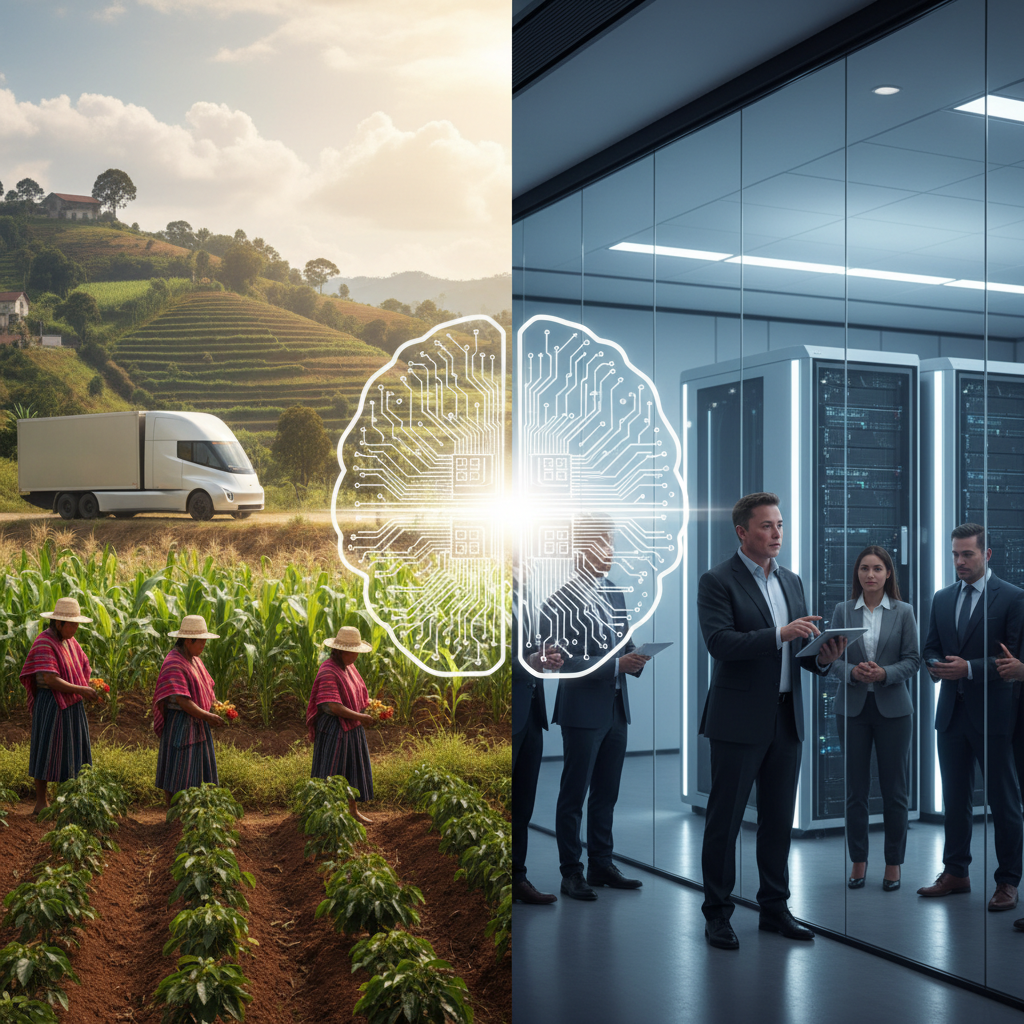

The morning mist still clung to the slopes of Lake Atitlán, painting the volcanoes in hues of soft gray and emerald green. Doña Elena, her hands gnarled from decades of coaxing life from the soil, carefully inspected a young corn stalk. Her grandmother's wisdom meets machine learning, not in a sleek Silicon Valley lab, but here, in a small village in Guatemala, where the hum of distant machinery is often mistaken for a new kind of cicada. Doña Elena is one of thousands whose lives are subtly, yet profoundly, being touched by the distant echoes of Tesla's AI Day announcements and the formidable processing power of its Dojo supercomputer project.
While Elon Musk speaks of self-driving cars and humanoid robots, here, the conversation is about optimizing crop yields, managing logistics for small cooperatives, and preserving ancient agricultural practices. The grand pronouncements from Tesla's stages might seem far removed from the daily struggles and aspirations of Guatemalan businesses and workers, yet the underlying AI advancements are creating both opportunities and challenges that are impossible to ignore. This is a story about resilience, about how a nation rich in cultural heritage and natural beauty navigates the tidal wave of global technological transformation.
Data from the Guatemalan Ministry of Economy indicates a significant uptick in AI adoption among larger agricultural exporters and logistics firms over the past two years. A recent report by the Ministry showed that 23% of agricultural exporters with annual revenues exceeding $5 million have integrated some form of AI driven analytics into their operations, a 15% increase from pre-AI Day 2024 figures. This adoption is largely driven by access to cloud-based AI services, often powered by the very same foundational models and processing capabilities that Tesla's Dojo aims to push further. These companies are seeing an average ROI of 18% within the first year, primarily through reduced waste, optimized shipping routes, and predictive maintenance for machinery. For instance, AgroExportaciones del Sur, a major avocado exporter, reported a 12% reduction in spoilage thanks to AI-powered climate control and routing algorithms, directly impacting their bottom line.
However, this progress is not uniform. The digital divide remains a stark reality. While larger players thrive, small and medium-sized enterprises (SMEs), particularly those in indigenous communities, struggle to access or understand these complex tools. "We hear about AI, about computers that can tell you when to plant or how much water to use, but for us, it's like a dream," says Miguel Xol, a coffee farmer from Alta Verapaz, his voice tinged with both curiosity and resignation. "Our internet is slow, and the cost of these systems is beyond what we can imagine for our small plots." His words echo a sentiment common among the 77% of Guatemalan agricultural businesses that have yet to adopt any AI solutions, according to the same Ministry of Economy report.
The winners in this new landscape are clear: large-scale agricultural operations, logistics companies with international ties, and a burgeoning sector of local tech startups acting as intermediaries. For example, 'Cosecha Inteligente,' a Guatemala City based startup, has seen its valuation triple in the last year. They specialize in translating complex AI models into user-friendly interfaces for mid-sized farms, leveraging cloud infrastructure from giants like Google Cloud and AWS, which in turn benefit from the foundational research pushed by companies like Tesla. "Our role is to bridge the gap," explains Sofia Morales, CEO of Cosecha Inteligente. "We take the power of these global AI advancements, the kind of processing Tesla talks about, and make it relevant for a farm in Quetzaltenango. We’ve seen a 30% efficiency gain for our clients on average." You can read more about startups like hers on TechCrunch.
On the other hand, the losers are often the smaller, traditional enterprises and the workers who lack the skills to adapt. Truck drivers for independent transport companies find their routes optimized by AI, sometimes leading to fewer shifts. Manual laborers in warehouses are being replaced by automated sorting systems. "I've been loading coffee sacks for twenty years," shares Jorge Pérez, a worker at a regional distribution center. "Now, they have these machines that move everything. I worry for my sons. What will they do?" His concern is valid. The International Labour Organization (ILO) projects that while AI will create new jobs in data science and maintenance, it could displace up to 15% of low-skilled labor in Central America over the next decade, particularly in logistics and manufacturing sectors.
Experts believe that the impact of Tesla's AI Day announcements, particularly the focus on real-world AI and robotics, will only accelerate these trends. Dr. Ana María Flores, a leading economist at the Universidad del Valle de Guatemala, points out, "Tesla's advancements in areas like vision processing and decision-making AI, powered by Dojo, will trickle down into every sector imaginable. From optimizing traffic flow in Guatemala City to improving crop disease detection in Petén, the potential is immense. However, without significant investment in education and infrastructure, the benefits will remain concentrated, exacerbating existing inequalities." She emphasizes the need for proactive government policies to retrain workers and support small businesses in adopting these technologies.
What's coming next? The horizon is both promising and daunting. Elon Musk's vision for autonomous systems, pushed by Dojo's computational might, will undoubtedly lead to more sophisticated AI models. These models will become more accessible and cheaper to deploy, even in regions like Guatemala. We can expect to see more localized AI applications, perhaps even AI-powered drones for crop monitoring becoming commonplace. The Ministry of Agriculture is exploring pilot programs to introduce AI-driven pest detection systems to rural cooperatives, hoping to democratize access. "Imagine a system that can tell a farmer, in their own K'iche' language, exactly when to apply organic pest control, based on real-time data from their fields," says Ricardo Méndez, a project manager at the Ministry. "That's the future we are working towards, one where technology serves our people, not replaces them." This kind of localized application of global AI advancements is crucial for equitable development, a topic often discussed in publications like MIT Technology Review.
However, the challenge remains. Will Guatemala be ready? Will the infrastructure be in place? Will the education system prepare the next generation for these new roles? The path forward requires a delicate balance: embracing innovation while safeguarding traditional livelihoods and ensuring that the benefits of AI are shared broadly. It is a complex dance between ancient wisdom and cutting-edge algorithms, a testament to the enduring spirit of a people who have always found ways to adapt and thrive. The world watches as the global AI race heats up, and in Guatemala, the question is not if AI will arrive, but how we will shape its arrival to serve our communities. The future of work, and indeed, the future of our society, hinges on these choices. For more on the broader implications of AI, you can explore articles on Wired.