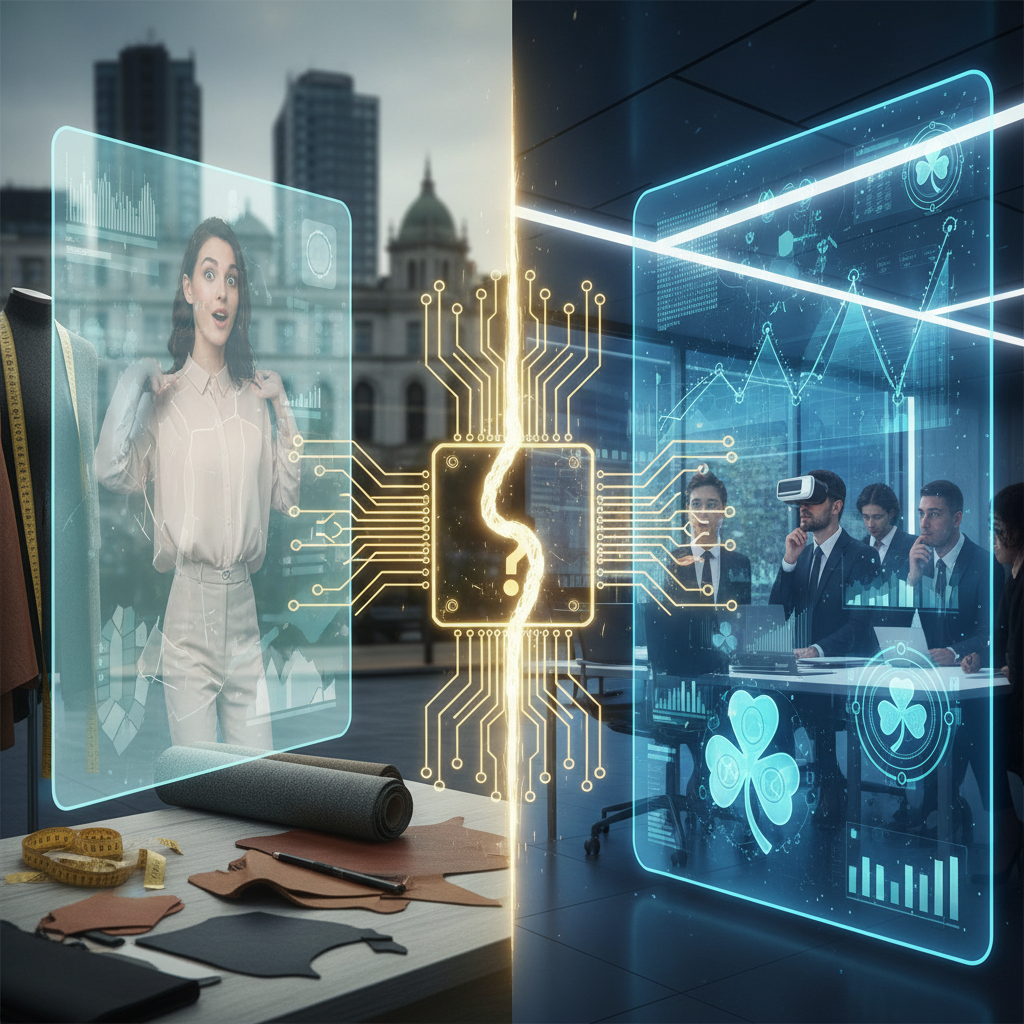

The smell of freshly brewed coffee and the faint hum of an AI-powered sewing machine filled the design studio on South William Street. It was only 8 AM, but Niamh O'Connell, lead designer at 'Cailleach Couture,' was already poring over a holographic display, a virtual model strutting in a gown that didn't yet exist. This wasn't some futuristic fantasy, mind you, but April 2026, and the fashion world, even here in Dublin, was well and truly caught in the AI whirlwind.
For years, the fashion industry has been a bit of a laggard when it comes to technology, preferring the tactile feel of fabric and the gut instinct of a seasoned designer. But that's all changing faster than you can say 'fast fashion.' From trend prediction algorithms that can sniff out the next big thing before it even hits the runways, to virtual try-on experiences that make fitting rooms feel as archaic as a flip phone, AI is redesigning the entire sartorial landscape. And let's not forget sustainable design, where AI promises to cut waste and optimize material use, a genuine godsend in an industry notorious for its environmental footprint.
But what does all this mean for the businesses and, more importantly, the people behind the seams here in Ireland? Dublin's Silicon Docks have a story to tell about tech's influence, and now, it's spilling over into our creative industries. The craic is mighty in Irish AI, but sometimes I wonder if we're all just dancing to a tune we don't quite understand.
The Data on Disruption: More Than Just a Pretty Picture
According to a recent report by the Irish Fashion Council, adoption rates for AI tools in the sector have skyrocketed by 65% in the last 18 months alone. Small to medium-sized enterprises (SMEs) are leading the charge, often leveraging accessible platforms from giants like Google Cloud and Microsoft Azure. The return on investment, particularly in inventory management and customer engagement, has been compelling. Companies using AI for trend prediction reported a 20% reduction in unsold stock, while those implementing virtual try-on saw a 15% decrease in returns, a significant win for both profit margins and sustainability.
“We used to spend weeks, sometimes months, trying to guess what customers would want next season,” explained Fiona Kelly, CEO of 'Celtic Threads,' a successful online retailer based in Cork. “Now, our AI models, powered by a blend of historical sales data, social media trends, and even weather patterns, give us insights that are almost spooky in their accuracy. It's like having a crystal ball, but one that actually works.”
Winners and Losers in the Algorithmic Age
Companies like Celtic Threads, quick to embrace the new tech, are clearly winning. They've streamlined their supply chains, reduced waste, and are offering personalized experiences that keep customers coming back. Niamh O'Connell's Cailleach Couture, for instance, has partnered with a local AI startup, 'FíorFit,' to develop hyper-realistic virtual try-on technology. “It's not just about convenience,” Niamh told me, adjusting her spectacles. “It's about inclusivity. We can offer bespoke designs to customers anywhere in the world, perfectly fitted, without them ever stepping foot in our studio. It's revolutionary.”
However, not everyone is thriving. Traditional brick-and-mortar stores, especially those without the capital to invest in sophisticated AI infrastructure, are struggling. Many smaller designers, who rely on intuition and personal connection, feel threatened. The fear is that AI will homogenize design, turning creativity into a data-driven commodity. “Where's the soul in a dress designed by an algorithm?” lamented Seamus Gallagher, a veteran tailor from Galway, whose business has seen a 30% drop in custom orders in the past year. “It's like asking a robot to write a poem. It might have all the right words, but it won't have the heart.”
The Human Element: Workers on the Front Line
The impact on workers is a mixed bag, as it always is with these grand technological shifts. For some, AI has freed them from tedious tasks, allowing them to focus on more creative or strategic work. Pattern makers, for example, are now collaborating with AI tools that generate complex patterns in minutes, rather than hours. “I used to spend half my day on repetitive adjustments,” said Aoife Brennan, a pattern maker at a large garment manufacturer in Limerick. “Now, the AI handles the grunt work, and I can focus on the artistic nuances, ensuring the garment drapes just so. It's actually made my job more interesting.”
Yet, others are facing redundancy. The demand for entry-level roles in inventory management, sales assistance, and even some aspects of design is shrinking. A recent survey by the Irish Congress of Trade Unions indicated that 12% of fashion retail workers felt their jobs were at risk due to AI automation. “It's a worry, isn't it?” remarked Liam Murphy, a sales assistant at a department store in Dublin city centre. “They're talking about virtual assistants and smart mirrors. What's left for us? We're the ones who know the customers, who can tell if a dress truly suits someone, not some fancy screen.”
This sentiment echoes a broader concern about the future of work. While AI promises to create new jobs, the transition period can be brutal for those whose skills become obsolete. Retraining programs are slowly being rolled out, but the pace of technological change often outstrips the ability of educational institutions to adapt.
Expert Analysis: A Stitch in Time?
“The fashion industry is undergoing a fundamental transformation, and Ireland, with its strong tech sector and creative heritage, is uniquely positioned to navigate it,” stated Dr. Maeve O'Sullivan, a leading AI ethics researcher at University College Dublin. “The key is not to resist AI, but to integrate it thoughtfully. We need to ensure that the human element, the artistry, and the craftsmanship, remain central. AI should augment, not replace, human creativity.” Dr. O'Sullivan emphasized the need for robust ethical guidelines, particularly concerning data privacy in virtual try-on systems and algorithmic bias in trend prediction. “We can't have AI dictating fashion trends that perpetuate harmful stereotypes, for example. Transparency and accountability are paramount.” MIT Technology Review has explored similar ethical considerations in AI's broader applications.
Another perspective comes from Colm Doherty, a venture capitalist specializing in fashion tech. “Irish startups are incredibly agile. We're seeing a surge in investment in companies developing niche AI solutions for sustainable material sourcing and hyper-personalized design. The global market for these tools is enormous, and our local talent pool is perfectly poised to capture a significant share.” He pointed to the recent acquisition of 'EcoStitch AI,' a Cork-based startup specializing in AI-driven textile waste reduction, by a major European fashion conglomerate as a prime example of Ireland's growing influence. You can often find similar stories of acquisition and innovation on TechCrunch.
What's Coming Next: The Future's Fabric
The next few years will likely see even deeper integration of AI into every facet of the fashion industry. Imagine AI-powered design assistants that can generate entire collections based on a designer's mood board, or smart factories that use AI to optimize every cut and stitch, minimizing waste to near zero. Virtual reality and augmented reality will become commonplace for shopping, blurring the lines between the digital and physical worlds. Only in Ireland would you find this blend of ancient craft and cutting-edge tech, a testament to our ability to adapt and innovate.
However, the challenge will be to ensure that this technological leap benefits everyone, not just the big players. We need policies that support retraining for displaced workers, foster ethical AI development, and protect the unique creative voices that define Irish fashion. The future of fashion, much like a finely woven tweed, will be a complex tapestry of human ingenuity and artificial intelligence. The question is, will we weave it together harmoniously, or will the threads unravel? The craic is mighty in Irish AI, but the stakes are higher than ever. It's a delicate balance, and one that Ireland, with its blend of pragmatism and poetry, is uniquely suited to address.