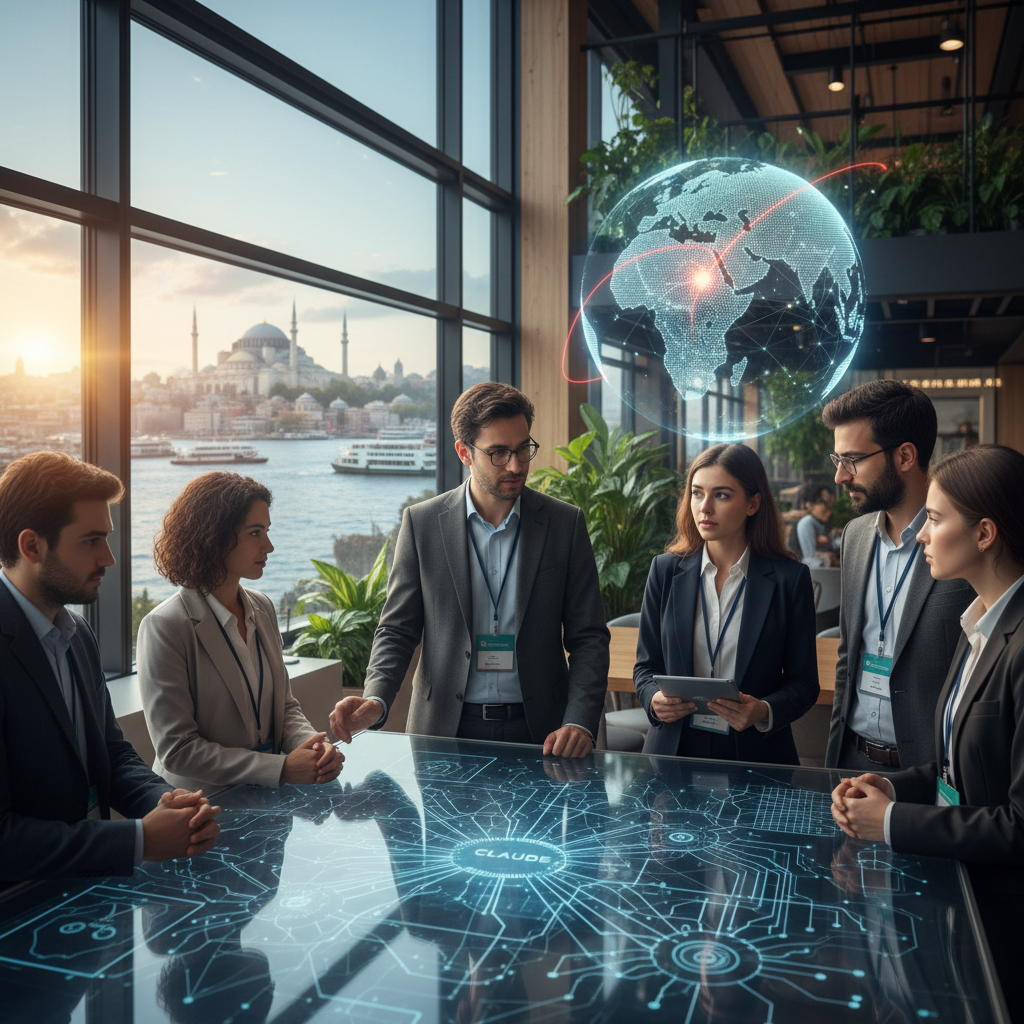
The Bosphorus, a timeless strait, has always been a crossroads, a place where continents meet and ideas clash, merge, and transform. For centuries, Istanbul has been a crucible of cultures, a city that understands the delicate balance between tradition and innovation. It is this very spirit that makes Turkey, and particularly its bustling tech hubs, a fascinating lens through which to examine one of the most pressing questions of our AI-driven decade: how do we build intelligent machines that are not just powerful, but profoundly safe and aligned with human values?
I am talking, of course, about Anthropic's Claude and its much-touted 'constitutional AI' approach. Dario Amodei, Anthropic's CEO, and his team have been vocal about their commitment to safety, proposing a method where AI models learn to self-correct based on a set of guiding principles, a 'constitution' if you will. This isn't just about filtering out toxic outputs; it's about embedding ethical reasoning directly into the AI's learning process. On paper, it sounds like the holy grail for responsible AI development, a way to prevent the dystopian futures so often painted by science fiction writers.
But here is my opinion, and it's a strong one: a constitution, by its very nature, is a reflection of the values of those who draft it. The foundational principles Anthropic has used for Claude, while admirable, are largely rooted in Western liberal thought. This is not a criticism, merely an observation. The real question for us, here at the crossroads of civilizations, is whether such a framework can be universally applied, or more importantly, universally accepted and evolved to reflect the diverse ethical landscapes of our world. Turkey is building the future at the crossroads, and our perspective is vital.
Consider the nuances of ethical decision-making. What one culture deems 'safe' or 'appropriate' might differ significantly from another. In Turkey, for instance, our societal values are shaped by a rich tapestry of history, faith, and communal bonds. An AI trained predominantly on Western datasets and constitutional principles might inadvertently miss these subtleties, leading to models that are technically 'safe' by one standard, but culturally tone-deaf or even problematic by another. This is not a small matter; it is the difference between an AI that truly serves humanity and one that merely serves a segment of it.
"The idea of a universal AI constitution is compelling, but its implementation requires a deep understanding of local contexts," explains Dr. Ayşe Demir, a leading AI ethicist at Boğaziçi University in Istanbul. "We cannot simply import a set of rules and expect them to fit perfectly. We need mechanisms for cultural adaptation, for local communities to contribute to these foundational principles. Otherwise, we risk creating AI that alienates rather than assists." Her point is salient; without local input, even the best intentions can go awry.
Anthropic's approach, which involves using AI feedback to refine its own behavior, is a significant leap. Instead of relying solely on human labeling, which is expensive and prone to human bias, Claude is taught to critique its own responses against a set of rules, then revise them. This iterative self-improvement is fascinating. Imagine a student who not only learns from their teacher but also from reviewing their own work against a strict code of conduct. This is the essence of constitutional AI. According to a recent report by MIT Technology Review, this method has shown promising results in reducing harmful outputs by as much as 40% in initial tests, a figure that certainly turns heads.
However, the challenge for a nation like Turkey, with its burgeoning AI sector, is not just to consume these technologies but to contribute to their very architecture. Our defense tech, drone technology, and fintech sectors are not just adopting AI; they are innovating with it at a blistering pace. We are not passive recipients of global tech trends; we are active shapers. Just last year, Turkish AI startups secured over $300 million in venture capital, a 25% increase from the previous year, with a significant portion going into ethical AI research and development, according to data from the Turkish Ministry of Industry and Technology.
"We are not just looking at how to make AI safe, but how to make it Turkish safe, if you understand what I mean," states Cem Yılmaz, CEO of Anatolian AI Labs, a fast-growing Istanbul-based startup focusing on culturally sensitive language models. "Our goal is to integrate our unique legal, ethical, and social norms directly into the training data and feedback loops. We are exploring ways to 'Turkify' the constitutional principles, ensuring that Claude, or any similar model, understands the nuances of our language, our history, and our values. This isn't about isolation; it's about enrichment." Yılmaz's vision is exactly what I mean when I say Istanbul's tech ambitions are massive and realistic.
The concept of constitutional AI also brings to mind the Ottoman approach to empire-building, which was often characterized by a pragmatic acceptance and integration of diverse legal and cultural systems under a unifying framework. It wasn't about imposing a single, rigid set of rules everywhere, but about finding common ground while respecting local customs. This historical precedent offers a powerful analogy for how global AI governance, particularly around safety and ethics, could evolve. We need a flexible, adaptable constitution for AI, not a monolithic decree.
This is where collaboration becomes paramount. Instead of Silicon Valley dictating the terms, we need a global dialogue. Imagine a consortium of nations, including Turkey, contributing to a living, evolving AI constitution. Our legal scholars, our ethicists, our religious leaders, and our technologists could all play a role in shaping these foundational principles. This would not only make AI safer but also more globally accepted and trusted. The alternative is a fragmented AI landscape where different models operate under different, potentially conflicting, ethical codes, leading to chaos and mistrust.
Consider the implications for climate tech, a critical area where AI can make a profound difference. If an AI designed to optimize energy grids or predict climate patterns operates under a constitution that prioritizes efficiency above all else, it might make decisions that, while technically sound, disregard local environmental sensitivities or social equity issues. A constitution informed by diverse perspectives, including those from regions most vulnerable to climate change, would lead to more holistic and just solutions. For instance, a project in the Eastern Mediterranean using AI to monitor marine ecosystems would benefit immensely from a Claude model that understands regional fishing practices and local conservation efforts, not just abstract environmental principles. For more on how AI is impacting global tech, you can always check TechCrunch's AI section.
The road ahead is long and complex. Anthropic's pioneering work with Claude and constitutional AI is a crucial first step, a beacon in the often-murky waters of AI safety. But it is only a first step. The true test will be its adaptability, its capacity to absorb and reflect the rich tapestry of human values across the globe. Turkey, with its unique position and rapidly growing tech prowess, stands ready to contribute to this grand endeavor, not as a follower, but as a co-creator. The future of AI safety will not be written by one company or one culture alone; it will be a collective masterpiece, forged at the crossroads of the world. Perhaps even Tim Cook's vision for Apple's AI in Turkey [blocked] will need to consider these broader constitutional implications.