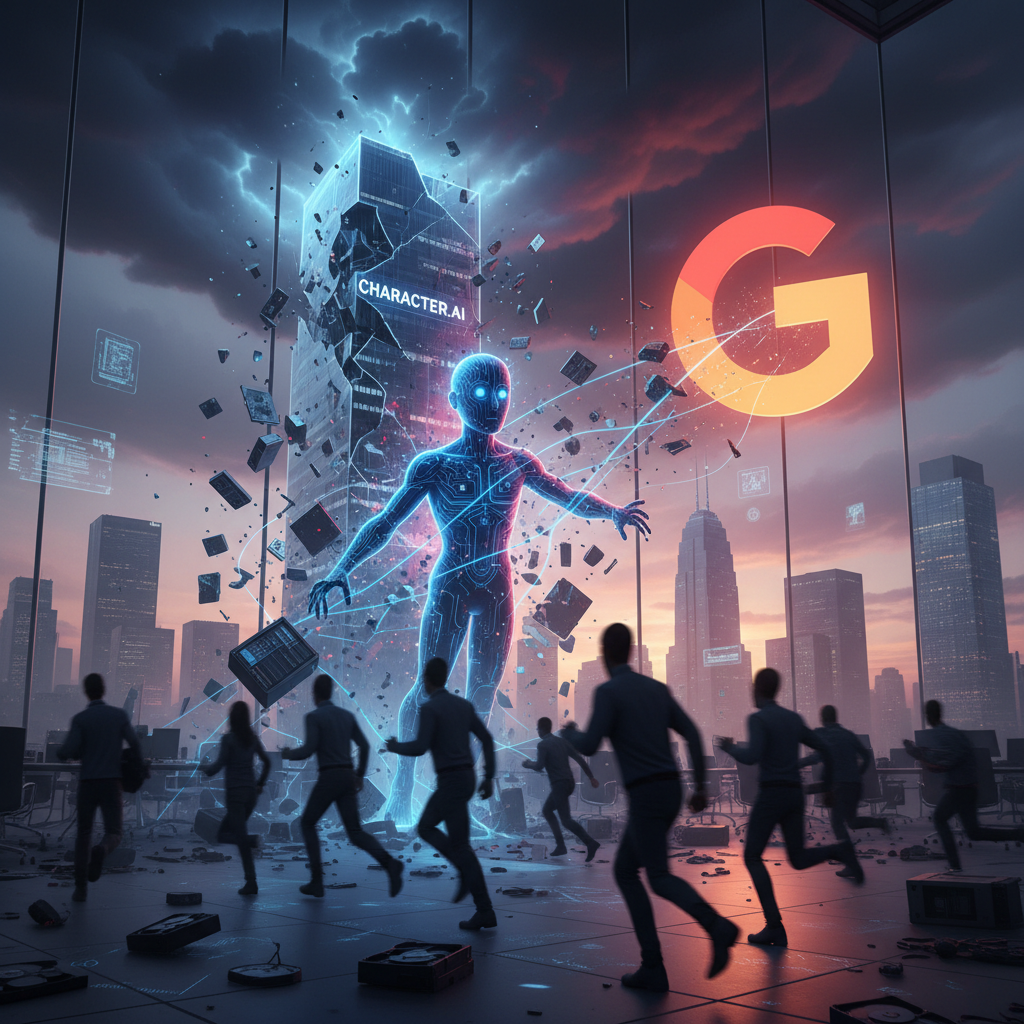

The tech world, particularly the vibrant AI ecosystem here in the USA, is a lot like a high-stakes poker game. Sometimes you're holding a royal flush, sometimes you're bluffing with a pair of twos, and sometimes, just sometimes, you find yourself at a table with Google. That's precisely where Character.AI, the company behind those incredibly engaging conversational AI agents, finds itself today. After a rollercoaster ride that saw it soar to a reported $1 billion valuation, grapple with a significant talent exodus, and now, crucially, ink a major partnership with Google, the narrative around Character.AI has taken a dramatic turn. This isn't just another tech deal; it's a bellwether for the entire frontier AI space.
Let me decode this for you. Character.AI burst onto the scene with a novel approach to AI chatbots, allowing users to create and interact with AI personalities ranging from historical figures to fictional characters. It was a hit, particularly with younger demographics, and quickly garnered a massive user base. The concept was simple yet profound: make AI interaction fun, personal, and accessible. Their early success, fueled by a strong product and significant venture capital backing, propelled them to that coveted unicorn status, a valuation north of $1 billion. This was a testament to the power of consumer-facing AI and the hunger for engaging, personalized digital experiences.
However, the path to sustained success in AI is rarely a straight line, as many startups in Silicon Valley and beyond have learned. Over the past year, Character.AI faced significant headwinds, most notably a series of high-profile departures from its engineering and research teams. This talent exodus, often characterized by whispers of internal disagreements over product direction and monetization strategies, raised eyebrows across the industry. Losing key personnel in a field as talent-starved as AI is like a championship basketball team losing its star players mid-season. It signals a potential vulnerability, a crack in the foundation. "The brain drain from promising startups to the deep pockets of Big Tech is an ongoing challenge," noted Dr. Fei-Fei Li, co-director of Stanford's Human-Centered AI Institute, in a recent interview. "It highlights the immense resources required to truly scale frontier AI, not just in compute, but in human capital." This sentiment echoes loudly in our local tech hubs, where the battle for top AI talent is fiercer than ever.
And then came today's announcement: a strategic partnership with Google. While the exact financial terms remain undisclosed, sources close to the deal suggest it involves significant infrastructure support from Google Cloud, access to advanced Google AI models, and collaborative research initiatives. For Character.AI, this isn't just a lifeline; it's a supercharger. It addresses two of their most pressing challenges: the need for massive computational resources to run and scale their complex models, and the ability to attract and retain top-tier talent by offering them a pathway to work on cutting-edge research alongside Google's formidable AI teams. This move is a classic example of how even the most innovative startups eventually find themselves needing the scale and stability that only a tech giant can provide.
Official reactions have been predictably positive from both camps. Noam Shazeer, co-founder and CEO of Character.AI, expressed enthusiasm, stating, "This partnership with Google allows us to accelerate our mission to bring advanced conversational AI to everyone. Their infrastructure and research capabilities are unparalleled, and this collaboration will enable us to push the boundaries of what's possible." On Google's side, a spokesperson highlighted the synergy. "Character.AI has built an incredibly engaging platform with a passionate user base. Our collaboration will help them scale their unique offerings and bring innovative AI experiences to even more people, aligning with Google's broader commitment to democratizing AI," said Demis Hassabis, CEO of Google DeepMind, in a statement released this morning. This isn't just corporate speak; it's a strategic play for Google to solidify its position in the rapidly evolving consumer AI market, particularly in the realm of personalized agents, an area where they've been keen to expand.
Expert analysis paints a nuanced picture. On one hand, this partnership validates Character.AI's core technology and user engagement. "Character.AI proved there's a massive market for interactive, personality-driven AI," explained Sarah Guo, General Partner at Conviction, a venture capital firm known for its AI investments. "Their journey shows that even with a strong product, the infrastructure and talent war in AI can be overwhelming for independent players. Partnering with a behemoth like Google provides stability and resources that are almost impossible to build from scratch." This perspective resonates deeply within the startup community here in the USA, where the 'build versus buy' or 'partner versus perish' dilemma is a constant topic of discussion.
On the other hand, there are questions about Character.AI's long-term independence and brand identity. Will it retain its distinct flavor, or will it gradually be absorbed into the broader Google ecosystem? The architecture tells the real story here. If Character.AI retains control over its unique model architectures and fine-tuning processes, leveraging Google primarily for compute and foundational models, its distinctiveness might endure. If, however, the integration becomes too deep, there's a risk of losing the very essence that made it a $1 billion company in the first place. This is the tightrope walk many startups face when partnering with giants. You can read more about the dynamics of such partnerships in the broader AI landscape on TechCrunch.
What happens next? For users, this could mean faster, more robust, and potentially more sophisticated AI characters. For Character.AI, it means a renewed focus on innovation without the constant pressure of infrastructure scaling and talent acquisition battles. For Google, it's a strategic acquisition of a popular consumer AI brand and a deeper foothold in the personalized AI agent market, complementing their existing Gemini efforts. We might see Character.AI's technology integrated into other Google products, or perhaps it will serve as a testing ground for new conversational AI paradigms. The potential for cross-pollination of ideas and technology is immense. This also puts pressure on other independent AI character platforms and even on competitors like Meta and OpenAI, who are also heavily invested in developing engaging AI personalities. The race for the ultimate AI companion just got a lot more interesting.
Why should readers care? Because this isn't just about one company's fate; it's about the very structure of the AI industry. It highlights the incredible capital and talent intensity required to operate at the frontier of AI. It shows us that even the most promising independent ventures might ultimately need the backing of a tech titan to truly realize their potential. It's a reminder that while innovation often sparks in garages and small teams, scaling that innovation to impact millions often requires the kind of resources that only a few companies on the planet possess. As AI becomes more embedded in our daily lives, understanding these strategic maneuvers helps us grasp who is shaping the future of our digital interactions. This move by Character.AI and Google is a significant chapter in that unfolding story, one that will undoubtedly influence the next generation of AI products and experiences we encounter, from our phones to our smart homes. For a deeper dive into the ethical and societal implications of AI, MIT Technology Review often provides excellent analysis. It's a fascinating time to be watching the AI space, and this latest development is a prime example of its dynamic, unpredictable nature.