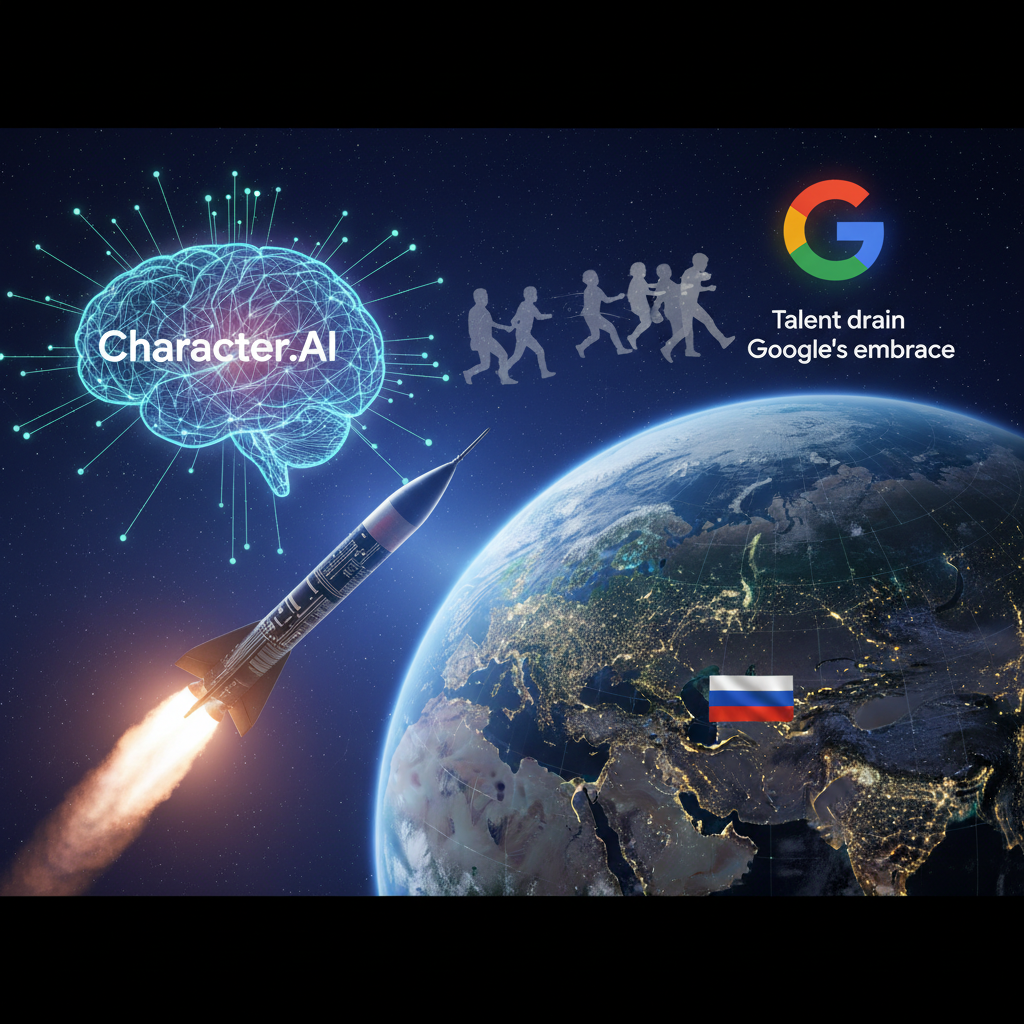

The narrative surrounding Character.AI, a company that once commanded a billion-dollar valuation, has become a microcosm of the broader, often turbulent, artificial intelligence industry. From its initial meteoric rise, fueled by the promise of advanced conversational AI, to a visible talent exodus, and now a strategic partnership with Google, the company’s trajectory is less a smooth ascent and more a series of sharp turns. For those of us observing the global tech currents from Moscow, this unfolding drama is not merely Silicon Valley gossip; it is a case study in how innovation, capital, and human talent converge and diverge under pressure.
Character.AI, co-founded by former Google Brain researchers Noam Shazeer and Daniel De Freitas, burst onto the scene with a compelling vision: AI companions capable of engaging in open-ended conversations, embodying distinct personalities. The concept resonated deeply, attracting millions of users and a substantial valuation. However, the initial euphoria has been tempered by reports of key personnel departures and the inherent challenges of monetizing such a novel platform. The recent announcement of a deeper collaboration with Google, leveraging its cloud infrastructure and potentially its formidable research capabilities, suggests a recalibration, perhaps even a lifeline, for the startup.
Why Most People Are Ignoring It: The Attention Gap
In the relentless churn of AI news, where new large language models and eye-watering funding rounds dominate headlines daily, the nuanced story of Character.AI often gets lost. The public tends to focus on the next shiny object, the latest benchmark, or the most provocative statement from a tech titan. The internal struggles of a company, even one valued at a billion dollars, rarely capture sustained attention unless they involve spectacular failures or unprecedented breakthroughs. This is a mistake. The ebb and flow of talent, the strategic alliances, and the operational pivots within a company like Character.AI offer far more insight into the real mechanics of the AI industry than any press release or demo video. We are often distracted by the fireworks, missing the intricate engineering behind the display.
For many, especially outside the immediate tech bubble, Character.AI is simply another app, another digital diversion. Its corporate machinations seem distant, irrelevant. Yet, the choices made by its leadership, the challenges it faces in retaining its brightest minds, and its reliance on a tech giant like Google, are indicative of systemic issues that affect every corner of the global AI ecosystem. This is not just about a chatbot; it is about the sustainability of independent innovation in an increasingly consolidated field.
How It Affects YOU: Personal Impact on Readers
One might ask, why should a Russian citizen, or anyone outside Silicon Valley, care about the fortunes of Character.AI? The answer lies in the fundamental nature of AI development. The tools and platforms being built today, whether for entertainment, education, or productivity, will inevitably shape our digital future. If platforms like Character.AI succeed, they could democratize access to advanced conversational AI, offering personalized learning, creative assistance, or even companionship. Imagine a student in Vladivostok having access to an AI tutor tailored to their specific needs, or a writer in St. Petersburg collaborating with an AI character to develop a novel. These are not distant fantasies but potential realities.
Conversely, if such ventures falter, or become entirely subsumed by larger corporations, it could lead to a more centralized, less diverse AI landscape. This centralization could limit innovation, reduce user choice, and potentially embed biases or control mechanisms that are not in the public's best interest. The quality, accessibility, and ethical frameworks of the AI tools you will use tomorrow are being decided by these corporate battles and partnerships today. Your digital experience, your professional opportunities, and even your personal interactions with technology are directly influenced by these developments.
The Bigger Picture: Societal, Economic, or Political Implications
The Character.AI saga highlights several critical trends with profound global implications. Firstly, it underscores the immense challenge of scaling AI startups. Developing cutting-edge models requires vast computational resources, which only a handful of tech giants like Google, Microsoft, and Amazon can consistently provide. This creates an inevitable gravitational pull, drawing smaller innovators into their orbit, often at the cost of their independence. The Google partnership, while pragmatic, raises questions about the future of independent AI innovation and market diversity. Will every promising AI startup eventually become a subsidiary or a deeply integrated partner of a tech behemoth?
Secondly, the talent exodus from Character.AI is a stark reminder that even a billion-dollar valuation cannot guarantee retention of top engineers and researchers. The allure of more stable environments, better resources, or simply new challenges at established players like OpenAI, Anthropic, or even Google itself, remains powerful. This brain drain is particularly relevant for countries like Russia, where geopolitical factors already complicate talent retention. Russian AI talent deserves better than to be constantly lured away by foreign opportunities, and the global flow of these minds dictates the pace and direction of technological progress everywhere.
Thirdly, the focus on character-driven AI touches upon evolving notions of digital identity and human-computer interaction. As AI becomes more sophisticated, the lines between human and artificial personas blur. This raises ethical questions about authenticity, manipulation, and the psychological impact of forming relationships with non-human entities. Governments and societies globally, including Russia, must grapple with regulating these new forms of interaction to protect users and maintain societal norms. The potential for misuse, from sophisticated propaganda to psychological exploitation, is not insignificant.
What Experts Are Saying
“The Character.AI situation is a classic example of the ‘build versus buy’ dilemma for large tech companies, and the ‘scale or die’ imperative for startups,” states Dr. Elena Petrova, a senior researcher at the Skolkovo Institute of Science and Technology. “Google’s investment is not just about technology; it’s about securing talent and market share in a fiercely competitive space. For startups, it’s a Faustian bargain, offering resources in exchange for a degree of autonomy.”
Professor Mikhail Volkov, an economist specializing in technology markets at the Higher School of Economics in Moscow, offers a more cynical view. “The official story doesn't add up entirely. A talent exodus from a well-funded unicorn suggests deeper internal issues beyond just scaling. It could be strategic disagreements, cultural clashes, or simply the realization that the path to profitability for a purely conversational AI platform is far more arduous than initially projected. Google steps in to pick up the pieces, gaining valuable IP and expertise without the initial risk.”
Anna Kuznetsova, an independent AI ethics consultant based in Kaliningrad, highlights the user implications. “When an independent platform becomes deeply intertwined with a giant like Google, questions of data privacy, content moderation, and algorithmic bias become even more pronounced. Who truly controls the character’s responses? What data is being collected, and how is it used? These are not trivial concerns for the millions of users interacting with these AIs daily.”
Finally, Alexey Lebedev, a venture capitalist with significant investments in Russian tech, notes, “Behind the sanctions curtain, Russian AI startups face an even steeper climb. Access to cutting-edge hardware, cloud infrastructure, and international capital is severely restricted. The Character.AI story, despite its Western context, serves as a cautionary tale and a blueprint: innovate rapidly, secure strategic partnerships early, and be prepared for intense competition for talent. The global AI race is unforgiving.”
What You Can Do About It
For individuals, understanding these dynamics means being a more discerning user of AI technologies. Question the origins of the AI tools you use, understand their privacy policies, and be aware of the corporate interests behind them. For developers and entrepreneurs, it underscores the importance of building sustainable business models and fostering strong internal cultures that can retain talent. For policymakers, especially in Russia, it means prioritizing investment in domestic AI infrastructure, fostering an environment conducive to innovation, and finding creative solutions to mitigate brain drain. Supporting open source AI initiatives and academic research can also help diversify the ecosystem and reduce reliance on a few dominant players. MIT Technology Review frequently publishes analyses on these very challenges facing global AI development.
The Bottom Line: Why This Will Matter in 5 Years
In five years, the Character.AI story will be remembered not just as a startup's journey, but as a pivotal moment in the consolidation of the AI industry. It will illustrate how even innovative, well-funded ventures can struggle to maintain independence against the gravitational pull of tech giants. This trend will profoundly shape the diversity of AI products available, the ethical standards governing them, and the distribution of power within the global technological landscape. The choices made by companies like Character.AI today, and the reactions of players like Google, are laying the groundwork for the AI-driven world of tomorrow. Whether that world is open and diverse, or centralized and controlled, depends on how we interpret and act upon these signals now. The future of conversational AI, and perhaps even the nature of digital interaction, hangs in the balance. For further global tech insights, one might consult Reuters Technology News. The implications for national technological sovereignty, particularly for a nation like Russia, are immense and cannot be overstated. The battle for AI talent and infrastructure is a battle for future influence, and these smaller stories are the early skirmishes. For more on the broader AI industry, TechCrunch AI offers continuous updates.