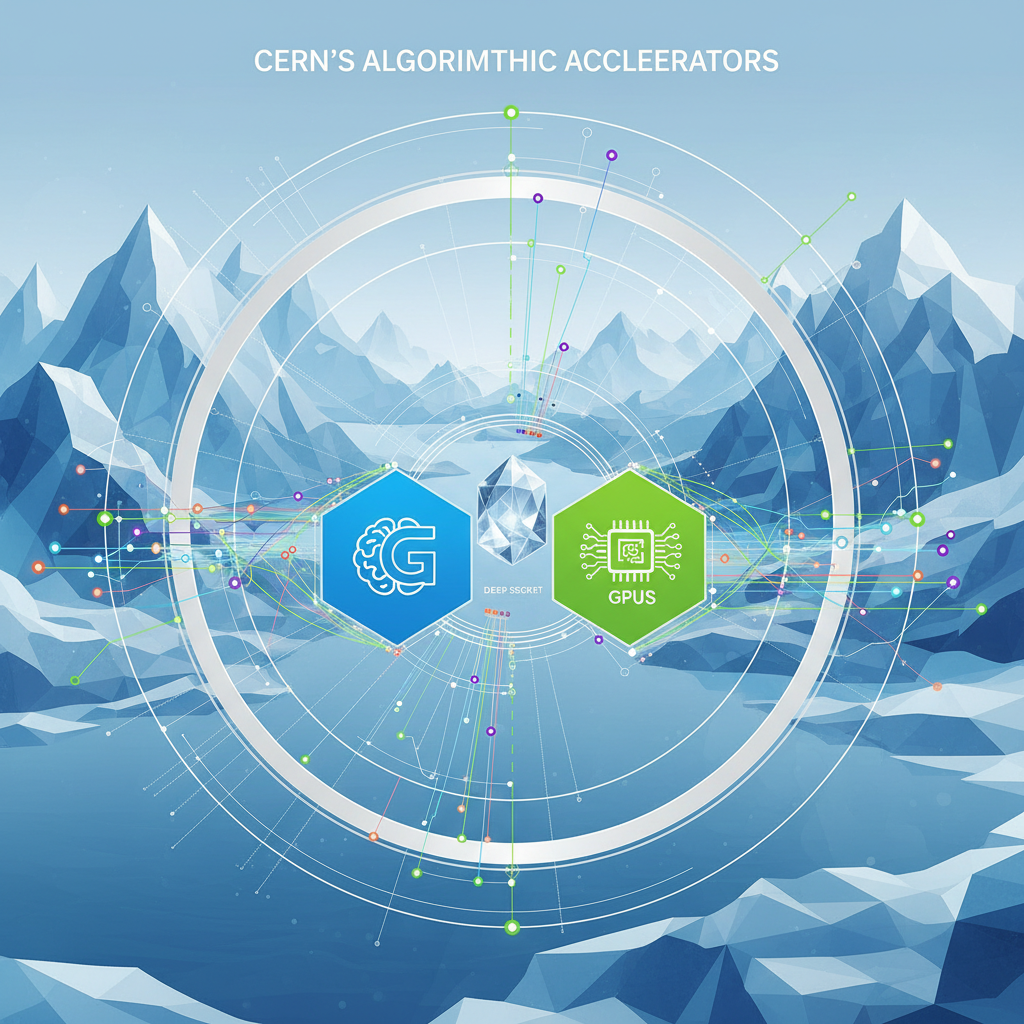

The colossal machines at Cern, burrowed beneath the Franco-Swiss border, have long been humanity's most ambitious eyes peering into the universe's primordial moments. For decades, physicists have grappled with unimaginable data volumes, seeking fleeting anomalies that hint at new physics. Now, a new force is accelerating this quest: artificial intelligence. But is this integration of AI a mere technological augmentation, or does it fundamentally redefine the pursuit of cosmic truth?
Let me explain the engineering. Particle accelerators, like the Large Hadron Collider (LHC), generate petabytes of data every second during their operational cycles. Imagine trying to find a single, unique snowflake in a blizzard that never ends, and then multiply that challenge by an astronomical factor. This is the daily reality for particle physicists. Historically, sophisticated statistical methods and human intuition have guided this search. However, the sheer scale of the LHC's High Luminosity upgrade, projected to increase data output by a factor of ten by the end of the decade, renders traditional approaches increasingly insufficient. This is where AI steps in, not as a replacement, but as an indispensable partner.
Historically, the journey of particle physics has been one of ever-increasing precision and computational power. From the early bubble chambers requiring manual event reconstruction to the advent of powerful silicon detectors and grid computing, each era brought new tools to bear on intractable problems. The current wave of AI integration, particularly machine learning and deep learning, represents a paradigm shift akin to the introduction of the first electronic computers. Early applications of neural networks in the 1990s were rudimentary, primarily used for simple pattern recognition. Fast forward to April 2026, and we see sophisticated models from entities like Google's DeepMind and specialized algorithms running on NVIDIA's latest GPU architectures, performing tasks that were once considered science fiction.
Consider the challenge of 'triggering' at the LHC. When protons collide, millions of interactions occur, but only a tiny fraction are scientifically interesting. AI algorithms are now being deployed in real time to filter this enormous data stream, identifying potential 'events' worthy of storage and further analysis. Dr. Elara Karlsson, Lead AI Scientist at CERN's Atlas experiment, explains, "Our traditional trigger systems were reaching their limits. With the implementation of deep learning models, we have seen a 35% improvement in signal efficiency for certain rare processes, reducing false positives while retaining critical data. This is not just an incremental gain; it's a game-changer for discovery potential." She adds, "Without AI, we would simply drown in data, unable to discern the whispers of new particles from the roar of background noise."
Beyond triggering, AI is revolutionizing data analysis. Complex tasks such as particle identification, jet reconstruction, and anomaly detection are being tackled with unprecedented accuracy. For instance, a recent collaboration between Cern and Google DeepMind demonstrated a new graph neural network architecture that improved the reconstruction of particle tracks by 15% compared to conventional methods, particularly in dense event environments. This translates directly into clearer signals for new physics. MIT Technology Review has highlighted how such advancements are not just theoretical but are actively shaping experimental design.
NVIDIA's role, through its Cuda platform and specialized Tensor Core GPUs, cannot be overstated. These hardware innovations provide the computational backbone necessary for training and deploying the massive deep learning models used in particle physics. "The demands of our simulations and real-time analysis require computational muscle that only purpose-built hardware can deliver," states Professor Henrik Solberg, a theoretical physicist at the University of Oslo. "NVIDIA's continuous advancements in GPU technology have been instrumental in pushing the boundaries of what's possible. We are seeing simulation times for complex quantum field theories reduced by factors of hundreds, enabling us to explore theoretical landscapes previously inaccessible." This synergy between advanced algorithms and powerful hardware is a testament to the collaborative spirit driving this field.
However, the integration of AI is not without its challenges. The 'black box' nature of some deep learning models raises concerns about interpretability and trust, especially in a field where every discovery must be rigorously validated. "While AI offers incredible power, we must maintain transparency," cautions Dr. Anya Sharma, a data ethicist specializing in scientific applications. "The scientific method demands explainability. We cannot simply accept an AI's conclusion without understanding how it arrived there, particularly when we are searching for fundamental truths about the universe." This concern resonates deeply with Norway's approach to AI, which is rooted in trust and ethical considerations, emphasizing transparency and human oversight.
Another significant challenge is the sheer cost and energy consumption associated with training and running these large AI models. The carbon footprint of AI, particularly for models with billions of parameters, is a growing concern. As a nation deeply invested in sustainable energy solutions, Norway watches these developments with a keen eye. Optimizing AI algorithms for energy efficiency is becoming as critical as optimizing them for accuracy. Researchers are actively exploring techniques such as sparse neural networks and neuromorphic computing to mitigate these environmental impacts.
Looking ahead, the potential applications of AI extend beyond data analysis. Generative AI models are being explored for designing new detector components, optimizing accelerator parameters, and even proposing novel theoretical frameworks. Imagine an AI suggesting new experiments to probe the nature of dark matter, or refining the design of future colliders. This is no longer pure fantasy. Dr. Olav Kristiansen, Director of Research at the Norwegian Computing Centre, remarks, "The Nordic model extends to technology, emphasizing responsible innovation. We are not just building tools; we are building intelligent partners for discovery. The next decade will see AI move from merely analyzing data to actively guiding the scientific process itself, perhaps even in the search for new natural resources here in the Arctic, mirroring its role at Cern." This holistic view of AI's potential is a hallmark of the Norwegian perspective.
So, is AI in particle physics a fad or the new normal? The evidence overwhelmingly points to the latter. The scale of data, the complexity of phenomena, and the relentless pursuit of discovery demand tools that can transcend human limitations. While ethical considerations and energy consumption remain critical areas of focus, the transformative power of AI is undeniable. It is accelerating discoveries, enabling physicists to probe deeper into the fabric of reality than ever before. From the icy fjords of Norway to the subterranean tunnels of Cern, the quest for knowledge is being redefined, powered by algorithms that learn, adapt, and reveal. This is not merely an evolution; it is a revolution, and it is here to stay.
For more insights into how AI is shaping scientific research, you might find this article on AI research and analysis particularly informative. The advancements at Cern are a microcosm of a broader trend across scientific disciplines, from medicine to materials science, where AI is proving to be an indispensable ally in the pursuit of knowledge. The future of fundamental physics, it seems, will be written in code as much as in equations.