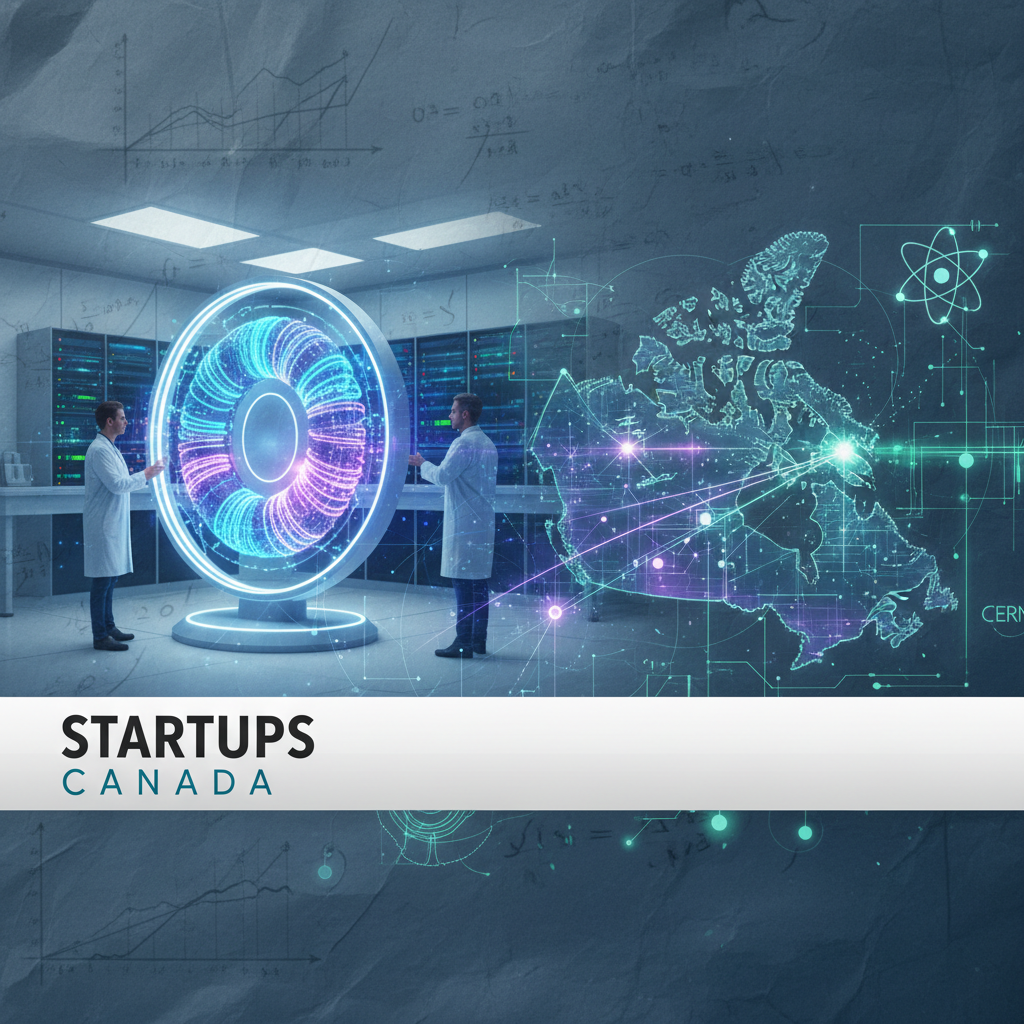

The colossal machinery of the Large Hadron Collider, buried beneath the Franco-Swiss border, has long been a testament to human ingenuity and collaborative science. For decades, physicists have grappled with petabytes of data generated from particle collisions, seeking fleeting anomalies that might unlock the universe's deepest secrets. However, the sheer volume and complexity of this data have pushed traditional analysis methods to their limits. Enter artificial intelligence, a technology now indispensable to the pursuit of discovery at facilities like Cern.
Recent advancements in machine learning, particularly deep learning, have not just accelerated data processing; they are fundamentally reshaping how physicists approach their research questions. The breakthrough is not a single, monolithic discovery, but rather a pervasive integration of AI across the entire experimental pipeline. From real-time event selection, known as 'triggering', to sophisticated anomaly detection and precise parameter estimation, AI is proving its mettle. It is allowing researchers to sift through the noise of billions of collisions to pinpoint the rare events that signal new physics, much like finding a specific snowflake in a blizzard, but with far greater stakes.
Why does this matter? The Standard Model of particle physics, while remarkably successful, is incomplete. It fails to explain dark matter, dark energy, or the origin of neutrino masses. New physics, if it exists, will manifest as subtle deviations from expected patterns. These deviations are often too faint or too complex for human-designed algorithms to reliably identify. This is where AI excels, leveraging its capacity for pattern recognition in high-dimensional data. As Professor Kyle Cranmer, a leading figure in AI for particle physics at New York University, stated in a recent seminar, "AI is not just an optimization tool; it is a new lens through which we can perceive the universe's hidden structures. It allows us to ask questions we couldn't even formulate before." Cranmer's work, often in collaboration with Cern scientists, focuses on developing robust machine learning methods that can distinguish genuine signals from statistical fluctuations, a task of paramount importance in high-energy physics.
The technical details, while intricate, can be understood without a doctorate in quantum field theory. Imagine a particle collision producing hundreds of subatomic fragments, each leaving a trace in a detector. Traditional methods might apply a series of hand-tuned filters to identify specific particle signatures. AI, particularly convolutional neural networks and graph neural networks, can learn these features directly from raw detector data. For instance, a neural network can be trained on simulated data of known particle decays and then applied to real experimental data to classify events with unprecedented accuracy. This is crucial for phenomena like the Higgs boson decay, which is exceedingly rare and often obscured by background processes.
One notable application involves the use of Graph Neural Networks (GNNs) for track reconstruction. Particles traversing the detector leave a series of hits. Connecting these hits into coherent 'tracks' is a computationally intensive problem. GNNs, which are adept at processing data with complex relational structures, can reconstruct these tracks far more efficiently and accurately than classical algorithms. This directly translates into faster data analysis and a higher probability of identifying significant events. Researchers at Cern, in collaboration with institutions globally, including several Canadian universities, have demonstrated significant improvements in reconstruction efficiency using these techniques.
The Canadian approach deserves more scrutiny in this context. While Cern is a European organization, Canada has been a long-standing observer state and a significant contributor to its scientific programs. Canadian universities, such as the University of Toronto, McGill University, and Simon Fraser University, have robust particle physics groups actively involved in Atlas and CMS experiments at the LHC. These groups are not merely consumers of Cern data; they are often at the forefront of developing and applying AI techniques to it. Dr. David Rousseau, a senior staff scientist at Cern and an alumnus of the University of Toronto, has been instrumental in advocating for and implementing machine learning solutions for LHC data analysis. His work on anomaly detection, for example, is directly aimed at finding unexpected signatures that could point to new fundamental particles.
Furthermore, Canada's burgeoning quantum computing sector, with companies like D-Wave Systems and Xanadu, and research hubs like the Vector Institute in Toronto, presents an interesting tangent. While quantum computing is still in its nascent stages, its potential for solving optimization problems and performing complex simulations could eventually intersect with the demands of particle physics. Could quantum machine learning algorithms offer a future leap in analyzing the intricate quantum mechanics of particle collisions? The data suggests a different conclusion for now; classical AI is still far more practical and powerful for current-generation problems. However, the long-term convergence of these fields remains a tantalizing prospect, especially for a nation investing heavily in both.
Let's separate the marketing from the reality. While AI is undeniably powerful, it is not a magic bullet. The quality of AI models is inherently tied to the quality of the data they are trained on. In particle physics, this means relying heavily on sophisticated simulations, which themselves are based on our current understanding of physics. If new physics behaves in a way entirely unexpected by our models, even the most advanced AI might struggle to identify it without careful human guidance and innovative algorithm design. As Dr. Sasha Hocker, a physicist at Cern working on machine learning applications, cautioned, "We must always remember that AI is a tool. It enhances our capabilities, but it does not replace the fundamental human insight and theoretical framework that drives scientific discovery." (MIT Technology Review).
The implications for future discoveries are profound. With the upcoming High-Luminosity LHC (hl-lhc) upgrade, the data volume is expected to increase by an order of magnitude. Without advanced AI, processing this data would be an insurmountable challenge. AI will be critical for maintaining and even enhancing the discovery potential of these future experiments. It promises to unlock new avenues of research, allowing physicists to probe phenomena with greater precision and sensitivity than ever before. This includes searches for exotic particles, investigations into the properties of the Higgs boson, and precision measurements that could reveal cracks in the Standard Model.
Looking ahead, the collaboration between Canadian researchers and Cern will likely deepen. Our nation's expertise in AI, coupled with its historical contributions to particle physics, positions us uniquely to contribute to this evolving landscape. The challenges are immense, demanding not just computational power but also a new generation of physicists fluent in both high-energy physics and advanced machine learning. The goal is not just to find new particles, but to understand the fundamental laws that govern our universe. AI is becoming an indispensable partner in this grand scientific quest, and Canada's role, though often understated, is increasingly vital. The ongoing work at Cern and its global partners, including Canada, demonstrates a powerful synergy between human intellect and advanced computation, pushing the boundaries of what we can know about the cosmos. (arXiv.org) for further research papers on this topic. The next few years will undoubtedly reveal whether this technological embrace leads to the next monumental breakthrough in physics or simply refines our existing understanding. It is a calculated gamble, one that the global scientific community, with significant Canadian input, is eager to take. (Reuters) has also covered the financial implications of such large-scale scientific computing. We are not just building bigger machines; we are building smarter ones.